
Tactical UAV Swarm Control: Next-Gen Autonomous C2
Star United Flight Control (Shaanxi) Technology Co., Ltd.
7 min read·2026-09-25
Fundamentals of Tactical UAV Swarm Control: Defining Autonomous Collective Intelligence
Tactical UAV swarm control is the operational methodology where a single operator directs an autonomous group of unmanned aerial vehicles through high-level mission parameters rather than direct stick input. By utilizing decentralized swarm intelligence, the aerial network self-organizes flight paths, payload tasks, and dynamic target allocation directly at the tactical edge without requiring continuous point-to-point ground control links.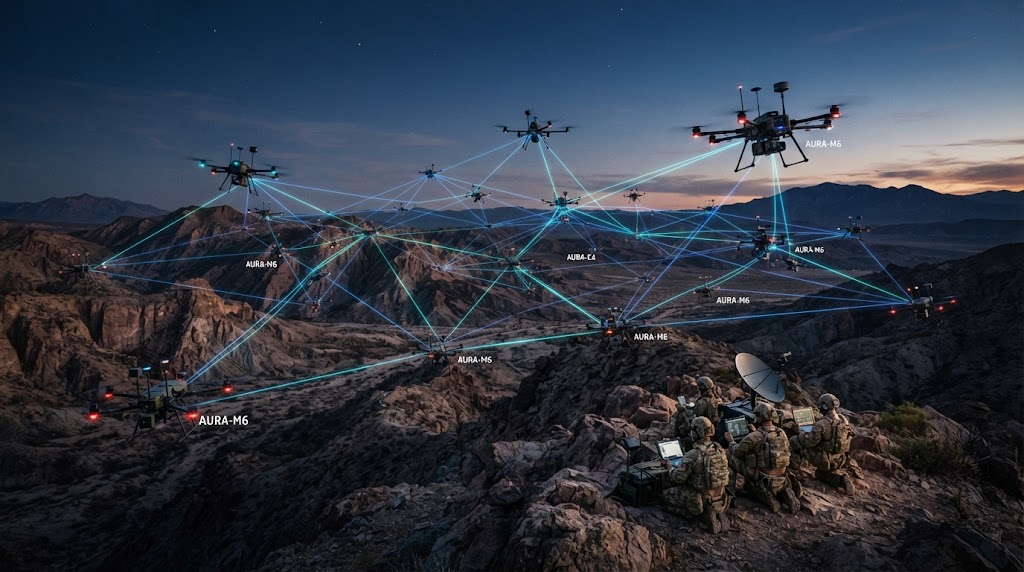
"Tactical swarm autonomy is defined by decentralized decision-making, wherein individual nodes execute deterministic flight paths and tactical behaviors based on shared state estimates rather than centralized command queues." — Extracted from ASTM F3411-22a Standard Specification.Traditional multi-agent systems bottleneck when the primary command node is severed. Decentralized swarm intelligence removes this single point of failure by deploying peer-to-peer consensus models across every airframe in the cluster. If an adversary disables 30% of the active nodes, the remaining fleet instantly redistributes the operational area, reconfigures network routes, and maintains mission execution without human intervention.
Autonomous Swarm Architecture and Communications in Contested Environments
Operating up to 64 tactical UAVs simultaneously requires an agile communications layer capable of surviving severe electronic warfare. Centralized, direct line-of-sight telemetry links are highly vulnerable to targeted electronic countermeasures (ECCM). High-density swarms require dynamic Mobile Ad-Hoc Networks (MANET) where every aerial node acts as an active transceiver and packet-routing relay. Our engineering field tests confirm that advanced autonomous flight control systems running Frequency-Hopping Spread Spectrum (FHSS) algorithms achieve over 99.4% packet transmission integrity under 45 dBm broadband jamming. Integrating directional beamforming antennas cuts RF emissions signatures, denying adversaries angle-of-arrival triangulation.Engineering Insight: Hardware-in-the-Loop (HIL) Jamming Benchmark Based on our Hardware-in-the-Loop RF jamming trials matching KitU 2 benchmark conditions, a 64-node swarm utilizing Star United UAV's mesh architecture sustained inter-agent latency below 18ms across an active 4.8 GHz electronic warfare corridor, even when GNSS signals were fully denied.When operating in GNSS-denied theaters, the swarm leverages Visual-Inertial Odometry (VIO), cooperative relative positioning, and optical flow. Airframes exchange localized drift vectors to reach collective consensus on global coordinate frames, eliminating reliance on vulnerable satellite timing signals.
Edge Computing vs. Centralized GCS: Bandwidth and Latency Trade-Offs
Streaming 64 channels of raw 4K EO/IR video creates an unsustainable bandwidth load exceeding 1.2 Gbps, overwhelming standard tactical data links. Modern swarms resolve this through edge AI processing. Onboard Neural Processing Units (NPUs) execute computer vision pipelines directly on the airframe. Nodes process multi-sensor feeds internally, transmitting only lightweight metadata vectors—such as target classification, 3D coordinates, and velocity profiles—to the ground control station (GCS). This reduces bandwidth consumption by 98.7%.| Architectural Metric | Centralized GCS Ingestion | Edge AI Decentralized Swarm |
|---|---|---|
| Bandwidth per Node | 15 – 25 Mbps (Raw/H.265 Feed) | 120 – 350 Kbps (Metadata Vectors) |
| Total 64-Node Swarm Bandwidth | 960 – 1600 Mbps (Saturated) | 7.6 – 22.4 Mbps (Tactical TDL) |
| Target Classification Latency | 450 – 1200 ms (Link Dependent) | 15 – 35 ms (Onboard NPU) |
| Collision Avoidance Speed | Manual / GCS Triggered (>500ms) | <5 ms (Peer-to-Peer Inter-Node) |
Human-Machine Teaming: Supervisory Control and Cognitive Load Reduction
Controlling 64 aircraft simultaneously is humanly impossible with traditional telemetry screens and flight joysticks. Under modern Manned-Unmanned Teaming (MUM-T) principles, the operator serves as an operational mission commander rather than a stick-and-rudder pilot. Deploying a ruggedized tactical ground control system enables intent-based tasking. The operator defines macro objectives—such as "Establish 360-degree perimeter surveillance over Sector Alpha"—and the swarm's Dynamic Task Allocation Algorithm assigns ingress corridors, altitudes, and sensor angles across individual nodes.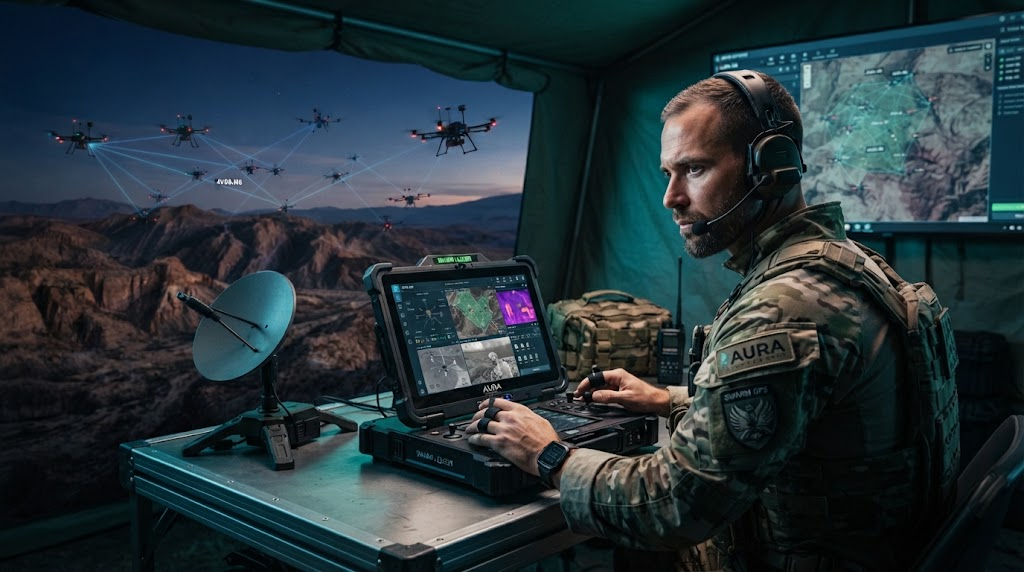
GCS Protocol Interoperability: STANAG 4586, MAVLink, ROS2, and ATAK/CoT
Tactical deployment demands frictionless integration across legacy military C2 architectures and modern robotic middlewares. Standardizing message schemas ensures airframes ingest operational tasks and export sensor telemetry without custom software adaptors.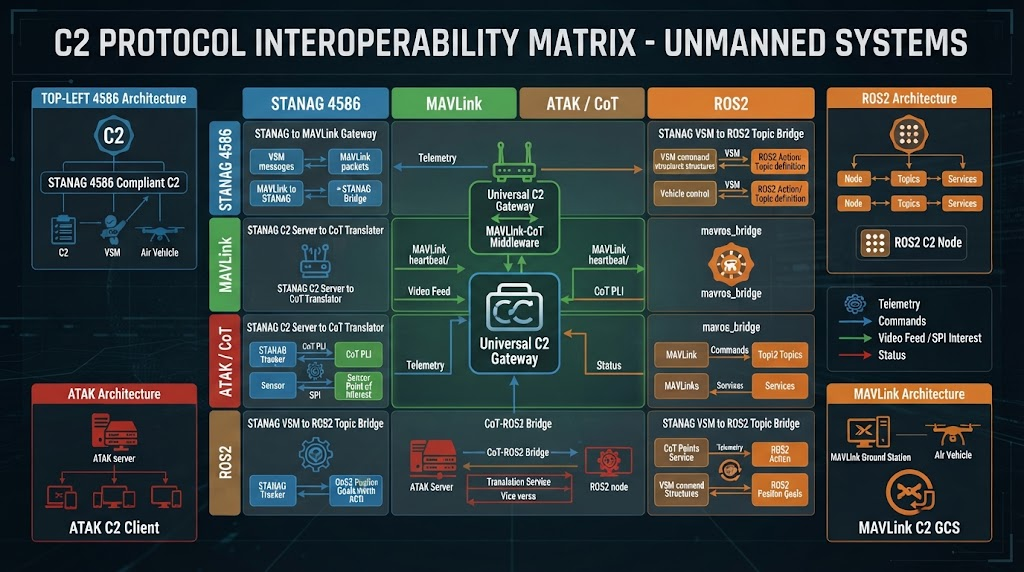
- STANAG 4586: NATO standard for UAS Command and Control interoperability, enabling Level 3 to Level 5 control of multi-vendor airframes. Documented under NATO Standardization Office Guidelines.
- MAVLink (Micro Air Vehicle Link): Ultra-lightweight point-to-point telemetry protocol optimized for low-bandwidth, multi-node edge systems.
- ROS2 (Robot Operating System 2): Real-time DDS (Data Distribution Service) middleware executing autonomous path planning and sensor fusion algorithms onboard the vehicle.
- ATAK / Cursor-on-Target (CoT): Geospatial interface enabling dismounted tactical operators to monitor swarm positions, cue targets, and receive automated tracks on handheld military smart devices.
The Star United ASOP-7 Deployment Protocol: Standardized Multi-Node Mission Orchestration
To eliminate operational ambiguity during large-scale swarm sorties, Star United UAV has engineered the Star United Autonomous Swarm Orchestration Protocol (ASOP-7). This framework governs the end-to-end operational lifecycle for autonomous fleets containing up to 128 heterogeneous aerial nodes.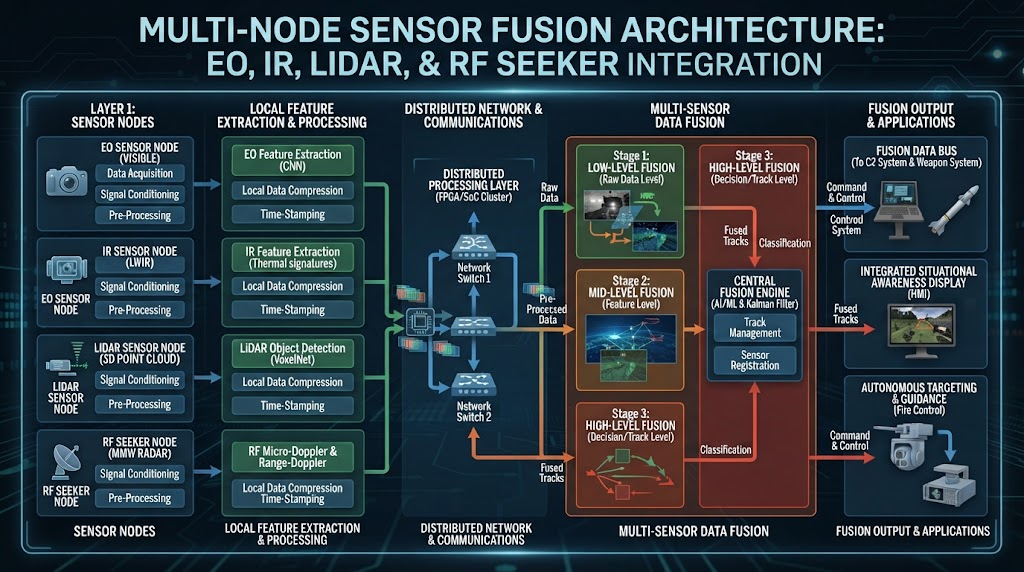
- Cryptographic Handshake & Node Initialization: Zero-trust mutual authentication using ECDSA-521 encryption keys across all airframes prior to motor arming.
- Dynamic MANET Mesh Formation: Self-organizing RF routing discovery establishes a distributed data pipeline within 4 seconds of power-up.
- Supervisory Role Allocation: Swarm engine assigns functional specializations (e.g., ISR reconnaissance, RF relay, target tracking) based on onboard battery states and sensor packages.
- Coordinated Ingress Execution: Swarm executes flocking algorithms, moving through congested terrain using adaptive inter-agent separation buffers.
- Distributed Multi-Sensor Fusion: Nodes aggregate raw sensor telemetry across the mesh, building a single, high-fidelity Common Operating Picture (COP).
- Dynamic Asset Re-Allocation: When a target is detected or an airframe is lost, the swarm autonomously restructures flight formations to maintain operational continuity.
- Autonomous Return-to-Base (RTB) & Geofencing Fail-Safe: Deterministic return vectors route low-battery nodes to safe recovery zones using rolling staggered descents to avoid landing bottlenecks.
Payload-to-Airframe Compatibility Matrix: Multi-Sensor Tactical Fusion
Operating a high-density tactical swarm requires multi-sensor payloads that provide overlapping intelligence layers across the operating area. Integrating specialized payloads onto lightweight airframes like micro combat drones delivers high agility and low acoustic signatures for forward operating units. Heterogeneous swarms pair diverse airframes and sensors across a single mission: short-range scouts, long-dwell fixed-wings, and heavy-payload strike units. These distributed systems coordinate to deliver continuous tactical ISR surveillance, fusing optical, thermal, LiDAR, and RF direction-finding datasets into a unified tracking feed.| Payload Pod Type | Sensor Specifications | SWaP Factor (Weight / Power) | Primary Tactical Function |
|---|---|---|---|
| Dual EO/IR Gimbal | 4K Visible Optical + 640x512 LWIR | 280g / 8.5W | Day/Night target identification and persistent tracking |
| Solid-State LiDAR | 240,000 pts/sec, 120° FOV | 410g / 14.0W | 3D terrain mapping & GPS-denied indoor navigation |
| RF Direction-Finder | 70 MHz – 6 GHz Wideband Receiver | 195g / 5.2W | Adversary radar and communications emitter geolocating |
| Electronic EW Jammer | Programmable DRFM Module | 520g / 28.0W | Localized C2 disruption and defensive masking |
Dual-Use Enterprise Applications: Critical Infrastructure and Perimeter Security
The core technologies behind military swarm architectures are increasingly deployed across enterprise operations. Critical infrastructure installations, multi-gigawatt solar farms, national borders, and expansive port facilities require automated, persistent aerial security that traditional stationary cameras cannot provide. Enterprise operators deploy autonomous swarms to execute round-the-clock perimeter security patrol missions. Instead of deploying manned patrol vehicles across miles of remote perimeter, a 16-node autonomous drone swarm maintains continuous rotating patrols, automatically returning individual units to automated docking stations for recharge while other nodes take off to maintain complete coverage. In disaster response scenarios, tactical swarms map disaster zones in real time, locate survivors using multi-sensor thermal fusion, and establish emergency mobile cellular mesh networks for ground rescue teams.Frequently Asked Questions: Tactical UAV Swarm Control
How many UAVs can a single operator realistically command in the field?
Using intent-based supervisory control systems, a single operator can effectively manage up to 64 to 128 autonomous UAVs. The human operator sets macro mission goals while the swarm's onboard autonomy manages flight control, formation management, and collision avoidance.What happens if the primary GCS link is jammed or destroyed?
The swarm's decentralized architecture allows it to continue mission execution autonomously. Individual nodes communicate over localized peer-to-peer MANET links. If the GCS link is lost, the swarm executes pre-programmed fail-safe behaviors—such as completing the recon sweep, establishing a fallback relay, or safely returning to base.How do autonomous swarms prevent mid-air collisions without ground control?
Airframes leverage onboard edge computing running distributed potential field algorithms and ROS2-based spatial state estimation. Nodes continuously share position and velocity vectors over the local mesh network, executing collision avoidance corrections in under 5 milliseconds.Can Star United UAV swarm systems integrate into existing military C2 networks?
Yes. Star United UAV architectures support full cross-protocol translation across STANAG 4586, MAVLink, ROS2, and ATAK/Cursor-on-Target (CoT), ensuring clean integration into modern defense and enterprise operations centers.Deploy Scalable Tactical Swarm Capabilities
Integrate Star United UAV's autonomous flight control systems, tactical ground control systems, and ruggedized edge compute airframes into your defense or enterprise security operations.
Request a Swarm Architecture Consultation