
Drone Swarm Technology: How 1 Operator Can Control 64 Combat Drones Simultaneously
The ability for a single operator to coordinate dozens of autonomous combat drones simultaneously represents one of the most significant tactical innovations in modern warfare. This article examines the technical architecture that makes it possible — and the operational implications for force structure.
The Swarm Paradigm: From Concept to Combat Reality
Military theorists have discussed drone swarms for decades. The concept is intuitive: overwhelm an adversary's defenses with sheer numbers, distribute lethality across dozens of low-cost platforms, and create a targeting problem that no point-defense system can solve. The challenge has always been execution — specifically, how to coordinate dozens of autonomous systems without requiring dozens of operators.
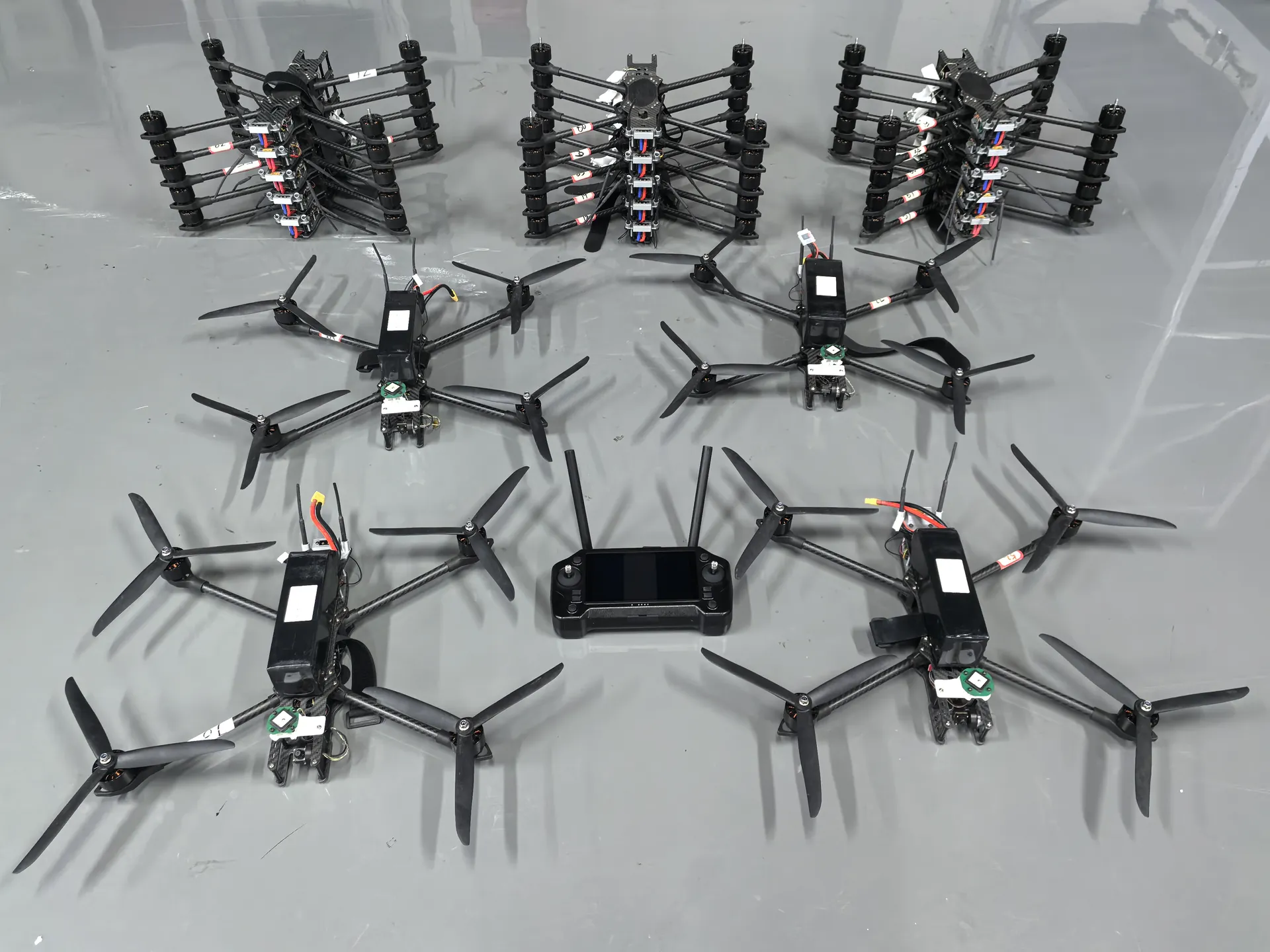
The SG FL950 Enhanced Cluster system represents the current state of the art in deployable swarm technology: a single operator controlling up to 64 autonomous combat drones simultaneously, using a standard screen controller (no FPV goggles required), with decentralized mesh networking that maintains operational integrity even when individual units are lost.
The Architecture Problem: Centralized vs. Decentralized
Early drone swarm concepts relied on centralized architectures — a single command node receiving sensor data from all drones and issuing movement commands to each. This approach has a fatal vulnerability: destroy the command node, and the entire swarm collapses.
The SG FL950 uses a decentralized mesh architecture that eliminates this single point of failure. Each drone in the swarm is an autonomous node that:
- Maintains its own situational awareness
- Communicates directly with adjacent nodes (not through a central hub)
- Executes its assigned mission autonomously if communication is lost
- Dynamically reallocates tasks when other nodes are destroyed or disabled
The result is a swarm that degrades gracefully under attack rather than catastrophically failing. Destroying 20% of the swarm reduces its capability by approximately 20% — not by 100%.
How the 1:64 Coordination Works
Layer 1: Operator Interface
The operator uses a standard screen controller — a tablet-sized device with a high-resolution display showing the swarm's collective situational picture. Unlike conventional FPV drone systems that require immersive goggles and one-to-one operator-to-drone ratios, the FL950 controller presents an overhead tactical view showing all drone positions, target assignments, and mission status simultaneously.
This interface design reduces operator training time by approximately 80% compared to conventional FPV systems. An operator can achieve basic swarm coordination competency in hours rather than days.
Layer 2: Mission Planning
Before launch, the operator defines:
- Target area or specific target coordinates
- Attack pattern (simultaneous saturation, sequential engagement, area denial)
- Priority hierarchy for target allocation
- Abort conditions and return-to-base triggers
The AI mission planning module then distributes these parameters across the swarm, with each drone receiving its specific role in the coordinated mission.
Layer 3: Autonomous Execution
Once launched, each FL950 unit executes its mission autonomously:
- Navigation: GPS-guided flight to the assigned area (with denied-environment fallback)
- Target acquisition: Onboard AI identifies and locks onto assigned target category
- Terminal guidance: Autonomous dive with continuous target tracking, achieving ≤Φ3m CEP
- Abort logic: Automatic return if target not confirmed within parameters
The operator monitors the collective mission status and can intervene at any point — adjusting target priorities, aborting individual units, or redirecting the swarm to a new objective.
Technical Specifications: FL950 Enhanced Cluster
| Parameter | Specification |
|---|---|
| Drone Weight | 2 kg (excl. payload) |
| Payload Capacity | 3 kg |
| Maximum Speed | ≥ 160 km/h |
| Endurance (no payload) | ≥ 33 minutes |
| Endurance (3kg payload) | ≥ 17 minutes |
| Strike Accuracy (CEP) | ≤ Φ3m (autonomous guidance) |
| Communication Range | ≥ 4 km (line-of-sight) |
| Swarm Nodes (standard) | ≥ 20 units |
| Swarm Nodes (maximum) | 64 units |
| Network Topology | Decentralized MESH |
| Controller Type | Screen controller (no goggles) |
| Video Resolution | 1920×1080 (1080P) |
| Wind Resistance (hover) | Level 6 Beaufort |
Tactical Applications
Saturation Attack
Against a defended position with active point-defense systems (machine guns, short-range air defense), a single loitering munition is easily engaged. A coordinated swarm of 20–64 units arriving from multiple directions simultaneously overwhelms any point-defense system's engagement capacity. Even if 50% of the swarm is intercepted, the remaining units complete the mission.
Area Denial
A swarm of FL950 units can be programmed to patrol a defined area, engaging any target that enters the zone. This creates a persistent, autonomous area denial capability that requires no ongoing operator attention once deployed.
Reconnaissance-Strike Integration
The FL950's 1080P camera enables real-time reconnaissance before engagement. A swarm can be tasked to survey a target area, with the operator reviewing the video feed before authorizing the strike. This "reconnaissance-strike" integration eliminates the traditional delay between target identification and engagement.
Asymmetric Force Multiplication
Perhaps the most significant tactical implication of swarm technology is force multiplication. A four-person squad equipped with an FL950 Enhanced Cluster system can deploy 20–64 autonomous combat platforms simultaneously — a capability previously requiring a company-sized element with dedicated aviation assets.
The Counter-Swarm Challenge
The proliferation of drone swarm technology is driving rapid development of counter-swarm systems — electronic warfare jamming, directed energy weapons, and kinetic interceptors. The SG FL950's decentralized mesh architecture provides inherent resilience against jamming: because there is no central command node to jam, disrupting individual communication links does not collapse the swarm.
The tactical competition between swarm systems and counter-swarm systems is ongoing. What is clear is that drone swarms have permanently altered the calculus of small-unit combat — and forces that fail to integrate this capability will face a decisive disadvantage against those that do.
Conclusion
The SG FL950 Enhanced Cluster system demonstrates that 1:64 operator-to-drone coordination is not a theoretical concept — it is a deployable operational capability available today. The combination of decentralized mesh networking, AI-assisted mission planning, and an intuitive screen controller interface makes swarm operations accessible to individual soldiers and small unit commanders, not just specialized drone operators.
For procurement inquiries and technical demonstrations, contact the Star United Flight Control defense systems team.