
How to Select a UAV Partner for Public Safety Operations
Star United Flight Control (Shaanxi) Technology Co., Ltd.
9 min read·2026-10-16
The Star United 4-D Critical Response UAV Partner Evaluation Matrix (P-S-A-C Model)
Selecting an enterprise UAV partner for public safety requires auditing an OEM against physical survivability, hardware-level sovereign security, sensor modularity, and rapid direct-factory support agreements rather than relying on consumer-tier retail specifications. Public safety agencies must bypass rebranded consumer gear and secure an industrial-grade manufacturer capable of sustaining operational uptime during severe weather, tactical standoffs, and mass casualty incidents. First responder drone systems operate under zero-fail constraints where consumer-grade equipment inevitably encounters thermal shutdowns, software lockouts, or structural failure. Commercial flight programs frequently collapse because procurement teams evaluate maximum dry flight time instead of usable payload power draw, telemetry sovereignty, and raw aerodynamic authority. To eliminate procurement ambiguity, our avionics engineering group developed a standardized qualification framework for defense and public safety procurement: the Star United 4-D Critical Response UAV Partner Evaluation Matrix (P-S-A-C Model).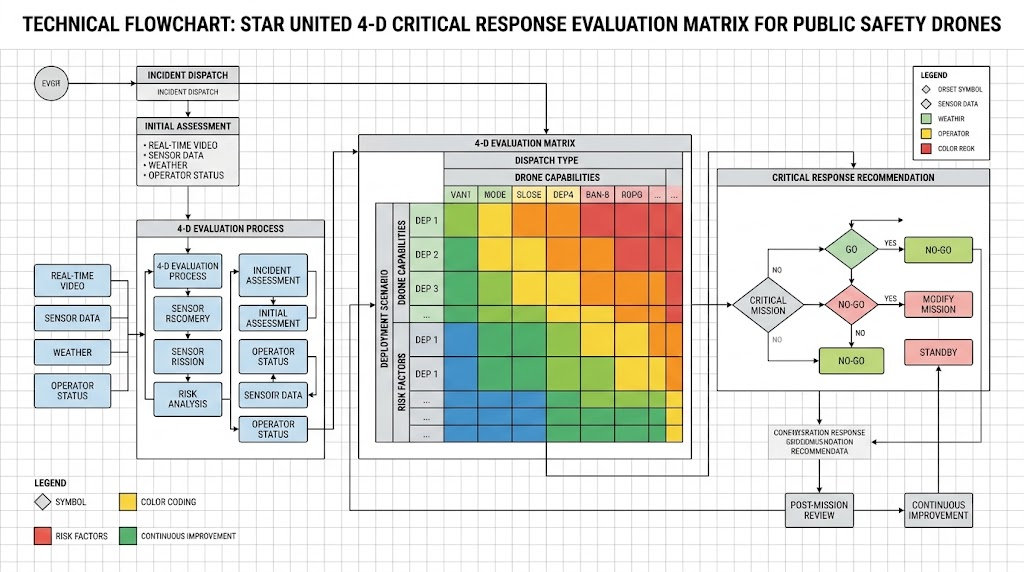 [P] Physical Survivability Index (Environmental Hardening): The airframe must feature verified IP67 ingress protection, sustained wind resistance rated to Beaufort Scale 8 (17.2–20.7 m/s), and internal thermal regulation operational from -20°C to +55°C without external heating blankets.
- [S] Sovereign Security Architecture (Data & Telemetry Control): End-to-end hardware AES-256 telemetry encryption, air-gapped local offline Ground Control Station (GCS) operations, and absolute immunity from third-party remote forced firmware lockouts or geofencing overrides.
- [A] Adaptability & Payload Integration Velocity: Mechanical and software payload SDK interoperability using an open-bus interface that achieves mechanical hot-swaps in under 90 seconds across dual-sensor gimbal cameras, thermal imagers, gas sniffers, spotlights, and LiDAR.
- [C] Direct Factory Lifecycle SLA: Direct access to primary flight system design engineers, sub-72-hour structural replacement parts delivery, tailored firmware development, and avoidance of third-party middleman supply chain delays.
Operational Reliability & Flight Performance Standards in Harsh Environments
Public safety deployments rarely happen on clear, calm days. Flash floods, hazmat fires, structural collapses, and coastal searches unfold during severe meteorological disturbances. Off-the-shelf platforms marked with superficial water-resistant ratings like IP43 or IP54 often suffer motor bearing corrosion, internal condensation, and optical fogging within 15 minutes of operating in downpours. Real-world readiness requires true, laboratory-verified environmental hardening.IP67 Ingress Standard: Defines complete enclosure protection against solid foreign objects (dust-tight vacuum seal) and guarantees liquid ingress protection against continuous high-pressure water jets and immersion up to 1 meter depth for 30 minutes under ISO/IEC 60529 protocols.Our industrial production facilities test structural carbon-fiber layups and motor seals using direct water-immersion pressure tests and wind-tunnel dynamometers. Industrial-grade public safety platforms utilize fully enclosed, sealed internal cavities and treated brushless stators to operate safely in driving rain exceeding 50 mm/h. For persistent incident command monitoring and active search operations, tactical teams deploy heavy-lift rotary UAV platforms capable of carrying multi-sensor arrays while holding station in severe turbulent drafts.
Benchmark Scenario: Gale-Force Coastal Floods and Blizzards
Consider an actual mission envelope: an extreme-weather search and rescue (SAR) deployment during a coastal flood or mountain blizzard, characterized by sustained 19 m/s gale-force winds, ambient air temperatures of -15°C, and heavy precipitation.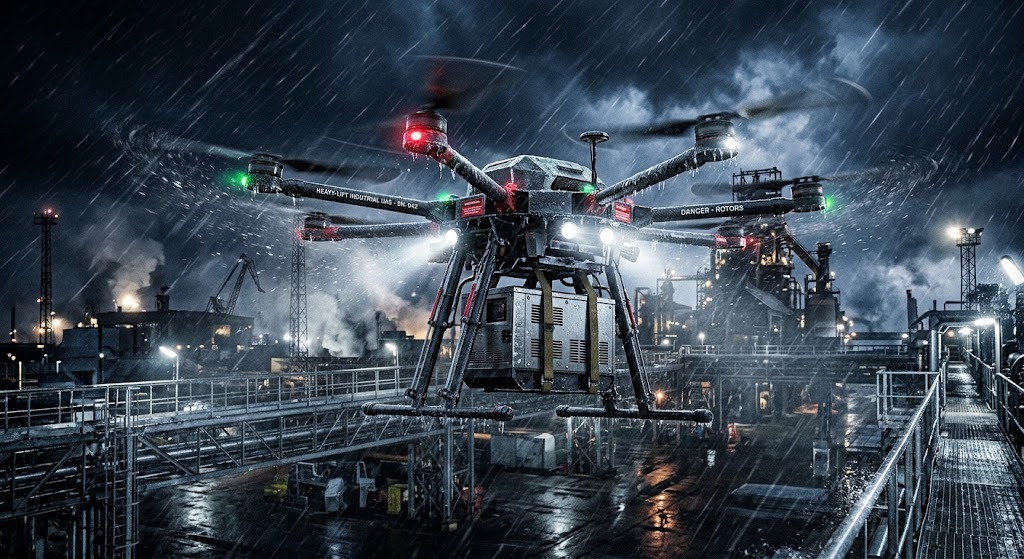
| Engineering Parameter | Consumer / Commercial Tier | Star United Industrial Spec |
|---|---|---|
| Ingress Protection | IP43 / IP54 (Splash resistant) | Certified IP67 (Continuous submersion/rain) |
| Wind Survivability | 12 m/s (Beaufort Scale 6) | 21 m/s (Beaufort Scale 8–9 Gusts) |
| Operating Temperature | -10°C to +40°C | -20°C to +55°C (Active Core Thermal Control) |
| Useful Payload Capacity | 1.5 kg – 2.8 kg | Up to 10 kg – 15 kg Multi-Sensor Array |
| Flight Duration (With 5 kg) | Not achievable (Motor overload) | 50+ minutes continuous hover |
Modular Payloads and Sensor Velocity: Breaking Free from Proprietary Ecosystems
Many commercial manufacturers lock agencies into closed proprietary ecosystems, forcing them to buy high-margin OEM sensors that quickly become obsolete. An effective tactical partner provides modular payload interfaces with standardized mechanical quick-disconnect rings and open SDK controls. Tactical teams shift operational priorities rapidly. A daylight missing-person search demands high-resolution electro-optical (EO) zoom gimbals, while night structure fires require long-wave infrared (LWIR) radiometric thermal imaging payloads to identify structural hotspots and victims through dense smoke.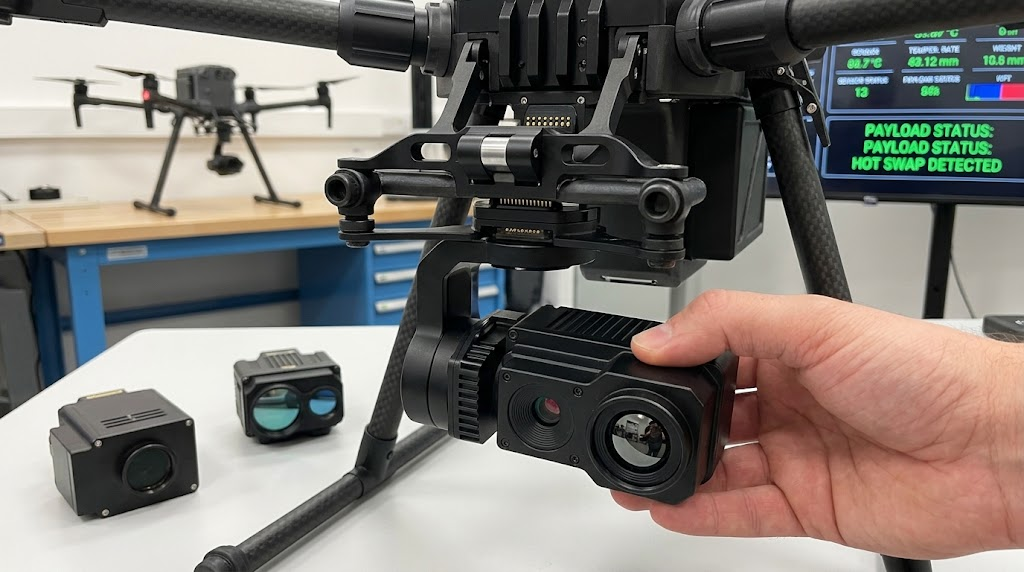
- Dual-Sensor EO/IR Gimbals: Radiometric 640×512 uncooled thermal sensors paired with 40× optical zoom daylight cameras and high-precision laser rangefinders (LRF) rated for 1,500+ meter target location tagging.
- Active Illumination & Loudspeakers: 15,000-lumen synchronized searchlights coupled with 125 dB directional megaphone systems to facilitate crowd guidance and direct tactical de-escalation.
- Hazmat Multi-Gas Detection: Integrated volatile organic compound (VOC), CO, CO2, and radiation sniffers feeding real-time ppm telemetry directly into the agency's Incident Command System (ICS).
- LiDAR & Photogrammetry Systems: Precision LiDAR sensors providing dense 3D point clouds to reconstruct post-incident crash scenes or map mudslide paths.
Data Sovereignty, Telemetry Encryption, and Regulatory Compliance
Public safety operations manage highly sensitive imagery, tactical positions, and critical infrastructure data. Transmitting unencrypted video feeds or synchronizing flight logs to unverified offshore servers violates agency protocols and risks critical intelligence leaks. True public safety partners engineer their data pipelines to comply with standards set by the National Fire Protection Association (NFPA) 2400 and the Federal Aviation Administration (FAA) Part 107 framework for Beyond Visual Line of Sight (BVLOS) operations.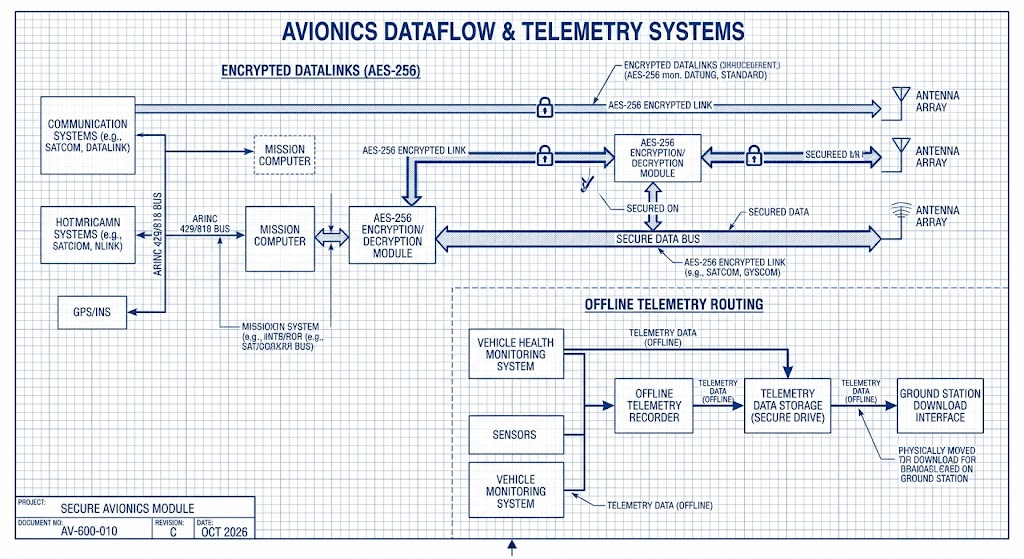 Data security must be hardwired into the platform's avionics architecture:
- Hardware AES-256 Telemetry Encryption: Control datalinks and high-definition video pipelines must be encrypted at the silicon level using AES-256 keys generated and controlled exclusively by the operating agency.
- True Air-Gapped Local Operation: Ground Control Stations must function completely offline without pinging cloud activation servers or requiring mandatory internet connections to arm the motors.
- Elimination of Forced Geofencing Lockouts: Software geofences built into consumer platforms have grounded emergency aircraft near airport perimeter fires. Industrial public safety platforms place airspace authorization management in the hands of the incident commander, not an offshore automated software profile.
- Seamless PSAP & Command Streaming: Low-latency video pipelines (H.264/H.265 RTSP streams) must output directly into Public Safety Answering Points (PSAP) and common CAD/GIS software frameworks without proprietary subscription walls.
Direct Factory Engagement vs. Commercial Resellers: Total Cost of Ownership
Procuring a tactical UAV fleet through regional commercial resellers introduces critical vulnerabilities: distributor markups ranging from 30% to 60%, slow warranty processing, and support personnel who lack engineering knowledge of the platform's flight control code. When an aircraft encounters an issue during an incident, an agency cannot wait weeks for a third-party distributor to ship the platform internationally for bench evaluation. Working directly with the original equipment manufacturer (OEM) dramatically improves long-term fleet readiness. Direct factory partnership provides distinct operational advantages:- Direct Avionics Engineering Access: Public safety pilots interface directly with the factory avionics engineers who developed the flight controllers and motor algorithms, enabling rapid troubleshooting and custom software patches.
- Sub-72-Hour Rapid Structural SLAs: Under critical infrastructure service agreements, structural spare arms, ESC modules, prop assemblies, and sensor gimbals ship straight from the production floor within 72 hours.
- Deep Platform Customization: Factory teams build airframes to match specific mission profiles, integrating specialized searchlights, tethered power stations, or mobile command van mounts right from the assembly line.
- Reduced Total Cost of Ownership (TCO): Cutting out intermediary distributor margins allows agencies to reinvest procurement funds into redundant airframes, extra battery banks, and advanced thermal payload configurations.
Frequently Asked Questions: Technical & Procurement Clarifications
For public safety operations, should agencies choose a Long-Range VTOL or a Heavy-Lift Multirotor?
While fixed-wing VTOL platforms excel at linear boundary surveying and wide-area rural mapping, heavy-lift industrial multirotors are the optimal choice for rapid-response tactical public safety. First responders rarely have the luxury of open, debris-free landing zones during flash floods, forest fires, or dense urban standoffs. Star United's industrial multirotor platforms deploy from a 2×2 meter footprint in under 3 minutes, maintain static hover directly over incident scenes in Beaufort Scale 8 gusts, and carry combined multi-sensor arrays (EO/IR, illumination, gas detection) up to 15 kg. For active tactical intervention and localized SAR, an IP67-rated heavy-lift multirotor provides superior stability, payload capacity, and close-quarters maneuverability.How can a public safety procurement team verify true IP67 weather resistance and Beaufort Scale 8 wind stability without relying on vendor marketing claims?
To prevent hardware failures during emergency operations, procurement agencies should bypass promotional videos and mandate three verifiable technical documents:- Accredited Laboratory IP67 Test Certificates: Verifying immersion in 1 meter of water for 30 minutes combined with continuous dust vacuum tests according to ISO/IEC 60529 standards.
- Calibrated Wind Tunnel Dynamometer Data: Demonstrating motor thrust margins and control authority at 17.2–20.7 m/s relative wind speeds, proving at least 25% control reserve under full payload.
- Live Salt-Fog & Thermal Chamber Reports: Confirming avionics and batteries conform to MIL-STD-810H standards without voltage sag between -20°C and +55°C.
Can flight logs and tactical video feeds be intercepted during active incidents?
Platform security depends entirely on the transmission architecture. Standard commercial drones broadcast over common Wi-Fi or light-encryption bands that commercial RF scanners can intercept. Star United platforms use dedicated, frequency-hopping digital transmitters with hardware-enforced AES-256 encryption, preventing unauthorized video interception, signal spoofing, or data hijacking.Deploying Your Fleet: Star United UAV 3-Step Public Safety Blueprint
Transitioning from consumer drones to an enterprise-grade tactical UAV fleet requires an organized, low-friction engineering integration path. Star United UAV eliminates bureaucratic procurement complexity through our transparent three-phase fleet integration program:The Tactical Integration Pathway
- Step 1: Operational Scope Intake — Your agency submits target mission parameters, operating environments, required sensor arrays (EO/IR, LiDAR, gas sniffers), and flight endurance targets through our secure engineering intake portal.
- Step 2: Custom Engineering Blueprint (24-Hour SLA) — Within 24 hours, our senior public safety flight systems engineers deliver a detailed technical blueprint outlining airframe dynamics, power budgets, sensor integration protocols, and encrypted datalink plans.
- Step 3: Direct Factory Consultation & Tactical Demo — Meet directly with our flight systems engineering team for a 1-on-1 technical review, schedule a live field flight demonstration, and configure direct-to-factory SLA support terms.
Upgrade Your Department to Industrial-Grade UAV Reliability
Eliminate software lockouts, weather groundings, and sensor limits. Partner directly with the engineers manufacturing the next generation of mission-critical public safety flight systems.
Request Your Custom Engineering Blueprint