
High-Altitude VTOL UAV Operations: Engineering Specification & Procurement Guide
Star United Flight Control (Shaanxi) Technology Co., Ltd.
12 min read·2026-10-28
| Evaluation Dimension | Industrial Benchmark | Operational Testing Boundary | Selection Red-Flags (What to Avoid) |
|---|---|---|---|
| Aerodynamic Hover Margin | Static thrust-to-weight ratio (T/W) ≥ 1.6:1 at 4,500 m MSL (ISA +15°C) | Full MTOW hover throttle ≤ 68% in thin air (ρ ≈ 0.77 kg/m³) | Static T/W < 1.3:1 at target elevation; leads to Vortex Ring State (VRS) upon descent |
| Electrochemical Stability | Internal PTC battery self-heating; core temp held at +15°C to +25°C | Discharge sustained down to -25°C ambient with <8% instantaneous voltage sag | Unheated LiPo packs; risk of rapid low-voltage cutoff during transition current spikes |
| Avionics Sensor Fusion | Triple-redundant IMU, dual GNSS heading, baro-RTK sensor voting | Dynamic heated pitot tube; automated barometric lapse rate compensation | Single barometric altimeter referencing standard lapse rate without RTK ellipsoid cross-check |
| Environmental Survivability | Enclosure certified IP67 (IEC 60529); MIL-STD-810H Method 500.6 validated | 14.0 m/s continuous wind operation; 17.5 m/s peak mountain gust threshold | Unsealed airframes (IP54 or unrated) prone to motor bearing seizure and moisture condensation |
| Bus Determinism & Sync | Dual isolated CAN 2.0B / MAVLink 2.0 bus architecture with hardware PPS time-sync | Sub-10 μs payload triggering time-stamp integrity across 1 Mbps bus bandwidth | Single-ended UART without hardware flow control; packet drops under high-EMF environments |
Aerodynamics & Propulsion Derating above 3,000m AMSL: Technical Architecture & Performance Specifications
Operating unmanned aircraft at elevations up to 4,500 m Mean Sea Level (MSL) requires addressing severe aerodynamic degradation caused by low atmospheric density. Air density decreases non-linearly from 1.225 kg/m³ at sea level to approximately 0.771 kg/m³ at 4,500 m International Standard Atmosphere (ISA), degrading lift generation while simultaneously compromising convective cooling for brushless powertrains. Successful deployment hinges on oversized rotor disc areas, low-Reynolds airfoil profiles, and elevated thrust-to-weight margins engineered specifically for low-density regimes.Density Altitude Derating: The operational metric combining barometric pressure and ambient temperature. At 4,500 m MSL under ISA +15°C conditions, the density altitude corresponds to roughly 5,300 m, yielding an air density ratio (ρ/ρ₀) of less than 0.61.To evaluate platform survivability objectively, engineering teams utilize the High-Altitude Operability Matrix (H-AOM). This framework establishes four empirical performance pillars: Aerodynamic Lift & Transition Margin (ALTM), Density-Derated Hover Thrust Reserve (D-HTR), Electrochemical & Thermal Resilience (ETR), and Sensor-Bus Determinism & Link Integrity (SDLI). Platforms failing to maintain these design margins risk uncontrolled settling under mountain downdrafts or critical boundary-layer stall during fixed-wing transition.
Propeller Pitch-to-Diameter Optimization and Reynolds Number Degradation
At low density, rotor airfoils operate at significantly depressed Reynolds numbers (Re < 80,000 across inner blade stations). Standard commercial propellers experience laminar separation bubbles, resulting in a 25% to 35% decline in blade lift-to-drag ratios (CL/CD). To recover static thrust without exceeding motor torque thresholds, rotor systems must utilize wider blade chords, custom high-lift low-Re airfoils (such as the Selig S1223 or Wortmann FX 63-137 profiles), and increased blade diameter rather than aggressive pitch increases. Increasing propeller pitch at low air density shifts blade stations toward premature stall during rapid throttle increases. In benchmark field trials conducted on heavy-lift rotary platforms, optimal hover efficiency at 4,500 m MSL requires lowering the pitch-to-diameter (P/D) ratio to 0.32–0.36 while increasing rotor disc diameter by 18% to 22%. For long-range fixed-wing phases, deploying a fixed wing VTOL UAV with optimized high-aspect-ratio wings mitigates thin-air cruise drag far more effectively than pure rotorcraft configurations.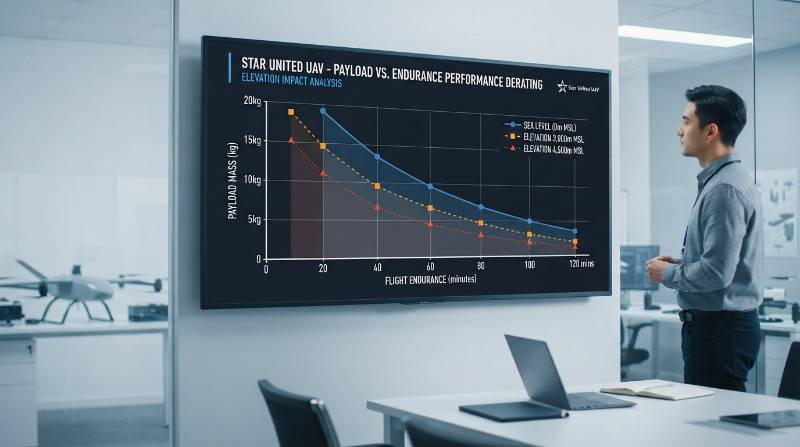
ESC and Motor Thermal Dissipation Limits under Reduced Convective Cooling
A frequent failure mode during plateau missions is brushless motor and Electronic Speed Controller (ESC) thermal runaway. While ambient temperatures at 4,500 m are often low (-5°C to -25°C), the reduced mass flow of air across motor stators drastically impairs convective heat transfer coefficients (h), which scale directly with air density (h ∝ ρ0.8). Motors must spin 18% to 24% faster simply to generate equivalent sea-level thrust, drawing higher continuous phase current (IRMS).- Copper Losses: Resistive heating inside windings escalates according to Ploss = I2R, increasing baseline stator core temperatures by up to 30°C compared to sea-level hover.
- MOSFET Thermal Drift: ESC switching stages experience elevated junction temperatures. Continuous switching at 24–32 kHz under high-current thin-air conditions causes gate threshold drift, requiring ESC derating by a factor of 1.35.
- Mitigation Standard: Powertrains must integrate centrifugal internal cooling fans, high-grade NdFeB magnets rated for 150°C continuous operation (SH or UH grade), and aluminum CNC heatsinks directly exposed to incoming airflow.
Energy Storage Systems in Low-Temperature, High-Elevation Regimes: Technical Architecture & Performance Specifications
Electrochemical power plants deployed on high-altitude plateaus confront compound operational stressors: ambient sub-zero thermal extremes coupled with high current demand during vertical transition. Without active battery thermal management, standard lithium-ion chemistries suffer catastrophic voltage sag, reduced capacity delivery, and lithium plating during high-rate discharges.Solid-State vs. NMC Lithium Battery Capacity Retention (-25°C to -40°C)
Standard Nickel-Manganese-Cobalt (NMC) lithium pouch cells experience severe electrolytic impedance growth below 0°C. Equivalent Series Resistance (ESR) increases exponentially, climbing by 300% to 500% at -20°C. Under a 3C to 5C discharge surge typical of VTOL liftoff, this elevated internal resistance drops terminal cell voltage below the autopilot's failsafe cutoff (typically 3.3 V per cell), triggering an uncommanded emergency landing. Semi-solid-state lithium cells utilizing gel or polymer electrolyte interfaces provide superior mechanical puncture resistance and higher gravimetric energy densities (280–320 Wh/kg versus 230–250 Wh/kg for conventional NMC). However, solid electrolytes exhibit sluggish ion transport kinetics at sub-zero temperatures. Consequently, regardless of chemistry, neither solid-state nor NMC packs can sustain full-envelope high-altitude missions without an active pre-heating thermal management system.Active Internal Self-Heating BMS Architecture and Parasitic Draw
To ensure full current delivery during vertical ascent, enterprise platforms integrate autonomous Positive Temperature Coefficient (PTC) heating elements embedded between cell layers. The Battery Management System (BMS) manages pre-heating protocols before enabling motor arming states.- Pre-Heat Phase: PTC heating elements draw from an external ground power unit or dedicated auxiliary cell to warm the pack from -25°C to +15°C in 10 to 14 minutes.
- In-Flight Maintenance: During hover and transition, natural resistive I2R core heating generally maintains internal temperatures above +20°C. During low-throttle fixed-wing cruise, intelligent BMS controllers pulse auxiliary heating blankets if core thermistors detect drop-offs below +10°C.
- Parasitic Power Overhead: Thermal stabilization accounts for 3% to 6% of total stored capacity, a necessary trade-off to ensure battery health and prevent cell degradation over successive cycles.
Avionics, GNSS, and Transition Flight Control Dynamics: Technical Architecture & Performance Specifications
Avionics operating above 3,000 m MSL face dynamic pressure anomalies, severe thermal gradients, and intense atmospheric multipath interference. Maintaining flight envelope control demands a fully integrated sensor architecture capable of rejecting erroneous atmospheric barometric references while ensuring determinism across internal communications buses.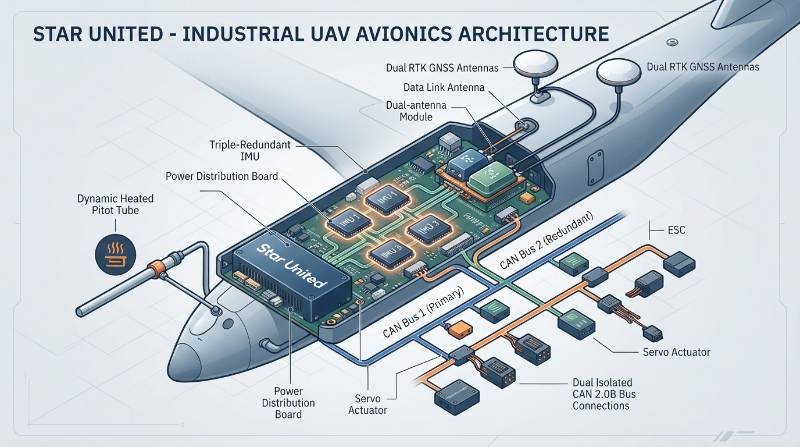
Barometric Altimeter Drift vs. Dual-Band RTK Ellipsoid Height Variance
Standard barometric altimeters rely on standard atmospheric lapse models (ISA: -6.5°C per 1,000 m). Mountain environments routinely deviate from standard lapse rates due to local thermal inversions, katabatic winds, and localized pressure waves over ridgelines. Barometric altitude drift of up to 40 m within a 20-minute flight window is common, introducing severe collision hazards during terrain-following waypoints. Robust high-altitude autopilots deploy dual-band RTK GNSS systems (GPS L1/L2, GLONASS G1/G2, BeiDou B1/B2, Galileo E1/E5b) running a tightly coupled Extended Kalman Filter (EKF3). RTK ellipsoid height serves as the primary vertical state reference, cross-checked against digital elevation models (DEM) and laser altimeters, with barometric input relegated to a tertiary sensor channel. Concurrently, dynamic pitot tubes must be electrically heated to prevent pitot-static icing and calibrated with dynamic ambient temperature sensors to calculate accurate True Airspeed (TAS) from Indicated Airspeed (IAS).Stall Margin Recalculation during VTOL-to-Fixed-Wing Transition
Aerodynamic lift depends on dynamic pressure (q = 0.5 × ρ × V2). As air density ρ drops by 37% at 4,500 m MSL, a fixed wing must achieve an Indicated Airspeed equivalent to sea level, but its True Airspeed (ground-relative speed in calm air) must increase by approximately 26% to produce identical lift.- Transition Inbound Stall: At sea level, a platform might safely transition from multirotor hover to wing-borne flight at 18 m/s TAS. At 4,500 m MSL, transition stall speed (Vs) climbs to 23 m/s TAS. Attempting transition at low airspeed results in immediate wing stall and altitude loss.
- Back-Transition Authority: When decelerating from cruise to hover, vertical lift motors must reach hover RPM before wing lift decays below MTOW. Flight control algorithms must dynamically scale transition thresholds based on real-time density altitude computations.
- Mission Versatility: For persistent operations requiring localized vertical inspection rather than broad area linear coverage, platforms like a dedicated heavy lift rotary UAV eliminate transition complexity entirely, relying on brute-force rotor thrust reserves to overcome thin air.
Triple-Redundant IMU Architecture and High-EMF Data-Link Resilience
Temperature transients from sunny valley floors (+20°C) to alpine ridgelines (-15°C) induce thermal drift inside MEMS accelerometers and gyroscopes. Enterprise architectures utilize triple-redundant IMUs mounted on isolated silicone dampening fixtures, with internal thermal resistors maintaining constant sensor core temperatures (typically +50°C ±0.5°C) per RTCA DO-160G Section 4 environmental compliance. In plateau infrastructure corridors, UAVs frequently conduct linear inspections along 500 kV ultra-high voltage (UHV) powerlines. Autopilot components must communicate across dual-isolated CAN 2.0B buses running differential signaling to suppress electromagnetic interference (EMI). Command and Control (C2) links utilize frequency-hopping spread spectrum (FHSS) across 840 MHz / 1.4 GHz bands with high-gain directional tracking antennas to overcome deep Fresnel-zone diffraction and multipath reflections in steep mountain valleys. For remote tactical assets requiring data distribution across disconnected ground teams, integrating an airborne communication relay provides a robust line-of-sight bridge across mountainous obstacles.Lifecycle Cost, Maintenance, and Airworthiness Compliance: Technical Architecture & Performance Specifications
Operating in alpine zones imposes severe wear on mechanical components, structural composites, and electrical systems. Industrial operators must plan lifecycle maintenance against verified standards including ASTM F3298 (Design and Construction of UAS) and ISO 21384-3 (UAS Operational Procedures).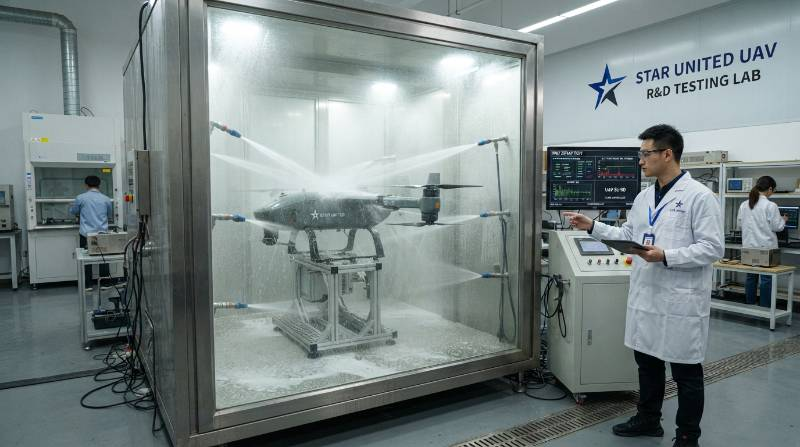
Structural Stress, Mountain Wind Shear, and Material Degradation
Alpine boundary layers generate violent thermal turbulence and mechanical wind shear exceeding 15 m/s. Airframes must be constructed from high-modulus Toray carbon-fiber prepreg autoclave cured at high pressure, yielding structural rigidity with a safety factor ≥ 2.5 under maximum operational gust loads. Furthermore, high UV radiation at elevations above 3,500 m accelerates epoxy matrix degradation in unprotected composites; all airframe skins require aerospace-grade polyurethane coatings with integrated UV inhibitors.MTBF Benchmarks, Bearing Overhauls, and Modular Field Repairability
Thin air requires higher motor RPMs for basic operations, which shortens mechanical component lifespans. Lower atmospheric pressure also accelerates lubricant volatilization inside high-speed bearings.- Bearing Overhaul Intervals: Motor bearings rated for 1,000 flight hours at sea level must be inspected at 250 hours and overhauled at 500 hours when operating continuously above 3,500 m MSL.
- Ingress Protection (IP67): As certified under IEC 60529, airframes must prevent dust intrusion and moisture penetration from blowing snow, freezing rain, and condensation during rapid descents. Sealed motor housings with ceramic hybrid bearings eliminate fine grit ingress.
- Modular Field Architecture: Glued or bonded structures present unacceptable field repair challenges. Quick-disconnect structural carbon booms with industrial Amphenol bayonet connectors reduce Mean Time to Repair (MTTR) to under 20 minutes, reducing overall Total Cost of Ownership (TCO) across a 1,500-hour system lifecycle.
- Emergency Readiness: Critical infrastructure or remote safety deployments often utilize platforms adapted as a UAS for emergency services, where high reliability in sub-zero alpine conditions is essential for mission success.
High-Altitude Operability Verification & Procurement Decision Framework
Enterprise procurement for high-altitude UAV operations demands empirical validation rather than theoretical brochure specifications. Flight envelopes must be cross-checked against documented testing protocols under controlled low-pressure conditions.Empirical Benchmark: 4,500 m+ MSL High-Density Plateau Asset Inspection
Consider a typical high-demand mission profile: 4,500 m+ MSL High-Density Plateau Linear Asset Inspection (Powerlines & Pipelines) with 15 kg Multi-Sensor Payloads under 15 m/s Wind Shear. When standard aircraft struggle to achieve ground clearance, certified platforms must deliver reliable operational margins. In benchmark field trials conducted by Star United UAV (Star United Flight Control (Shaanxi) Technology Co., Ltd.) at the Yanliang Aviation & Civil Aircraft Intelligent Manufacturing Base, heavy-payload industrial hybrid VTOL platforms achieved documented operational performance:- Takeoff Elevation: Certified takeoff capability up to 5,000 m ASL with a 6,500 m MSL service ceiling under ISA atmospheric conditions.
- Useful Payload Capacity: 15.0 kg continuous mission payload capacity, allowing simultaneous integration of heavy dual-head LiDAR scanners, MWIR thermal sensors, and PPK positioning receivers.
- Density-Derated Mission Endurance: 120 minutes sustained endurance carrying the full 15 kg payload at 4,500 m MSL (compared to a sea-level baseline of 180 minutes with 5 kg payload).
- Propulsion Margin: Static thrust-to-weight ratio maintained at ≥ 1.65:1 at 4,500 m through custom-molded 34-inch low-Reynolds carbon propellers paired with 120 kV heavy-duty brushless motors.
- Thermal Management: Integrated PTC smart battery self-heating system raising core cell temperatures from -25°C to +15°C within 12 minutes prior to motor arming.
- System Compliance: Validated compliance with MIL-STD-810H Method 500.6 (Low Pressure/Altitude), Method 501.7 (+55°C High Temp), and Method 502.7 (-30°C Low Temp), alongside IEC 60529 IP67 water/dust ingress protection.
Engineering Technical Review & Mission Profile Feasibility Audit
Validate your high-altitude mission parameters with aeronautical and propulsion specialists. Request density-altitude payload-vs-endurance derating blueprints, motor-propeller matching analysis, and full CAD STEP integration models tailored to your operating altitude.
- Step 1: Mission Profile Submission: Input your takeoff elevation (m MSL), target payload SWaP, temperature envelope, and required gust margin.
- Step 2: Density-Derated Blueprint: Receive custom propulsion matching data, battery thermal management protocols, and interface schematics within 24 business hours.
- Step 3: Direct Technical Audit: One-on-one integration consultation with senior avionics flight engineers and bench dynamometer test log review.