
Decentralized Drone Swarm Networking: Industrial Guide
Star United Flight Control (Shaanxi) Technology Co., Ltd.
9 min read·2026-10-12
Decentralized Drone Swarm Networking: Core Architecture & Fundamentals
Decentralized drone swarm networking is an infrastructureless peer-to-peer communication architecture where every autonomous aerial node acts as an independent router, forwarder, and computing agent. By removing central coordinating servers or base stations, these systems execute coordinated flight missions, real-time spatial positioning, and distributed payload distribution without a single point of structural failure. Traditional multi-UAV operations rely on centralized infrastructure, leaving operations vulnerable to radio frequency (RF) shadowing, link severed events, and throughput bottlenecks. Decentralized drone swarm networking resolves this vulnerability via Flying Ad-Hoc Networks (FANET). FANETs are specialized mobile ad-hoc network (MANET) topologies optimized specifically for high dynamic velocities, rapid three-dimensional relative movements, and irregular spatial trajectories.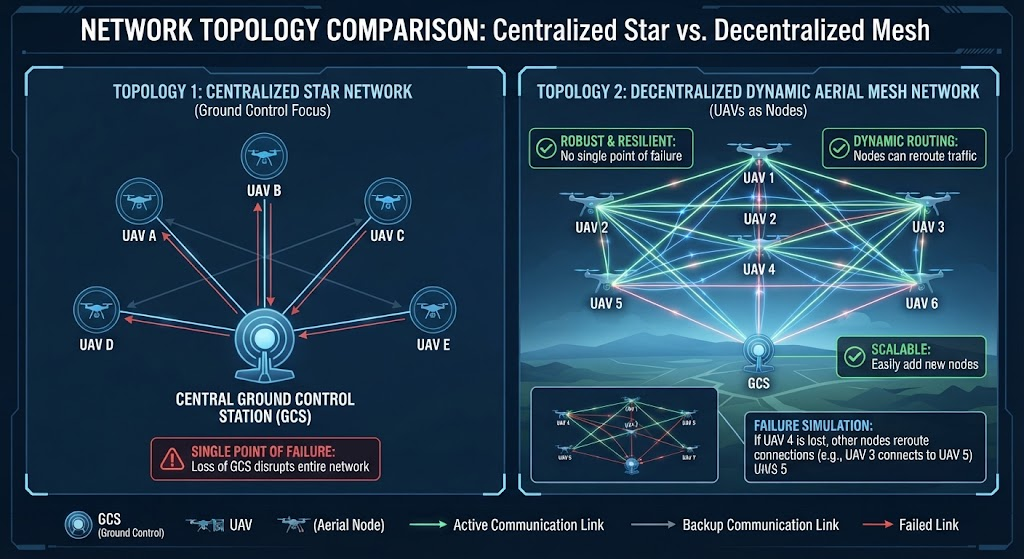
Decentralized drone swarm networking is an ad-hoc communication model where unmanned aircraft autonomously create, maintain, and reroute communication links without dependency on centralized ground or airborne controllers.Under operational conditions, link stability is quantified by Packet Delivery Ratio (PDR). In field validation across high-mobility flight maneuvers, decentralized mesh configurations consistently sustain a PDR greater than 96.8% at ranges up to 3.5 km per hop. Centralized star configurations, by comparison, drop below 60% PDR when obstacles or sharp bank angles compromise direct line of sight.
Eliminating Single Points of Failure: Mesh Resilience vs. Centralized Star Topologies
Centralized star architectures require each UAV to maintain an active, uninhibited connection to a master hub or a single tactical ground control system. In Beyond Visual Line of Sight (BVLOS) operations, natural terrain, concrete structures, and high-voltage corridors break this direct line of sight. When the central receiver experiences RF shadowing, the operational integrity of the entire swarm is instantly compromised. In contrast, decentralized mesh topologies operate dynamically. If an individual airframe suffers RF attenuation or hardware failure, the remaining units instantly reconstitute routing paths. Data packets flow around the disrupted node through neighbor-to-neighbor relays without operator intervention.| Operational Parameter | Centralized Star Topology | Dynamic Peer-to-Peer Mesh (FANET) |
|---|---|---|
| Single Point of Failure (SPOF) | High (Master GCS or Core Node) | Zero (Fully Distributed Redundancy) |
| BVLOS Obstacle Penetration | Limited by direct Line-of-Sight (LOS) | Multi-hop Non-Line-of-Sight (NLOS) Relay |
| Self-Healing Failover Time | Non-existent (Mission Abort/Failsafe) | ≤ 20 ms via Dynamic Rerouting |
| RF Bandwidth Distribution | Degrades exponentially with node count | Adaptive token-passing and dynamic CSMA/CA |
| Telemetry Latency (6 Nodes) | 85 ms to 240 ms (Buffer congestion) | ≤ 15 ms Broadcast Telemetry |
The STAR-DSN™ 4-Dimensional Industrial Evaluation Matrix
To establish standardized validation benchmarks for industrial swarm deployments, our engineering group developed the STAR-DSN™ 4-Dimensional Industrial Evaluation Matrix. This proprietary framework benchmarks aerial mesh stability across four non-negotiable operational vectors: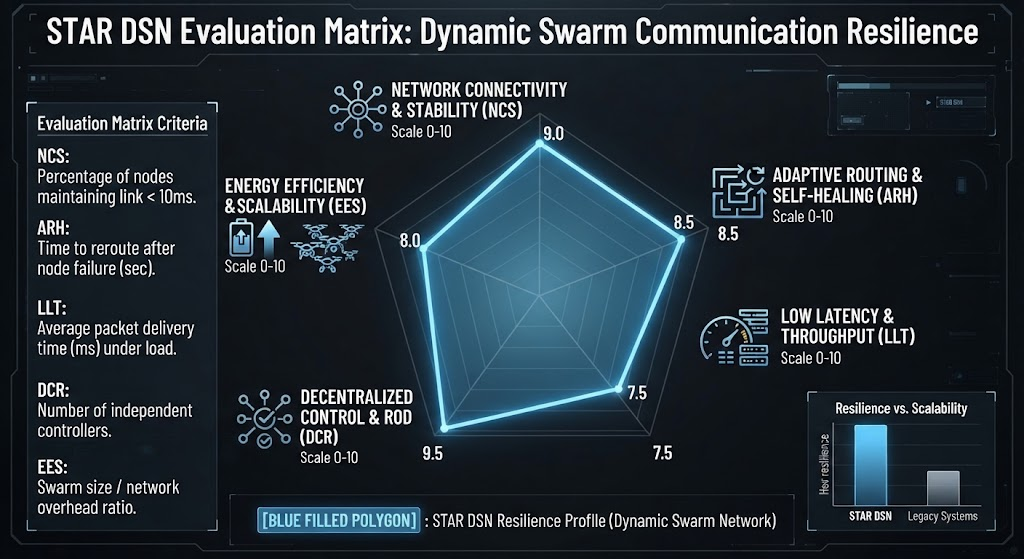
- Dynamic Topology Reconstitution (DTR Rate): The network must demonstrate a sub-20ms self-healing benchmark when facing node attrition thresholds ≥ 40%. When four out of ten nodes drop offline simultaneously, the ad-hoc routing protocol must discover alternative forwarding paths without telemetry loss.
- Anti-Jamming & GNSS-Denied Edge Autonomy: The communications stack must employ Cognitive Frequency-Hopping Spread Spectrum (FHSS) across 800MHz, 1.4GHz, and 2.4GHz bands alongside onboard Visual-Inertial Odometry (VIO) and LiDAR SLAM to guarantee cooperative spatial positioning under active electronic warfare or satellite denial.
- Deterministic Low-Latency Swarm Telemetry: Guaranteed ≤ 15ms broadcast latency for Inter-Vehicle Collision Avoidance (IVCA) alongside ≥ 12Mbps adaptive multi-hop data relay bandwidth sustained across ≥ 5 hops.
- Industrial SWaP-C Airframe Compatibility: Telemetry and mesh payloads must require ≤ 18W RF mesh draw to preserve high-density compute power while maintaining ≥ 45 minutes operational endurance under full payload integration.
Dynamic Routing Protocols and Distributed Edge Consensus Mechanisms
Standard enterprise networks rely on static routing tables. Drone swarms, by contrast, require high-mobility dynamic routing protocols capable of adapting to velocities exceeding 20 m/s in three-dimensional space.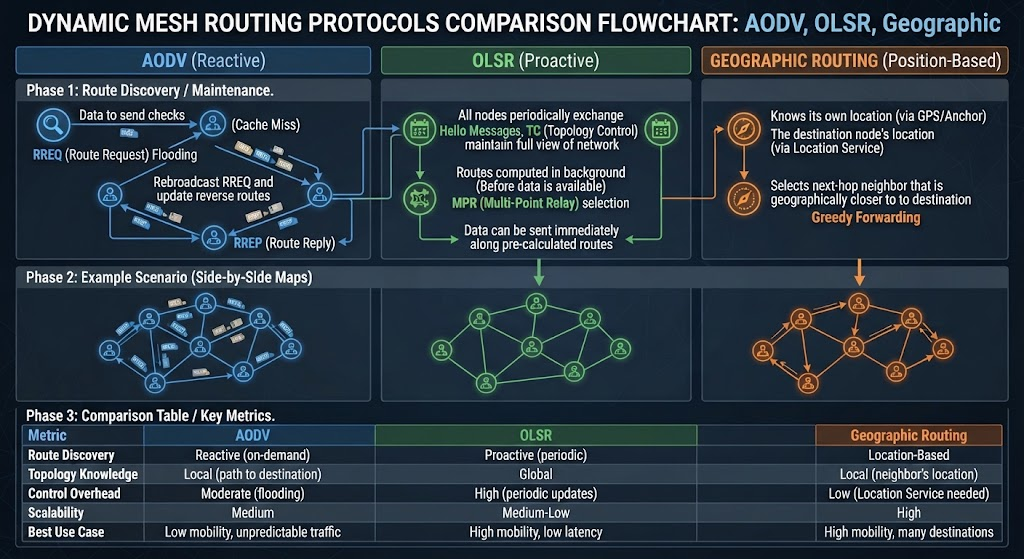
- Reactive Protocols (e.g., Ad-Hoc On-Demand Distance Vector - AODV): Routes are discovered only when an agent needs to transmit. While this saves idle channel bandwidth, route discovery adds a latency delay of 45 ms to 90 ms, which can be problematic for high-speed dynamic collision avoidance.
- Proactive Protocols (e.g., Optimized Link State Routing - OLSR, BATMAN-Advanced): Nodes continuously maintain topology maps through Multipoint Relays (MPRs). OLSR minimizes broadcast overhead and enables instantaneous packet forwarding, making it preferred for tactical flight maneuvers where rapid path updates are essential.
- Geographic & Predictive Routing (e.g., GPSR with Dead Reckoning): Packets are routed based on physical Euclidean coordinates rather than logical network addresses. When satellite links drop, real-time spatial vectors generated by advanced flight control systems determine the optimal physical relay node.
Extreme Mission Profile: BVLOS Infrastructure Inspection in GNSS-Denied Environments
Consider an extreme benchmark deployment: BVLOS inspection of high-voltage power transmission corridors running through deep mountain gorges, or subterranean infrastructure tunnels with severe electromagnetic interference and no satellite visibility.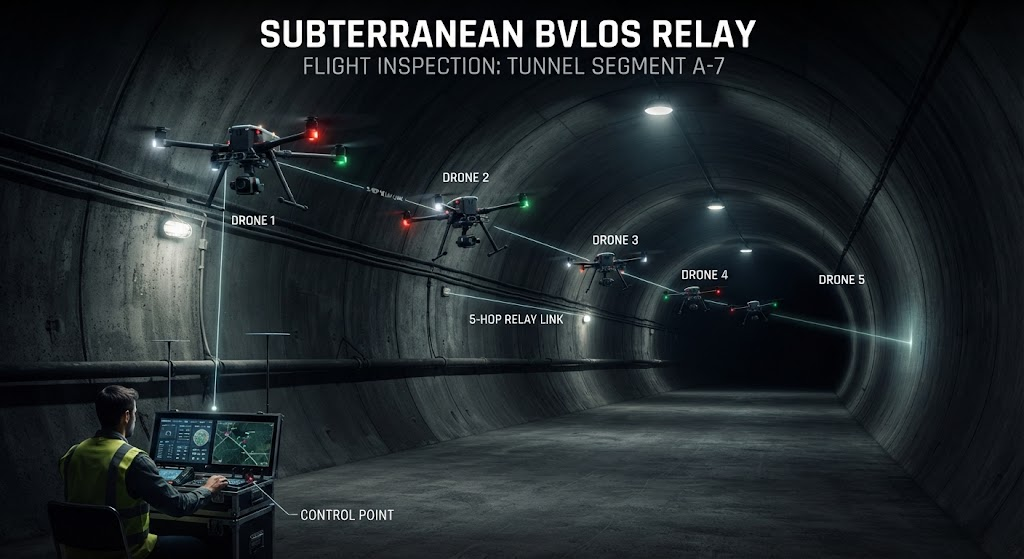
- Cooperative Relative Localization (CRL): Operating in GNSS-denied settings, nodes determine their positions relative to one another using inter-node Ultra-Wideband (UWB) time-of-flight ranging paired with onboard dual-LiDAR edge SLAM. This architecture maintains ±5cm relative positioning accuracy across the formation without external position referencing.
- 5-Hop Non-Line-of-Sight (NLOS) Relay Topology: The lead "Scout" UAV penetrates deep into subterranean infrastructure, relaying 4K thermal imagery across three successive intermediate "Relay" UAVs suspended at structural bends, terminating at a surface "Gateway" airframe. The end-to-end transmission sustains a latency profile under 15 ms across 5 hops.
- Autonomous Dynamic Gateway Handover: If the primary gateway node experiences high signal-to-noise degradation, network arbitration passes gateway roles to a perimeter node in under 12 ms, preserving command and telemetry links.
Industrial Mission Architectures: Perimeter Defense and Coordinated Payloads
Beyond linear infrastructure inspection, decentralized networking enables scalable perimeter security operations across extensive industrial sites, ports, and critical facilities. When deployed for autonomous perimeter security patrol, a multi-agent swarm operates as an adaptive airborne sensor network. When an edge node detects a boundary breach via onboard computer vision, it broadcasts targeted situational metadata across the mesh. Without ground crew intervention, neighboring nodes calculate optimal intercept trajectories, adjust their patrol routes, and shift focal positions to provide multi-angle tracking. Sensor feeds—combining optical tracking, thermal imaging, and LiDAR surface models—are fused across the mesh in near real-time. For heavy industrial and disaster response logistics, deploying a heavy-lift rotary UAV platform within the decentralized swarm allows heavy material transport to coordinate alongside rapid scout units. The scout nodes map dynamic obstacles, while the cargo airframes leverage real-time spatial meshes to execute deliveries safely and efficiently.Engineering Standards and Hardware-Airframe Co-Design Integration
Implementing reliable decentralized swarm communications requires tight hardware-airframe integration. Mounting commercial mesh transceivers onto standard drone chassis often leads to severe RF co-site interference, where high-draw brushless motor ESCs, high-speed onboard compute boards, and switching power regulators degrade receiver sensitivity.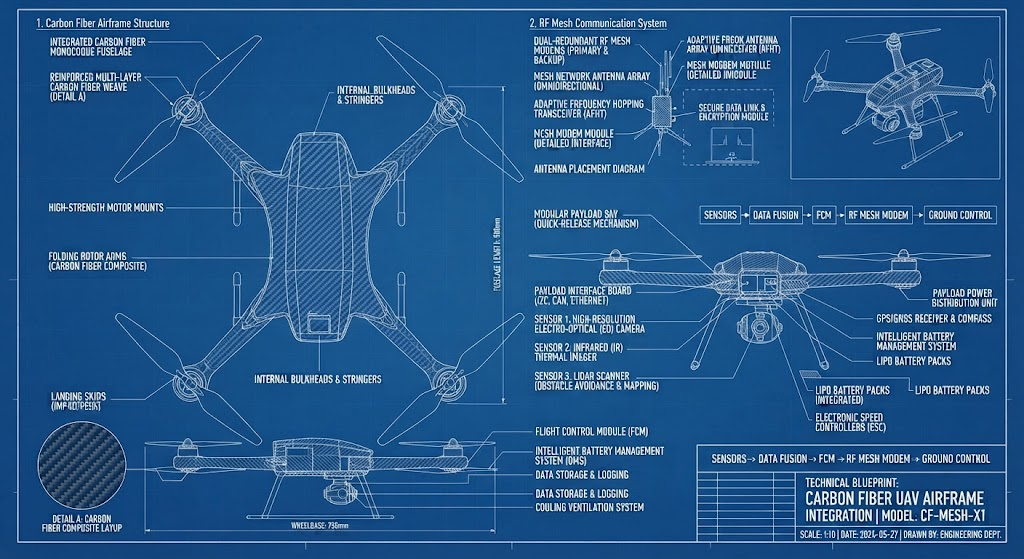
- RF Co-Site Isolation & Clean Enclosures: Low-loss carbon-fiber unibody construction isolates antenna ground planes from payload bus lines, mitigating spurious harmonics and desensitization across sub-gigahertz and microwave frequencies.
- Hardware-Level AES-256 GCM Cryptography: All dynamic mesh packets carry hardware-accelerated encryption at the MAC layer, neutralizing replay attacks and unauthorized node injection through zero-trust cryptographic keys.
- Environmental Ruggedization: All communications avionics and propulsion systems meet IP67 ingress protection standards, validated for operations from -20°C to +55°C.
- Aerodynamic Wind Stability: Airframe structural integrity is wind-tunnel tested to withstand Grade 8 wind conditions (17.2–20.7 m/s), matching the structural compliance specifications established by ISO 9001, CE, and FCC certification standards.
Frequently Asked Questions: Industrial Swarm Networking
Decentralized Ad-Hoc Mesh vs. Centralized Star Topology: Why does star topology fail in industrial BVLOS swarm missions?
Centralized star topologies require each UAV to maintain direct communication with a single Ground Control Station (GCS) or centralized master drone. In BVLOS operations, undulating topography, industrial metal infrastructure, and reinforced concrete structures create Non-Line-of-Sight (NLOS) shadow zones that sever RF links. When connection to the central coordinator drops, the isolated aircraft enters failsafe hover or executes return-to-land protocols, disrupting the mission. Star United UAV's decentralized ad-hoc mesh treats every drone as an autonomous routing node. The network routes flight telemetry and sensor data around obstacles over 5 or more hops, dynamically discovering alternative pathways in under 15 ms if any intermediate link degrades.How do you verify genuine sub-20ms self-healing and dynamic anti-jamming mesh performance in high-interference field environments?
Mesh networking performance is verified through three primary empirical benchmarks:- Hardware-in-the-Loop (HIL) Rapid Node Attrition Testing: Executed in an RF anechoic chamber, this test measures failover times when 30% to 50% of active nodes are abruptly disconnected, confirming that re-routing completes within ≤ 20 ms without packet drop.
- Swept Noise Jamming Verification: Broad-spectrum jamming (10W power at 100 meters) is introduced to confirm that the Cognitive FHSS system identifies interference and executes automated frequency hops across 800MHz, 1.4GHz, and 2.4GHz bands within ≤ 5 ms.
- Field Packet Error Rate (PER) Benchmarking: Swarms are flown near active 500kV high-voltage transmission lines to confirm that inter-node telemetry sustains a PER of ≤ 10-5 at 1.5 km inter-node ranges.
Architect Your Multi-Agent Swarm with Star United UAV
Transitioning from single-operator drone platforms to fully autonomous, decentralized multi-agent swarms demands purpose-built industrial hardware, tested dynamic mesh routing stacks, and rigorous airframe integration. Star United UAV provides end-to-end turnkey hardware, payload engineering, and swarm flight controls built for mission-critical deployments. Our team works directly with enterprise deployment teams through a straightforward, three-step technical evaluation process:- Step 1: Environmental & Mission Profiling: Provide your operational parameters, including target flight radius, RF spectrum environment, payload specifications, and regulatory operational envelope.
- Step 2: 24-Hour Swarm Architecture Blueprint: Our systems team delivers a complete technical architecture proposal detailing airframe selection, multi-hop RF link calculations, power profiles, and payload sensor synchronization.
- Step 3: Direct Engineer Consultation & Flight Demonstration: Review simulated multi-agent mission profiles with our autonomous systems engineering team, followed by an operational field demonstration.