
Custom UAV Manufacturer Contract Questions: OEM Buyer Guide
Star United Flight Control (Shaanxi) Technology Co., Ltd.
8 min read·2026-10-01
Navigating Enterprise Drone Procurement: The Strategic Importance of Custom UAV Contracts
Procuring an industrial-grade unmanned aircraft system differs fundamentally from purchasing consumer off-the-shelf units or contracting third-party pilot flight services. When entering an enterprise-level, turnkey OEM/ODM drone manufacturing agreement, aerospace procurement teams must establish legally binding, physically verifiable engineering milestones that govern the entire product lifecycle. In aerospace manufacturing programs, contract ambiguities routinely lead to unverified payload limits, thermal shutdowns in severe climates, unexpected supply chain stranding, and catastrophic IP disputes over proprietary tooling molds. Custom UAV manufacturing contracts must function as an enforceable technical specification document rather than a generic commercial invoice.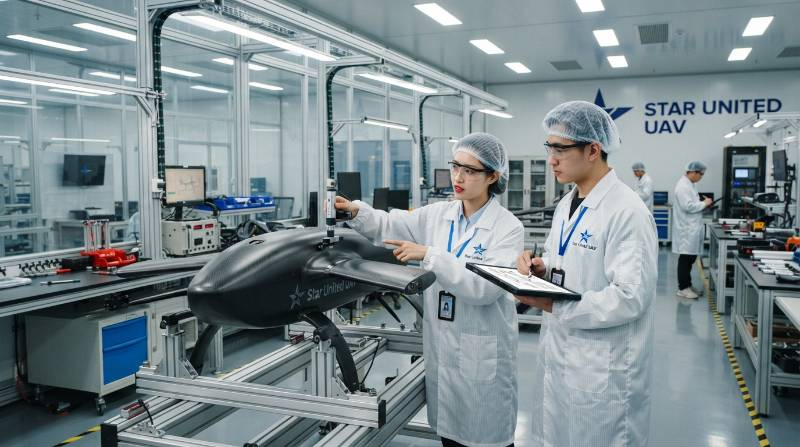
The Star United 4-Dimensional Industrial UAV Contract & Risk Governance Matrix (UAV-CRGM)
To eliminate operational ambiguity and hardware risk, enterprise procurement teams evaluate prospective manufacturing partners using our systematic evaluation architecture: The Star United 4-Dimensional Industrial UAV Contract & Risk Governance Matrix (UAV-CRGM). This framework provides an end-to-end due diligence structure across four mission-critical engineering pillars.Engineering Insight: Contractual risk in custom UAV procurement concentrates heavily at the interfaces: physical payload mounting, software API bus integration, and raw material lineage. Enforcing the UAV-CRGM framework protects enterprise capital prior to mold cutting and assembly line tooling.
| Governance Vector | Primary Contractual Focus | Enforceable Verification Metric | Risk Mitigation Outcome |
|---|---|---|---|
| 1. IP & Architecture Rights | Tooling mold ownership, SDK/API decoupling, Foreground vs. Background IP | Full transfer of CNC/carbon mold titles upon acceptance; open MAVLink/advanced flight control systems API access | Eliminates vendor lock-in; ensures long-term software independence |
| 2. Environmental & ATP | Factory Acceptance Testing (FAT), Level 8 wind tunnel proofing, IP67 testing | Certified dyno curve logs, 20 m/s sustained wind tunnel telemetry, IEC 60529 chamber data | Guarantees full envelope airworthiness under severe field conditions |
| 3. Supply Chain Sovereignty | Dual-use compliance, Bill of Materials (BoM) lineage, component obsolescence | Tier-1 chip-level BoM disclosure, non-ITAR global shipping agility, multi-source sourcing | Guarantees export clearance and shields against component end-of-life bottlenecks |
| 4. Lifecycle SLA & MTBF | Hardware Mean Time Between Failures, 5-year parts retainers, factory remedies | Contractual Flight MTBF ≥ 1,500 hours; guaranteed 48-hour parts dispatch; replacement remedies | Maximizes fleet operational readiness and protects total cost of ownership (TCO) |
Technical & Engineering Capability Verification: Core Contractual Questions
Enterprise buyers must verify that a supplier operates as a true original equipment manufacturer rather than a simple kit assembler. Aggregators often lack the engineering depth to execute structural modifications or debug flight control firmware loops under non-standard payload dynamics. Before executing binding agreements for heavy-lift rotary UAV platforms, procurement contracts must clearly define and verify several core technical parameters:- In-House Composite Fabrication: Does the contract specify structural fabrication using aviation-grade prepreg carbon fiber (Toray 3K/T700) cured via autoclave or high-pressure compression molds, ensuring an elastic modulus ≥ 230 GPa?
- Propulsion Dynamometer Validation: Are motor-ESC-propeller pairings matched and validated on a static dynamometer, guaranteeing a continuous thrust-to-weight ratio ≥ 2.0:1 at maximum takeoff weight (MTOW)?
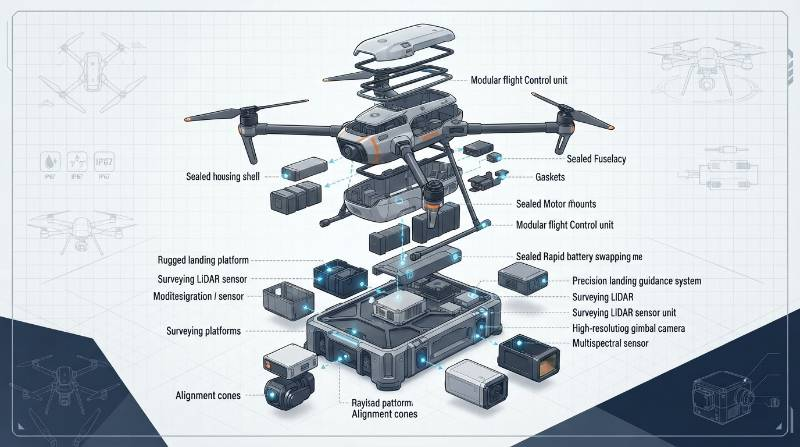
- Payload Interface Modularity: Does the airframe incorporate standard mechanical quick-release rails and unified power/data connections (supporting UART, CAN bus, Ethernet, and SBUS) to interface LiDAR, multispectral, and optical gas imaging (OGI) payloads seamlessly?
Quality Assurance, Testing Standards & Factory Acceptance Testing (FAT)
Quality assurance clauses must transition beyond generic marketing language to reference concrete, globally recognized testing protocols. Incorporating references to standards such as ASTM F38 Committee on UAS Standards and ISO 21384-3 Operational Procedures gives contracts definitive legal and operational authority. A rigorous UAV manufacturing agreement must mandate formal Factory Acceptance Testing (FAT) protocols witnessed by the buyer’s technical representative or verified via digitally signed, unalterable telemetry logs before shipping authorization:- Environmental Ingress Validation: Mandatory compliance testing per IEC 60529 for IP67 ingress protection, subjecting the fully integrated airframe to continuous sand and dust chambers followed by high-pressure continuous water jets.
- MIL-STD-810H Compliance: Verification under Method 501.7 (High Temperature up to +55°C), Method 502.7 (Low Temperature down to -20°C), and Method 514.8 (Vibration Stress Profiles across all operating motor frequencies).
- Full-Load Sustained Wind Aerodynamics: Flight validation in a calibrated wind tunnel proving stable holding position and control authority under sustained crosswinds of 20.0 m/s (Level 8 Gale).
Contractual, Legal & Commercial Due Diligence for Global Drone Procurement
Commercial structures must explicitly account for long development cycles and hardware depreciation. Enterprise procurement teams protect capital by locking in specific legal and financial mechanisms:- Tooling & Mold Title Transfer: If the client funds customized airframe modifications, the contract must explicitly state that physical carbon fiber compression molds and CAD tooling files transfer fully to the buyer upon final payment.
- Milestone-Based Payment Schedules: Funds release tied to tangible milestones (e.g., 30% initial deposit, 30% airframe fabrication and bench dyno sign-off, 30% FAT flight sign-off, and 10% final delivery and site acceptance).
- Liquidated Damages for Schedule Slips: Clear delivery timelines under Incoterms 2020 (such as DDP or FOB) supported by enforceable penalties (e.g., 0.5% per week of delay) for unexcused manufacturing delays.
- 5-Year Component Lifecycle Retainer: A contractual guarantee that critical proprietary components (ESCs, motor windings, power distribution boards) will remain available for purchase for a minimum of 5 years to avoid premature fleet retirement.
Benchmark Selection Scenario: Extreme Offshore Wind Turbine & Sub-Zero Inspection Platforms
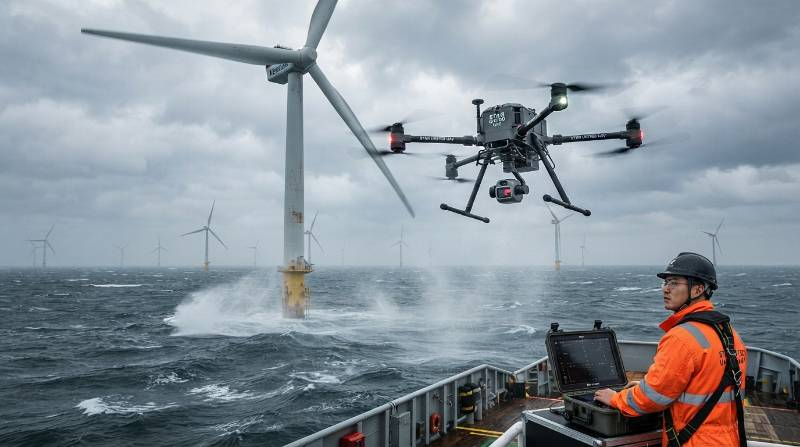
To understand how these contractual criteria translate into physical specifications, consider the demanding operational scenario for enterprise asset managers: Turnkey OEM/ODM Heavy-Payload (15kg–30kg MTOW) Platforms for Offshore Wind Turbine & Sub-Zero Infrastructure Inspection under Sustained Level-8 Gale Winds (20 m/s) and Marine Salt-Mist. For this mission profile, our industrial inspection drone systems establish the standard contract performance baseline:| Engineering Parameter | Contract Performance Specification | Verification & Test Protocol |
|---|---|---|
| Payload Capacity & MTOW | 15.0 kg nominal payload (30.0 kg MTOW structural rating) | Static dyno thrust matching + 120-minute structural stress test |
| Wind Resistance Threshold | 20.0 m/s sustained (Level 8 Gale) with motor reserve thrust ≥ 40% | Calibrated wind tunnel velocity log at maximum pitch deflection |
| Ingress & Corrosion Protection | Dual IP67 sealed avionics bay; marine-grade anti-corrosion conformal coating | IEC 60529 chamber submersion + ASTM B117 salt spray testing |
| Operating Thermal Range | -20°C to +55°C continuous with internal battery BMS heating | MIL-STD-810H climatic thermal chamber cycle testing |
| Propulsion Safety Redundancy | Coaxial Hexacopter / Octocopter configuration with single-rotor fail-safe | In-flight single-motor cut-off test with automatic attitude recovery |
Star United UAV: Enterprise Turnkey OEM/ODM Industrial Airframe Solutions
Star United UAV is a world-class industrial drone and commercial UAV platform OEM/ODM manufacturer, specializing in high-payload, long-endurance, IP67-rated heavy-lift multirotor and VTOL fixed-wing UAV solutions for industrial inspection, mapping, and security. We operate specialized composite molding, CNC machining, and automated propulsion dyno testing facilities built to meet the most exacting aerospace procurement demands. Every platform engineered and manufactured at Star United UAV is fully backed by verified credentials and manufacturing compliance:- ISO 9001:2015 Quality Management Certified: Complete batch traceability from raw prepreg carbon fiber to integrated avionics.
- CE Certification (EMC / LVD / Radio Equipment): Full international electromagnetic and radio frequency regulatory adherence.
- IEC 60529 IP67 Ingress Protection Verified: True all-weather enclosures resistant to high-pressure washing, torrential rain, and sand ingress.
- MIL-STD-810H Environmental Compliance: Thoroughly proven across extreme operational temperatures ranging from -20°C to +55°C.
- Calibrated Aerodynamic Proofing: Fully documented wind tunnel validation up to 20 m/s sustained gale velocities.
Frequently Asked Questions (FAQ)
VTOL vs. Heavy-Lift Multirotor: Which Airframe Should Be Contractually Specified for Long-Range Corridor Inspection?
For linear assets exceeding 50 km per sortie (such as cross-country transmission lines or oil pipelines), a Hybrid VTOL Fixed-Wing platform delivers up to 3× the area coverage per battery cycle due to aerodynamic wing lift. However, when the mission requires stationary hover, close-quarter photogrammetry, vertical tower inspection under turbulent eddy currents, or payloads > 10 kg, a Heavy-Lift Coaxial or Hexacopter Multirotor is contractually superior. Star United UAV custom contracts clearly outline the flight envelope, guaranteeing cruise efficiency for VTOL platforms and millimeter-precise hover stability (±0.1 m RTK accuracy) for multirotor systems.How Can Procurement Teams Verify Genuine IP67 Ingress Protection and Level-8 Wind Resistance Without Relying Solely on Marketing?
Industrial UAV contracts must require the manufacturer to provide third-party laboratory test reports compliant with IEC 60529 (IP67), covering continuous high-pressure water spray and fine-particulate dust penetration tests. For wind resistance, the contract must stipulate calibrated wind tunnel test logs demonstrating motor reserve thrust capacity ≥ 40% while counteracting 20 m/s crosswinds at maximum operational takeoff weight (MTOW). Star United UAV provides factory acceptance test certificates and live dyno telemetry data with every custom enterprise delivery batch.Streamlined 3-Step Action Pathway for Custom UAV Procurement
Eliminate risk from your aerospace supply chain by initiating an engineering-driven OEM/ODM contract process:- Step 1: Submit Operational Conditions & Payload Requirements Define mission range, payload dimensions, operating climate, and target MTOW.
- Step 2: Receive Custom UAV Engineering Blueprint & ATP within 24 Hours Review our detailed airframe 3D envelope, propulsion match calculations, and compliance matrix.
- Step 3: Direct 1-on-1 Aerospace Engineer Consultation & Demo Schedule Finalize contractual IP terms, tooling ownership clauses, and Factory Acceptance Testing criteria.
Ready to Engineer Your Custom Enterprise Fleet?
Partner directly with an aerospace manufacturer that guarantees full IP ownership, Level-8 wind resistance, and verified IP67 airframe durability.
Consult with Star United UAV Aerospace Engineers