
White-Label Drone Manufacturing for Defense & Government
Star United Flight Control (Shaanxi) Technology Co., Ltd.
8 min read·2026-10-14
Overcoming Tier-1 Integration Bottlenecks: Market Realities and Lead Times
White-label drone manufacturing for defense and government suppliers delivers pre-engineered, flight-certified Unmanned Aerial Systems (UAS) platforms that defense integrators brand, configure, and deploy as proprietary mission assets. This turnkey OEM methodology eliminates multi-year engineering cycles, providing instant compliance with defense procurement mandates while maintaining complete control over proprietary mission software and sensor suites. Traditional clean-sheet aerospace engineering routinely traps defense contractors in 14- to 24-month development bottlenecks. Designing structural tooling, resolving aeroelastic resonance, and achieving aerodynamic stability drain capital budgets long before payload deployment. Contract aerial platform fabrication shifts this burden by leveraging mature, factory-tested hardware. Tier-1 integrators bypass autoclave capital expenditures and prototype tooling phases, moving directly to C4ISR operational requirements validation. By sourcing ruggedized heavy-lift rotary UAV platforms through established original equipment manufacturer (OEM) channels, prime contractors convert heavy non-recurring engineering (NRE) costs into predictable unit deliverables.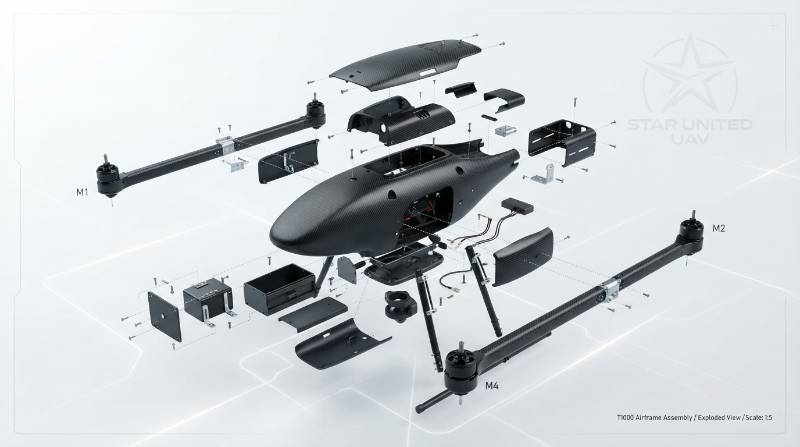
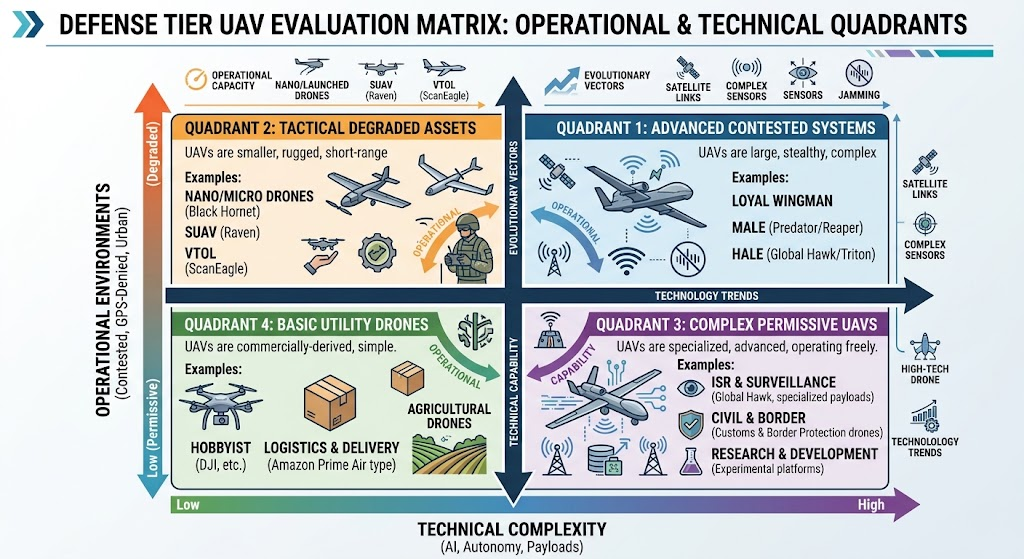
The Defense-Tier UAV Evaluation Matrix (DTUE-4 Matrix)
Evaluating uncrewed platforms for tactical applications demands an empirical framework rather than promotional datasheets. Defense procurement teams require verifiable technical thresholds that guarantee mission survival. We evaluate and manufacture contract airframes according to the Defense-Tier UAV Evaluation Matrix (DTUE-4 Matrix). This framework quantifies airframe reliability across four engineering vectors:- Open Avionics Architecture & Interoperability: Complete isolation between flight dynamics microcontrollers and payload telemetry computers to prevent proprietary lock-in.
- Hardened Environmental Integrity: Ingress protection ratings and structural survivability under severe precipitation, wind shear, and corrosive marine atmospheres.
- Transparent Supply Chain & Traceability: End-to-end component visibility excluding unauthorized silicon, ensuring strict NDAA and international defense compliance.
- Agile Scale & Production Elasticity: Production bandwidth capable of surging from low-rate initial production (LRIP) to mass factory fabrication within compressed fiscal quarters.
| Evaluation Dimension | Commercial Standard | Defense-Tier Specification (DTUE-4) |
|---|---|---|
| Avionics Architecture | Proprietary encrypted bus | Open MAVLink/CAN bus, dual-redundant IMU, isolated mission SDK |
| Ingress Protection | IP43 / IP54 (Splash resistant) | IP67 Hermetic sealing under IEC 60529 standard |
| BOM Traceability | Tier-2 distributor sourcing | 100% lot-tracked components, verified silicon origin, NDAA-compliant |
| Dynamic Wind Limit | 10–12 m/s (Beaufort 6) | ≥ 20 m/s sustained (Beaufort Force 8) with > 25% thrust reserve |
"Aerospace Systems Engineering Rule: True open architecture separates flight control stability from mission computation. If a sensor failure can compromise motor mixing loops, the platform fails defense airworthiness criteria."
Operational Benchmark: Coastal Defense & ISR Under Beaufort Force 8 Conditions
Coastal and maritime installations present the ultimate test of unmanned platform endurance. Salt-fog corrosion, thermal shifts, and sustained gale-force winds degrade commercial drones within hours. Under a benchmark mission profile—24/7 Coastal Border & Critical Infrastructure Defense ISR under Beaufort Force 8 Gale Conditions with 15kg Multi-Sensor Payloads—standard platforms experience catastrophic motor desync or structural failure. Star United UAV engineered the SU-M15 and SU-V20 tactical platforms specifically to survive these operational envelopes. In our CNC production and carbon layup facilities, structural integrity is engineered at the molecular level.Toray High-Modulus T1000 Carbon-Fiber Monocoque
The SU-Series airframes utilize Toray T1000 carbon-fiber composites with high-pressure autoclave consolidation. This eliminates arm deflection under 20 m/s wind shear and maintains torsional stiffness across operational cycles. The monocoque core delivers a mean time between failures (MTBF) exceeding 2,500 flight hours. Vibration harmonics remain isolated below 0.05 g, preserving optical resolution for long-range electro-optical and infrared (EO/IR) sensor payloads during integrated ISR surveillance solutions.Hermetic Ingress and Thermal Protection
Avionics bays are sealed to IP67 standards according to IEC 60529 protocols. Internal heat from high-performance edge computing modules dissipates through thermodynamic conduction plates built directly into the fuselage skin. This design protects mission avionics against heavy downpours, fine sand penetration, and corrosive coastal salt atmospheres. It passes environmental stress testing modeled after MIL-STD-810H Method 509.7 without requiring external cooling vents.Modular Propulsion, Clean-Slate Bays, and Sensor Payload Integration
Defense suppliers require hardware flexibility. A platform dedicated to a single sensor package quickly becomes obsolete as field intelligence requirements evolve. Our OEM manufacturing lines incorporate a clean-slate payload bay engineered with standardized mechanical rails and pre-routed power feeds. Integrators mount dual-sensor EO/IR gimbals, synthetic aperture radar (SAR), or hyperspectral LiDAR in under 15 minutes.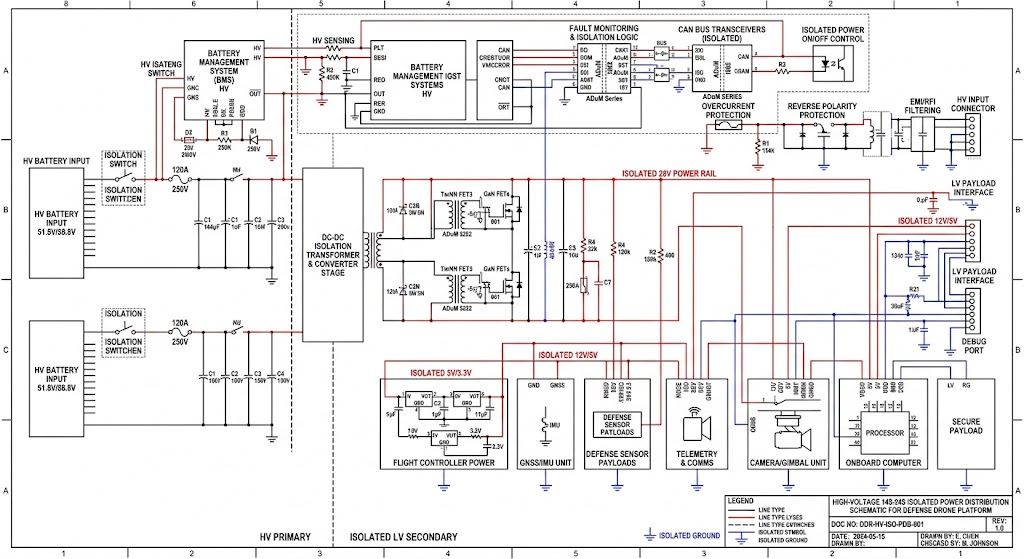
High-Voltage Redundant Propulsion Architecture
Payload capacity is governed by electrical efficiency and thermal margins. Star United UAV utilizes high-voltage 14S and 24S distributed power rails paired with Field-Oriented Control (FOC) Electronic Speed Controllers (ESCs). Key propulsion and electrical specifications include:- Thrust-to-Weight Ratio: 2.8:1 at maximum 15 kg payload weight, preserving dynamic climb authority during sudden downbursts.
- Station-Keeping Precision: ±0.1 m hover accuracy maintained under 18–20 m/s gale gusts using dual RTK GPS modules.
- Isolated Power Conditioning: Dedicated step-down regulators providing continuous, ripple-free 12V, 24V, and 48V lines (≤ 25 mV ripple) to prevent RF cross-talk with onboard radars.
- Propulsion Redundancy: Coaxial motor geometries deliver automated fault tolerance, allowing continuous controlled descent if a motor loses a phase.
Airframe Architecture: VTOL Fixed-Wing vs. Heavy-Lift Multirotor Deployments
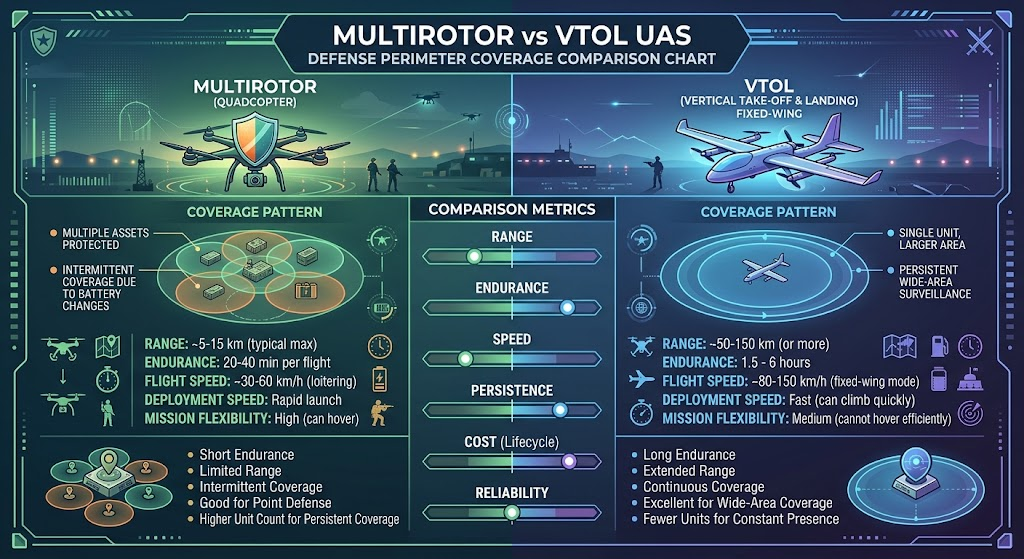
Choosing between rotary platforms and fixed-wing configurations represents a primary trade-off in defense surveillance procurement. Each architecture addresses distinct tactical mission envelopes. Heavy-lift multirotors excel at static observation, urban reconnaissance, and confined perimeter defense. They launch without mechanical ground support, hold stationary hover over targets, and handle heavy sensor payloads up to 20 kg with low structural fatigue. Conversely, tactical VTOL fixed-wing drones provide wide-area linear corridor monitoring. Combining vertical takeoff capability with aerodynamic wing-borne cruise, these platforms support border surveillance missions spanning hundreds of kilometers.| Tactical Parameter | Heavy-Lift Multirotor (e.g., SU-M15) | Hybrid VTOL Fixed-Wing (e.g., SU-V20) |
|---|---|---|
| Primary Mission Role | Stationary surveillance, point target tracking | Extended border patrol, corridor mapping |
| Operational Radius | 15 – 30 km line-of-sight | 100 – 250 km operational range |
| Flight Endurance | 45 – 75 minutes (payload dependent) | 180 – 360 minutes cruise |
| Maximum Useful Payload | Up to 20 kg | 5 – 10 kg |
| Lifecycle Maintenance Cost | Baseline (Low mechanical complexity) | +35% to +45% (Aileron servos, tilt mechanisms) |
Production Elasticity, MIL-STD Quality Assurances, and OEM Branding
Contract manufacturing for defense tiers requires certified production consistency. Every carbon laminate, motor winding, and solder joint must meet strict aerospace quality standards. Star United UAV operates under an audited ISO 9001:2015 Quality Management System. Every batch of pre-preg carbon fiber undergoes ultrasonic non-destructive testing (NDT) to prevent delamination under high G-load maneuvers.Private-Label Integration and Secure Telemetry
Government suppliers maintain ownership of customer-facing interfaces. Our white-label program delivers turnkey hardware enclosures ready for proprietary silk-screening, custom chassis paint finishes, and custom firmware bootloaders. On the ground, platforms interface smoothly with customized, advanced ground control systems. We supply unbranded telemetry APIs, encrypted COFDM video links, and frequency-hopping transceivers configured to client-specified AES-256 standards. All airframes ship with dual-use compliant commercial export documentation. This enables defense and security tier-suppliers to integrate platforms across global borders without regulatory delays or supply chain gaps.Frequently Asked Questions: Defense White-Label Drone Procurement
VTOL Fixed-Wing vs. Heavy-Lift Multirotor: Which white-label platform is more cost-effective for defense and government perimeter security?
VTOL Fixed-Wing platforms offer superior linear coverage (100–250 km mission radii) and cruise efficiency for expansive corridors, but incur higher mechanical complexity and payload geometric limitations. Heavy-Lift Multirotors (such as the Star United UAV SU-M15) provide tactical versatility within a 15–30 km radius. They can hover over high-threat chokepoints, carry dual-sensor payloads up to 20 kg, launch without runways or catapults, and reduce fleet maintenance costs by up to 42%. For fixed installations, border checkpoints, and quick-reaction tactical ISR, heavy-lift multirotors yield the highest operational return on investment.How can defense integrators physically verify authentic IP67 ingress protection and Beaufort Force 8 wind resistance without relying on vendor marketing claims?
Defense integrators should demand three empirical verification artifacts before executing a supply contract:- Calibrated Airflow Wind-Tunnel Test Logs: Verifying motor RPM telemetry, throttle reserve margins (> 25% at peak gust), and gimbal IMU angular jitter (< 0.02°) under continuous 20 m/s laminar wind.
- Continuous Hydrostatic Submersion Reports: Testing the sealed fuselage immersed under 1 meter of water for 30 minutes (IEC 60529 standard), followed by dielectric insulation and internal humidity telemetry analysis.
- Thermal Chamber and Salt-Fog Exposure Cycles: Independent testing adhering to MIL-STD-810H Method 509.7, proving zero mechanical delamination, bearing degradation, or galvanic corrosion across 96 hours of continuous 5% salt-fog exposure.
How does Star United UAV address NDAA compliance and supply chain origin requirements?
We maintain full Bill of Materials (BOM) transparency. Platforms can be provisioned with NDAA-compliant flight computers, non-restricted microcontrollers, and western-manufactured RF datalinks to satisfy federal procurement guidelines.Initiate Your OEM Airframe Program: 3-Step Rapid Onboarding Pathway
Accelerating your timeline from proposal submission to operational flight demonstration follows a transparent three-step integration process: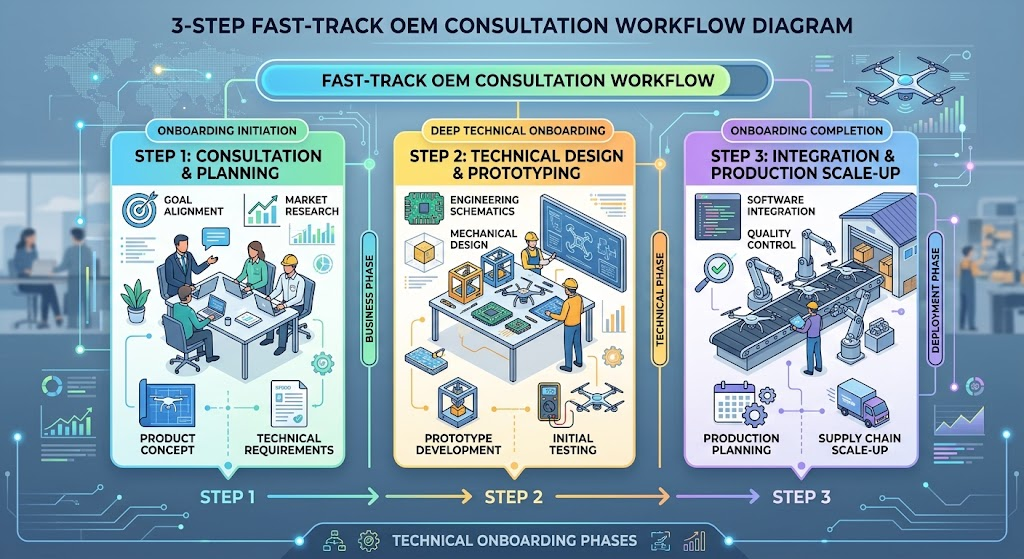
- Step 1: Submit Operational Scope & Payload Specifications: Provide your mission requirements, including payload mass, operational environment, endurance targets, and preferred avionics architecture.
- Step 2: Receive Custom White-Label Blueprint within 24 Hours: Our engineering team delivers a platform blueprint featuring exact CAD integration envelopes, power-budget models, motor thrust margin analysis, and volume OEM pricing tiers.
- Step 3: Systems Flight Engineer Consultation & Live Flight Demonstration: Engage directly with a Senior Aerospace Systems Architect to evaluate real-time telemetry and schedule live stress-flight teleoperation under wind-simulated loads.
Accelerate Your Defense UAS Program Today
Eliminate tooling lead times and deliver mission-certified, private-label UAV systems under your own brand.
Consult with a Systems Engineer