
Long-Endurance VTOL UAV Buyer's Guide: Enterprise Specs
Star United Flight Control (Shaanxi) Technology Co., Ltd.
8 min read·2026-09-06
VTOL Architectural Comparison: Quad-Plane vs. Tilt-Rotor Systems
A long-endurance VTOL (Vertical Take-Off and Landing) fixed-wing UAV uses dedicated lift motors or tilting mechanisms to launch vertically without runways, transitioning into forward aerodynamic flight via an aerofoil wing profile. For enterprise operations requiring 100+ km linear coverage or continuous 2 to 8-hour flight times, these platforms reduce site setup footprint while providing 400% greater area coverage per hour than conventional multirotors. Selecting the optimal airframe architecture is the foundational decision in commercial UAV procurement. Industrial airframes primarily divide into Quad-Plane (Separate Lift and Thrust - SLT) and Tilt-Rotor configurations.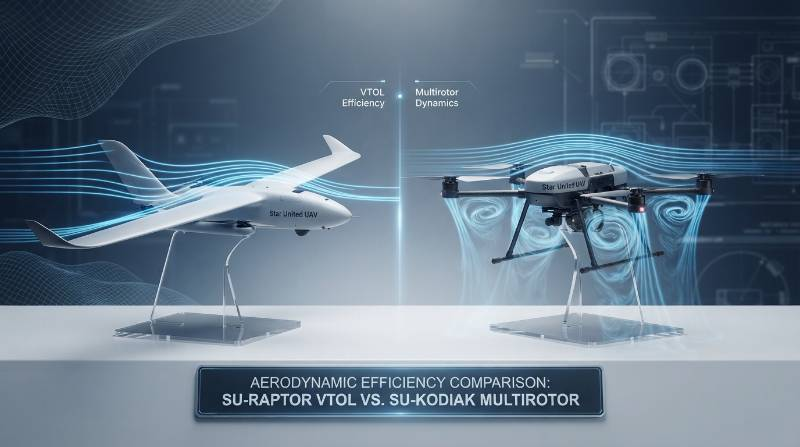
Quad-Plane (SLT) Configuration
Quad-Plane designs isolate vertical lift and forward thrust mechanisms. Four dedicated vertical lift motors operate exclusively during takeoff, hovering, and landing phases, while one or two forward push/pull motors sustain cruise flight.- Mechanical Simplicity: No complex servomotors or tilt-bearing linkages, resulting in an operational Mean Time Between Failures (MTBF) exceeding 800 flight hours.
- Parasitic Drag Penalty: Idle vertical boom arms and stationary carbon-fiber propellers create an estimated 12% to 18% increase in overall aerodynamic drag during cruise.
- Failsafe Hover Authority: Direct motor cutouts during transition can immediately trigger a multirotor hover mode if an aerodynamic stall is detected.
Tilt-Rotor and Tilt-Wing Architectures
Tilt-Rotor platforms rotate their thrust vectoring nacelles forward after vertical climb, utilizing the same motors for both hover and horizontal cruise.- Aerodynamic Cleanliness: Zero parasitic drag from idle vertical motors allows higher lift-to-drag (L/D) ratios, often reaching 16:1 to 20:1.
- Mechanical Failure Points: Heavy cyclic strain on transition gearboxes and servo linkages requires airframe structural overhauls at roughly 250 to 350-hour intervals.
- Transition Envelope Vulnerability: Crosswinds during nacelle tilt-over introduce turbulent airflow separation across the wing chord, requiring advanced flight control compensation.
| Metric | Quad-Plane (SLT) | Tilt-Rotor Architecture |
|---|---|---|
| Cruise Lift-to-Drag (L/D) | 11:1 – 14:1 | 16:1 – 20:1 |
| Mechanical Complexity | Low (Fixed Boom Geometry) | High (Actuated Nacelles/Gears) |
| Airframe MTBF | > 800 Hours | 250 – 400 Hours |
| Max Crosswind (Transition) | 14 m/s (27 knots) | 9.5 m/s (18.5 knots) |
Engineering Benchmark: In wind tunnel evaluations per ASTM F3298-19 standards, Quad-Plane airframes maintain pitch and roll stability within ±1.5 degrees during high-turbulent transition phases, while tilt-rotor configurations require up to 40% more control loop bandwidth to counter aerodynamic vortex shedding.
Propulsion & Endurance: Pure Electric vs. EFI Gas-Electric Hybrid
Endurance determines operational radius and survey productivity. The trade-off between pure battery electric systems and Electronic Fuel Injection (EFI) hybrid powertrains dictates maintenance logistics, acoustic signature, and mission duration. When selecting industrial enterprise drones, matching power storage technology to payload weight is essential to prevent operational shortfalls.
Pure Electric (Solid-State / High-Density Li-Ion)
Modern industrial electric platforms leverage custom lithium-ion battery packs achieving specific energy densities between 260 and 310 Wh/kg.- Endurance Range: 90 to 180 minutes under typical payload configurations (1.5 kg to 3 kg).
- Acoustic Footprint: Below 52 dBA at 100 meters altitude, suitable for discreet inspection and urban perimeter monitoring.
- Operational Readiness: Zero field engine tuning, hot-swap battery enclosures, and minimal mechanical servicing.
EFI Gas-Electric Hybrid Powertrains
Hybrid powertrains integrate a two-stroke or four-stroke internal combustion engine driving an onboard DC generator, directly powering the cruise motor and charging a buffer battery for vertical transitions.- Energy Density Advantage: Standard 95-octane unleaded fuel yields effective specific energy exceeding 1,800 Wh/kg after combustion losses.
- Heavy Payload Flight Duration: Continuous flight durations of 6 to 10 hours with 5 kg+ multi-sensor payloads.
- Cold Weather Tolerance: Waste heat from the engine cylinder head warms internal avionics bays, ensuring dependable operation down to -20°C without battery pre-heating degradation.
Modular Sensor Integration: Payloads, Pin-Outs, and Gimbal Interfaces
Long-endurance airframes must accommodate evolving sensor technologies without structural overhauls. Industrial operations require standardized electromechanical quick-release mechanisms that route power, serial control, and high-bandwidth video simultaneously. Deploying specialized high-precision mapping drones demands hardware-level synchronization between the camera shutter trigger and the onboard RTK/PPK GNSS positioning engine.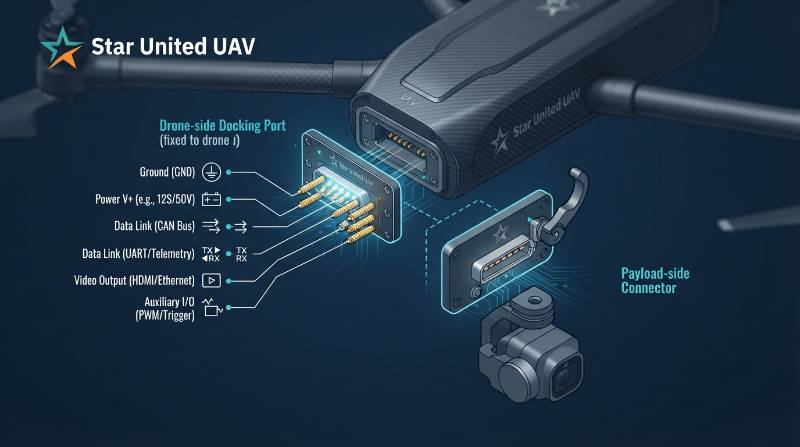
Primary Commercial Payload Classes
- High-Resolution Photogrammetry: 61MP full-frame sensors with calibrated metric lenses and mechanical leaf shutters, eliminating rolling shutter distortion during high-speed 22 m/s cruise mapping.
- Multi-Return Airborne LiDAR: High-frequency laser scanners emitting 240,000 to 2,000,000 pulses per second, integrated with tactical-grade Fiber Optic Gyro (FOG) IMUs for dense canopy penetration.
- Dual/Triple Sensor Tactical Gimbals: Continuous 360° pan-tilt gimbals featuring a 4K 30x optical zoom visible sensor, an uncooled 640x512 radiometric thermal camera (LWIR), and an eye-safe laser rangefinder (LRF) rated up to 3,000 meters.
| Payload Type | Nominal Weight | Required Hardware Interface | Data Throughput |
|---|---|---|---|
| 61MP Metric RGB | 680 g – 950 g | USB-C / Hot-shoe Sync / UART | ~350 MB/s (Direct NVMe) |
| Triple EO/IR + LRF Gimbal | 1,200 g – 1,850 g | Ethernet (RTSP) / CAN / HD-SDI | 15 – 30 Mbps Stream |
| High-Pulse Survey LiDAR | 2,200 g – 4,500 g | PPS Pulse / RS232 / Gigabit LAN | ~1.2 GB/min Binary File |
Avionics, Datalinks, and BVLOS Airworthiness Protocols
Beyond Visual Line of Sight (BVLOS) operations demand high levels of avionics redundancy and link integrity. Flight safety systems must autonomously mitigate sensor drift, motor cutouts, and RF jamming without ground crew intervention. Deploying advanced flight control systems ensures real-time sensor fusion across triple-redundant, temperature-controlled IMUs and dual barometers.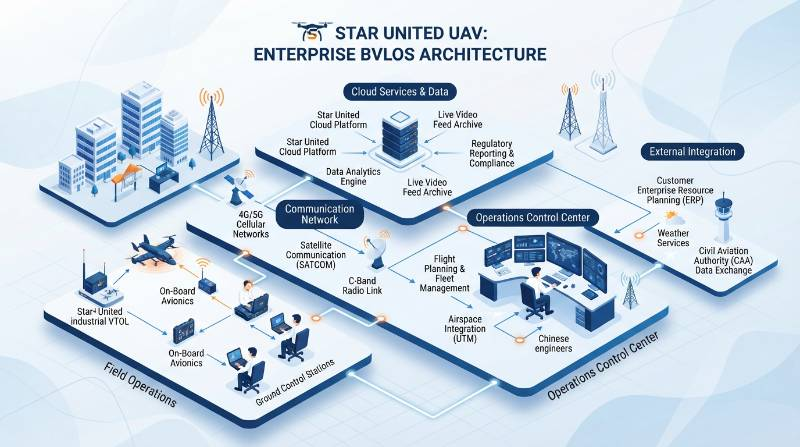
Encrypted Command and Control (C2) Datalinks
Industrial BVLOS flights rely on hybrid communications architectures configured for automatic link-switching:- Primary Point-to-Point COFDM Link: 1.4 GHz / 2.4 GHz frequency-hopping spread spectrum (FHSS) links providing real-time HD video and C2 control up to 50 km in clean RF corridors.
- Secondary Cellular (4G/5G Private APN): Ultra-low latency telemetry through cellular networks, bypassing terrain-masking obstacles along utility lines.
- Tertiary Satcom (Iridium/Inmarsat): Narrowband satellite transceivers transmitting emergency waypoint commands, GPS telemetry, and status pings globally.
Failsafe and Compliance Standards
To secure operational waivers under EASA Specific Category SORA and FAA Part 107 rules, platforms must integrate passive and active emergency mechanisms.- Ballistic Parachute System: Pyrotechnic or CO2-actuated parachute deployment triggered automatically in <150 milliseconds upon structural or total motor failure.
- Geofencing & Lost-C2 Protocols: Deterministic Return-to-Home (RTH) pathways that adhere to terrain-avoidance algorithms and pre-programmed safe loiter altitudes.
- ADS-B In/Out & Remote ID: Dynamic broadcast identification and real-time civil airspace deconfliction displaying nearby manned aircraft on the Ground Control Station (GCS).
Industrial Deployment Scenarios and ROI Analysis
Long-endurance VTOL aircraft replace manned rotary platforms and slow multirotors across high-value enterprise inspection corridors. Lower operating costs per flight hour combined with rapid mobilization make VTOL platforms cost-efficient for industrial asset managers. For large-scale utility infrastructure, deploying corridor and utility inspection solutions cuts acquisition costs per mile by up to 65% compared to manned helicopter hire.Commercial Use Cases
- Linear Energy Corridors: Surveying 150+ km of oil and gas pipelines or electrical transmission grids in a single 3-hour flight, detecting right-of-way encroachments and vegetation threats.
- Border Patrol and Base Defense: Utilizing perimeter security and patrol drone systems for continuous 6-hour thermal perimeter tracking, automated target following, and intrusion vector calculation.
- Large-Scale Topographic Surveying: Mapping 3,000+ hectares daily at 2.5 cm Ground Sampling Distance (GSD) using integrated PPK modules for geodetic accuracy.
| Platform Type | Daily Linear Coverage | Cost per Km ($USD) | Runway Required |
|---|---|---|---|
| Industrial Multirotor | 25 – 40 km | $45 – $65 | No (VTOL) |
| Runway Fixed-Wing | 180 – 250 km | $22 – $35 | Yes (100m+ Strip / Catapult) |
| Hybrid VTOL Fixed-Wing | 250 – 400 km | $12 – $18 | No (VTOL) |
The Star United UAV STEP-V Fleet Procurement Framework
To streamline enterprise UAV acquisition, our flight operations engineers developed the STEP-V Framework (Scope, Terrain, Energy, Protocols, Value). This evaluation model helps procurement teams objectively compare airframes against operational goals.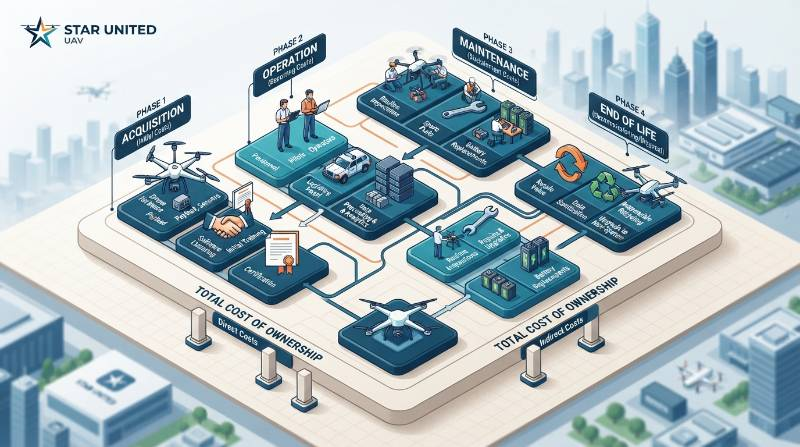
The 5 Stages of STEP-V
- 1. Scope & GSD Targets: Define minimum acceptable spatial resolution (Ground Sampling Distance), sensor weight, and daily flight distances before selecting MTOW classifications.
- 2. Terrain & Environmental Envelope: Evaluate field density altitude, operating temperature ranges (-20°C to +50°C), and sustained Level 7 wind resistance (15 to 17 m/s).
- 3. Energy & Powertrain Matching: Choose between zero-emission, quick-turnaround electric batteries (<180 min) or EFI hybrid powertrains (6-8 hours) based on field fuel availability.
- 4. Protocols & Redundancy: Verify triple-redundant IMUs, encrypted datalinks with manual override channels, and independent ballistic parachute systems for BVLOS waivers.
- 5. Value & 3-Year TCO: Calculate true life-cycle costs including replacement batteries, fuel logistics, scheduled airframe overhaul intervals (500-hour cycles), and manufacturer technical support.
Standardization Rule: Per ISO 21384-3 Unmanned Aircraft Operational Procedures, enterprise fleet managers should standardize ground control software, payload bays, and battery charging infrastructure across all airframes to lower training overhead and minimize field errors.
Frequently Asked Questions (VTOL UAV Buyer's Guide)
What are the maximum wind limits for VTOL transition phases?
Most commercial Quad-Plane VTOL platforms safely complete vertical-to-horizontal transitions in sustained winds up to 14 m/s (27 knots) and wind gusts up to 17 m/s. Tilt-rotor designs typically restrict transitions to under 10 m/s due to crosswind vortex turbulence across the tilting wings.What maintenance is required for hybrid gas-electric UAV engines?
EFI hybrid combustion generators require routine spark plug checks and fuel filter replacements every 50 flight hours. Comprehensive cylinder inspections, piston de-carbonization, and generator bearing replacements occur at standard 200 to 300-hour overhaul intervals.How do encrypted datalinks protect BVLOS flight security?
Enterprise long-range datalinks utilize AES-128 or AES-256 bit encryption on both the control uplink and payload video downlink. This prevents unauthorized command injection, signal hijacking, and data interception during critical infrastructure and defense surveillance missions.Can long-endurance VTOL aircraft land safely if a lift motor fails?
If a vertical lift motor fails during hover in a quad-plane layout, the flight controller executes an asymmetric power recovery or deploys the ballistic parachute. If failure occurs during fixed-wing forward cruise, the aircraft can continue flight and glide toward an open, flat landing surface.Upgrade Your Enterprise Fleet with Star United UAV
Explore our field-proven long-endurance electric and hybrid VTOL fixed-wing platforms engineered for high-precision mapping, corridor inspection, and BVLOS defense missions.
Request a Technical Consultation