
30kg VTOL UAV Selection: Complete Enterprise Guide
Star United Flight Control (Shaanxi) Technology Co., Ltd.
9 min read·2026-09-09
Deconstructing the 30kg Class: 30kg MTOW vs. 30kg Payload Capacity
Selecting a 30kg VTOL UAV requires distinguishing between Maximum Takeoff Weight (MTOW) and useful payload capability. A platform rated at 30kg MTOW typically carries between 4kg and 8kg of net sensor equipment, whereas a platform designed to carry a 30kg payload operates within an entirely different 70kg to 100kg MTOW envelope. Misinterpreting this distinction results in compromised range calculations, airframe overloading, and structural failure.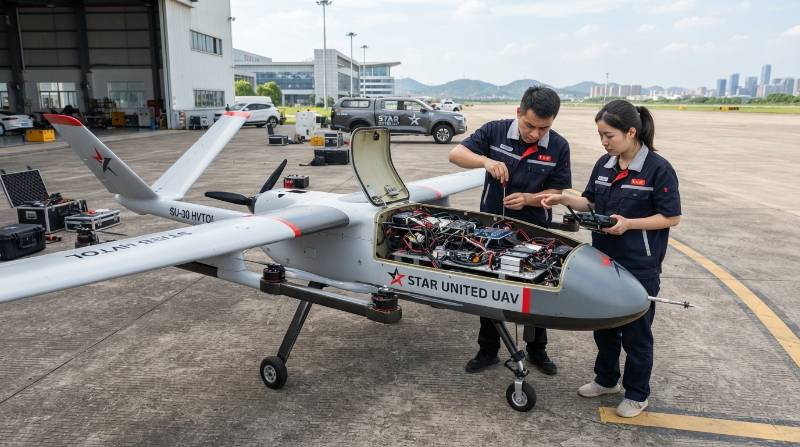
Empty Airframe & Mechanical Systems: 12kg to 14kg (40–46% MTOW) Energy Storage (Fuel or Batteries): 8kg to 10kg (27–33% MTOW) Avionics, Datalinks & Wiring Harnesses: 2kg to 3kg (7–10% MTOW) Maximum Usable Payload: 5kg to 7kg (17–23% MTOW)Fleet operators migrating from multirotors must evaluate airframe structural limits under operational load factors. When reviewing industrial VTOL drones, confirm whether technical datasheets define dry airframe mass, Maximum Takeoff Weight (MTOW), or payload capacity. Operating beyond the structural envelope compromises stability margins during hover transitions and accelerates composite fatigue.
Aerodynamic Architecture: Quad-Plane vs. Tilt-Rotor Configuration
Selecting a 30kg VTOL airframe involves choosing between lift-and-cruise (Quad-Plane) configurations and mechanical tilt-rotor systems. Each architecture introduces trade-offs in aerodynamic efficiency, mechanical complexity, and field maintenance.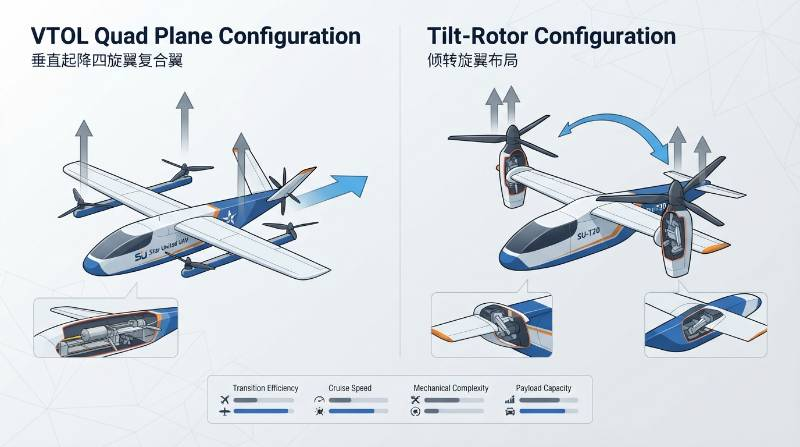
| Evaluation Parameter | Lift-and-Cruise (Quad-Plane) | Mechanical Tilt-Rotor |
|---|---|---|
| Mechanical Complexity | Low (Fixed motor mounts, independent actuators) | High (Servo-driven tilt mechanisms, synchronized pivots) |
| Aerodynamic Cruise Drag | Higher (Parasitic rotor/boom drag) | Lower (Clean wing surface, streamlined profile) |
| Hover Transition Risk | Low (Continuous vertical thrust authority) | High (Dynamic center-of-thrust shifts during tilt) |
| Field Repairability | Modular arm replacement; low maintenance | Complex calibration; requires clean-room servo overhaul |
| Wind Gust Tolerance (Hover) | Up to 15 m/s (Level 7) | Up to 12 m/s (Sensitive to cross-axis tilt turbulence) |
Propulsion Architecture: Pure Electric vs. EFI Gas-Electric Hybrid
Powertrain selection dictates operational range, flight endurance, mission turnaround time, and cold-weather performance. Pure lithium-polymer (LiPo) or solid-state batteries offer zero localized emissions and low noise, but are constrained by specific energy limits (typically 240–280 Wh/kg at pack level). Electronic Fuel Injection (EFI) gas-electric hybrid powertrains use a small internal combustion engine coupled to a generator, supplying steady DC power to the cruise motor while charging a dynamic buffer battery for high-draw VTOL transitions. High-grade avgas or standard gasoline provides specific energy values exceeding 8,500 Wh/kg, significantly outperforming chemical batteries over long missions.Engineering Insight: In field testing per ASTM F38 Committee Standards, pure electric 30kg VTOL systems average 90 to 120 minutes of flight time with a 3kg payload. Under identical environmental conditions (25°C, sea level, 20 m/s cruise), an EFI gas-electric hybrid 30kg airframe delivers 360 to 480 minutes (6 to 8 hours) of sustained flight.Pure electric platforms suit localized survey missions within visual line of sight (VLOS) or short-range automated loops where rapid battery swapping is viable. For Beyond Visual Line of Sight (BVLOS) operations, pipeline monitoring, and border patrol, EFI hybrid propulsion provides the endurance required to cover several hundred linear kilometers per sortie.
Payload-to-Endurance Degradation Curves
Endurance decreases non-linearly as payload mass increases. Added weight raises the required lift coefficient, increasing induced drag during cruise and demanding higher hover motor current draw during vertical flight phases.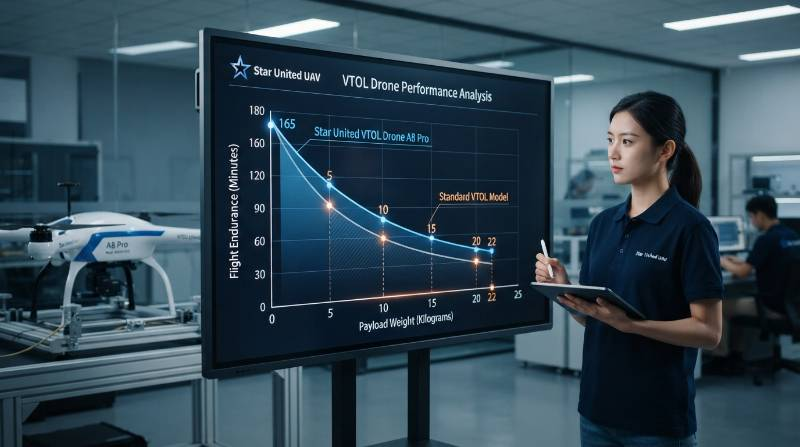
- 1.0 kg Payload (Miniature EO/IR Turret): 480 minutes (8.0 hours) endurance; ~600 km total distance.
- 3.0 kg Payload (Full-Frame Photogrammetry + Oblique Unit): 390 minutes (6.5 hours) endurance; ~485 km total distance.
- 5.0 kg Payload (Long-Range High-Density LiDAR + Dual IMU): 270 minutes (4.5 hours) endurance; ~340 km total distance.
- 7.0 kg Payload (Multi-Sensor Pod: EO/IR + LiDAR + Searchlight): 180 minutes (3.0 hours) endurance; ~225 km total distance.
Avionics Redundancy & BVLOS Airworthiness Standards
BVLOS operations require fail-operational avionics architectures that prevent catastrophic loss in the event of hardware or sensor failure. Industrial UAVs operating in controlled or remote airspace must adhere to strict airworthiness guidelines aligned with EASA Specific Operations Risk Assessment (SORA) and FAA Part 108 airworthiness frameworks.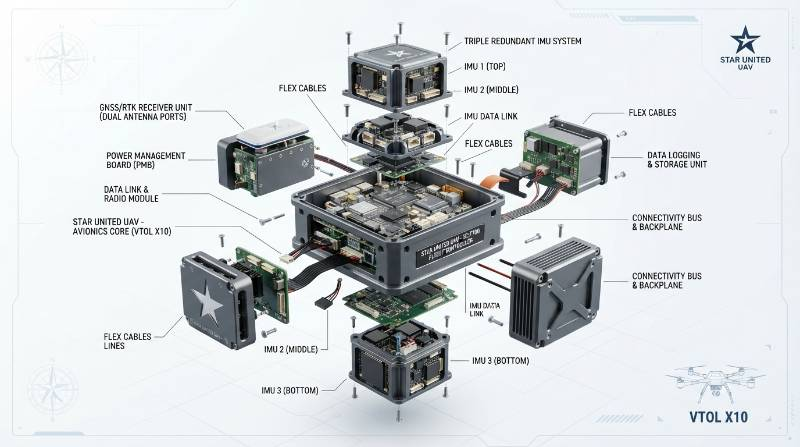
- Triple-Redundant Flight Controllers: Three independent internal measurement units (IMUs) with isolated sensor buses, voting logic, and temperature-controlled damping chambers.
- Dual-Antenna Differential GNSS / RTK / PPK: High-precision heading calculations that remain unaffected by localized electromagnetic interference from on-board generators or high-voltage power lines.
- Airspace Awareness Transponders: Integrated ADS-B In/Out transceivers to track nearby crewed aircraft and execute automated avoidance maneuvers.
- Diverse Datalinks: Dual-band RF tactical datalinks (e.g., 800MHz / 1.4GHz) paired with failover 4G/5G cellular modules and optional satellite communication (SATCOM) links.
- Autonomous Fail-Safe Logic: Programmable Return-to-Home (RTH) protocols triggered by link loss, fuel depletion, engine health anomalies, or actuator malfunctions.
Modular Sensor Integration: LiDAR, Photogrammetry, and Dual-Sensor EO/IR
A multi-mission 30kg VTOL platform relies on a modular payload bay that supports quick, field-swappable sensor changes. This versatility allows the same airframe to perform high-resolution topographic surveys in the morning and switch to thermal corridor surveillance at night. Payload integration requires careful management across three physical domains:- Mechanical Rigidity and Vibration Isolation: High-resolution LiDAR units (such as Riegl, Hesai, or Livox) require tuned silicone or wire-rope isolation dampers. High-frequency vibrations from pusher engines can degrade point-cloud accuracy and distort photogrammetric datasets.
- Regulated Clean Power Delivery: High-end surveillance gimbals and LiDAR sensors require isolated DC-DC conversion steps (12V/24V/28V rails) to protect sensitive optics from voltage ripple generated by onboard starter-generators.
- High-Speed Sensor Synchronization: High-precision aerial mapping UAVs use hardware PPS (Pulse Per Second) signals to sync camera shutter triggers and LiDAR pulses with the RTK/GNSS positioning engine to the sub-millisecond level.
Core Enterprise Use Cases for 30kg VTOL UAV Systems
The 30kg VTOL UAV class offers an effective balance of payload capacity and endurance, making it a standard choice across several commercial and industrial sectors.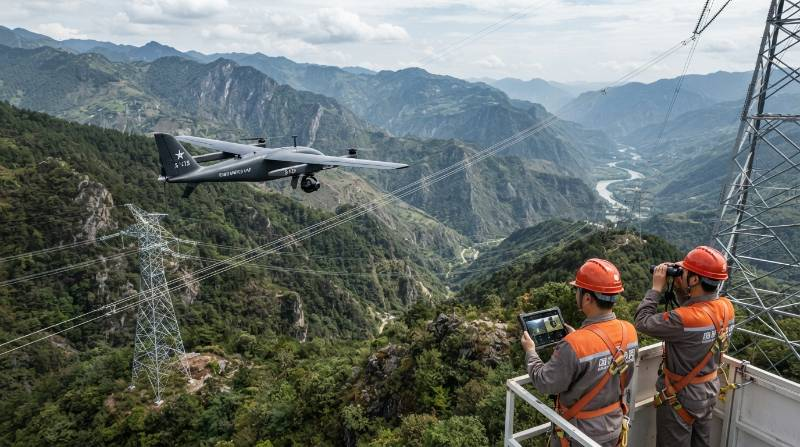
- Linear Infrastructure Corridor Inspection: Inspecting high-voltage power transmission lines, oil pipelines, and rail networks. Gas-hybrid 30kg platforms can map over 200 kilometers of corridor per flight, capturing thermal and visible-light imagery in a single run. Learn more about infrastructure corridor inspection workflows.
- Large-Scale Topographic & Mining Surveys: Mapping vast agricultural areas, open-pit mines, or forestry zones exceeding 5,000 hectares per mission day using heavy, multi-return LiDAR and full-frame oblique cameras.
- Perimeter Defense & Tactical Border Patrol: Operating continuously along maritime coasts or international borders. Outfitted with optical/thermal gyrostabilized turrets and AI-powered edge tracking, these systems monitor critical areas effectively. Learn more about our perimeter security and patrol drones.
The Star United V-TCO Framework: Evaluating Lifecycle Costs and Maintenance
Evaluating long-range UAV platforms solely on initial acquisition cost overlooks lifecycle operating expenses. Star United UAV uses the Star United V-TCO Framework (Vehicle Total Cost of Ownership) to help enterprise fleets evaluate the real-world costs of operating 30kg VTOL systems over a 1,500-flight-hour or 3-year operational window.V-TCO Equation: Total Cost of Ownership = CapEx (Airframe + Sensors) + OpEx (Fuel/Power + Overhaul Costs + Battery Depreciation + Training & SORA Compliance)
| Cost Variable | Pure Electric Platform | EFI Gas-Electric Hybrid Platform |
|---|---|---|
| Energy Source / Fuel Over 1,500 Hours | $1,200 (Electricity costs) | $4,800 (Avgas / 98 Octane Fuel) |
| Battery Pack Replacement Cycles | $24,000 (12 pack sets @ 300 cycles) | $3,200 (2 buffer battery sets) |
| Engine Overhauls / Motor Servicing | $2,500 (Bearing replacements & checks) | $8,500 (5 overhauls @ 300-hr intervals) |
| Sortie Count to Cover 10,000 km | ~110 sorties (Due to shorter range) | ~25 sorties (Long-endurance profiles) |
| Field Labor & Mobilization Expenses | Higher (More frequent battery swaps & moves) | Lower (Covers large areas per takeoff location) |
Star United UAV 30kg VTOL Solutions vs. Global Market Competitors
Star United UAV designs and builds industrial-grade VTOL fixed-wing platforms engineered to meet stringent reliability requirements. Our airframes are manufactured using high-pressure autoclaved carbon-fiber composites, ensuring high structural rigidity while minimizing empty weight. Key advantages of the Star United UAV 30kg VTOL platform include:- Modular Payload Architecture: Swappable nose and belly bays engineered to balance center of gravity automatically across diverse mapping, LiDAR, and security payloads.
- Advanced EFI Hybrid Integration: Custom ECU calibration for high-altitude starts (up to 4,000m AMSL) with real-time fuel consumption telemetry.
- Industrial Build Quality: Manufactured to ISO 9001 quality standards and tested against ASTM airworthiness parameters.
- Comprehensive OEM/ODM Engineering Support: Direct access to airframe and avionics engineers for payload integration, custom datalinks, and specialized software workflows.
Frequently Asked Questions (FAQ) on 30kg VTOL UAV Selection
What are the real-world wind limits for a 30kg VTOL UAV during transition?
Quality 30kg VTOL platforms handle continuous winds up to 12 m/s (23 knots) and wind gusts up to 15 m/s (29 knots) during hover and wing-transition phases. In forward cruise mode, fixed-wing aerodynamics handle crosswinds up to 18 m/s without significant loss of track accuracy.What avionics redundancy is required to secure BVLOS flight authorization?
Civil aviation authorities (such as the FAA, EASA, and CAA) generally require triple-redundant autopilot processors and IMUs, dual GPS/GNSS sources, ADS-B In situational awareness receivers, independent C2 datalink loss fail-safes, and geofencing systems that satisfy SORA SAIL III/IV safety levels.Can one technician swap payloads in the field without re-tuning flight control gains?
Yes. When using a well-engineered quick-release modular mounting system, payload swaps take under 5 minutes. As long as the payload center of gravity (CG) aligns within the airframe’s designated 15mm tolerance envelope, the flight controller does not require re-tuning.When should an operator choose pure electric over an EFI hybrid powertrain?
Pure electric is well-suited for missions under 90 minutes, flights near populated centers where low noise is essential, and organizations operating in jurisdictions with strict emissions policies. For longer missions requiring 3 to 8 hours of continuous flight, EFI hybrid platforms remain the practical industry choice.Equip Your Fleet with Star United UAV Industrial Platforms
Contact our technical sales team for comprehensive technical specifications, custom sensor payload matching, and direct factory pricing.
Request a Platform Consultation