
150kg VTOL UAV Mission Planning: The Enterprise Guide
Star United Flight Control (Shaanxi) Technology Co., Ltd.
8 min read·2026-09-10
Core Engineering Realities of 150kg Class VTOL Platforms
Mission planning for a 150kg Maximum Takeoff Weight (MTOW) vertical take-off and landing unmanned aircraft requires a fundamental shift from standard commercial drone workflows. At 150kg, the platform exhibits significant kinematic inertia, extended aerodynamic transition windows, and complex split-phase power curves that demand strict deterministic routing. Reliable operations require balancing multi-sensor payload distributions, reserve fuel fractions, and contingency flight envelopes before uploading waypoints to the autopilot.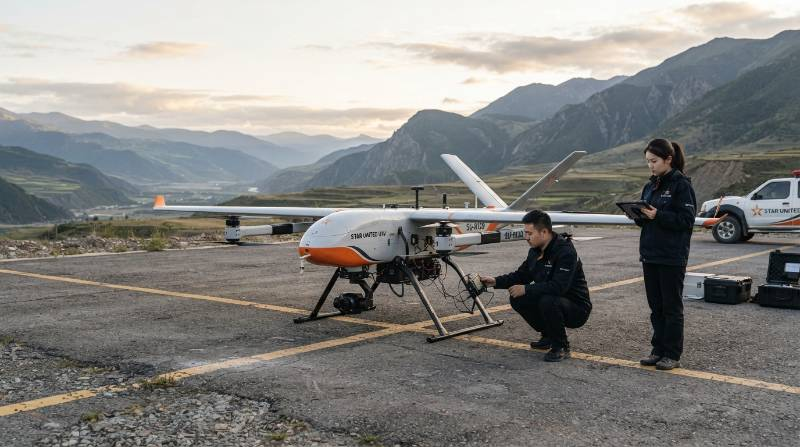
150kg MTOW Class Definition: An unmanned aerial system category featuring a structural airframe designed to carry high-fraction payloads (up to 35% of total mass) utilizing hybrid-lift configurations. These platforms operate under strict airworthiness standards such as NATO STANAG 4703 and civil Specific Operations Risk Assessment (SORA) guidelines.High-mass airframes demand meticulous pre-flight mass balance calculations. Moving the Center of Gravity (CG) by as little as 15mm along the longitudinal axis alters elevator authority and increases rotor trim energy during the hover phase by up to 22%.
- Structural Mass Fraction: High-modulus carbon-fiber composite airframe accounts for 40–45% of empty operating weight.
- Usable Payload Allocation: Up to 50kg dedicated to multi-spectral, LiDAR, radar, or cargo systems.
- Fuel/Energy Reservoir: 25–35% of MTOW allocated to fuel cells, high-density Li-ion packs, or combustion fuel.
Powertrain Strategy: Hybrid Gas-Electric vs. Pure Electric Calculations
Pure battery-electric powertrains struggle with energy density limits when scaling to 150kg MTOW platforms. Hybrid gas-electric architectures provide the power density needed for sustained Beyond Visual Line of Sight (BVLOS) operations, pairing an internal combustion generator with a high-discharge buffer battery.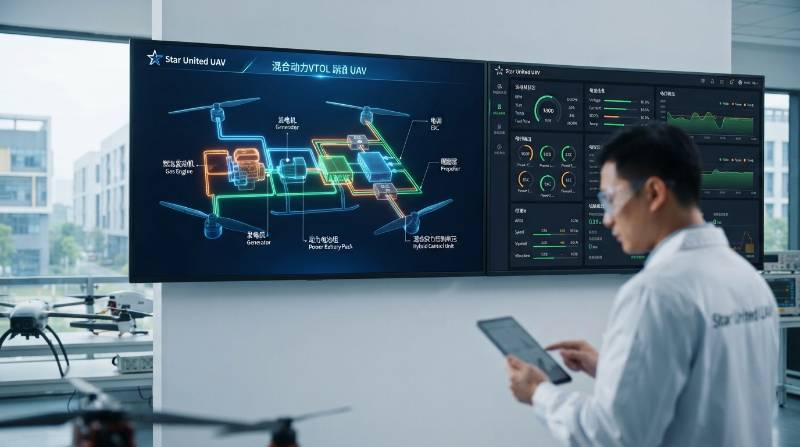
| Flight Phase | Primary Power Source | Average Power Draw | Fuel/Energy Consumption |
|---|---|---|---|
| Vertical Ascent (0–100m AGL) | Buffer Battery + EFI Generator | 36.5 kW | 8.5C Battery Discharge + 1.2 L/hr Fuel |
| Inbound/Outbound Transition | Dual Quad-Rotor + Pusher Motor | 24.0 kW | 4.0C Battery Discharge + 2.0 L/hr Fuel |
| Fixed-Wing Cruise (32 m/s) | EFI Generator (Battery Recharging) | 5.8 kW | 1.8 L/hr Fuel Burn (0.8 kW charge rate) |
| Vertical Descent & Flare | Buffer Battery + EFI Generator | 28.2 kW | 6.0C Battery Discharge |
Heavy-Payload Flight Dynamics: Corridor Transition, Turning Radii, and Deceleration
Lightweight drones can transition rapidly within a 30-meter radius, but a 150kg VTOL operates under substantial aerodynamic momentum. Transition corridors require dedicated linear clear zones of at least 250 to 400 meters to safely accelerate from rotor-borne hover to the wing-borne stall safety speed ($V_{stall} \times 1.3$).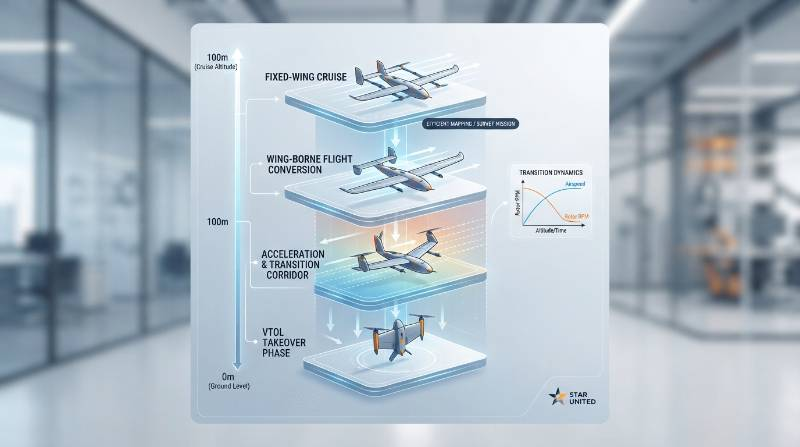
| Airspeed (True Airspeed - TAS) | Bank Angle ($\phi$) | Turn Radius ($R$) | Required Linear Decel Corridor |
|---|---|---|---|
| 28 m/s (54 kts) | 20° | 219 meters | 180 meters |
| 34 m/s (66 kts) | 25° | 253 meters | 260 meters |
| 40 m/s (78 kts) | 30° | 282 meters | 340 meters |
The Star United UAV Heavy-Lift Transition & Corridor Planning (HTCP) Protocol
To eliminate operational risk during long-range deployments, Star United UAV engineers follow a structured mission design architecture. The Heavy-Lift Transition & Corridor Planning (HTCP) Protocol standardizes safe routing for airframes with high wing loading and high payload-to-mass ratios. Integrating the HTCP protocol into advanced flight control systems relies on five procedural stages:- Phase 1: Dynamic Center of Gravity & Ballast Verification: Automated load-cell telemetry matches physical mass distribution against the digital flight control model.
- Phase 2: Transition Corridor Deconfliction: Establishing 400m directional safety corridors aligned into the prevailing wind vector to minimize asymmetric wing stall during wing-borne conversion.
- Phase 3: Cruise Energy Equilibrium Calculation: Calculating altitude steps based on progressive fuel burn, adjusting cruise velocity to maintain minimum continuous power draw.
- Phase 4: C2 Coverage & Link Margin Profiling: Mapping the planned route against dual RF and SATCOM line-of-sight terrain elevation models.
- Phase 5: Autonomous Contingency Corridor Indexing: Injecting dynamic safe landing zones (SLZs) every 3km along the route vector for automated engine-out diversion.
Ground Control Station (GCS) Multi-Sensor Data Link and Telemetry Architecture
Mission planning for 150kg platforms requires orchestrating multi-channel telemetry streams simultaneously. While the primary autopilot transmits core flight parameters over encrypted C2 links, heavy payloads generate high-throughput data that must be managed dynamically.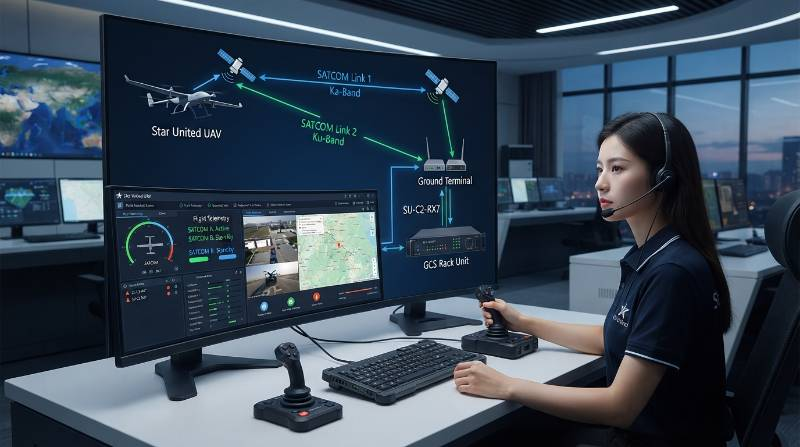
- Primary C2 Link (Point-to-Point COFDM / Mesh RF): 800MHz / 1.4GHz bands reserved for Mavlink/STANAG 4586 flight commands with sub-50ms latency.
- Secondary Beyond-Line-of-Sight Link (Inmarsat/Iridium SATCOM): Low-bandwidth, high-reliability global telemetry fallback for remote BVLOS waypoint updates.
- High-Bandwidth Payload Downlink: 5.8GHz / Ku-Band directional data pipe for EO/IR gimbal telemetry, target tracking metadata, and sensor control.
BVLOS Regulatory Frameworks, Redundant C2, and Fail-Safe Emergency Systems
Operating a 150kg unmanned aircraft across civil or segregated airspace demands strict compliance with global aviation safety mandates. Under both FAA Part 107 BVLOS waivers and EASA Specific Category (SAIL IV / VI) requirements, operations rely heavily on redundant hardware and automated risk mitigations. Triple-redundant flight control architectures execute automated cross-checks of inertial measurement units (IMUs), GPS-RTK compass modules, and air data computers. If a sensor disagrees beyond a 4% variance threshold, voting logic isolates the faulty channel without disrupting active guidance.
- Total C2 Link Loss: The aircraft holds orbit for 60 seconds. If the link is not re-established, it climbs to the planned clearance altitude and navigates autonomously along a pre-programmed return corridor.
- Generator / Engine Flameout: The avionics immediately initiate an emergency glide profile while the buffer battery pack powers the flight surfaces. The flight control system vectors the platform toward the nearest pre-designated Safe Landing Zone (SLZ).
- Low Energy Critical Threshold: If available energy drops below the calculated margin required for vertical descent, the autopilot prioritizes an immediate fixed-wing belly landing or emergency recovery maneuver.
- Autonomous Ballistic Parachute: Independent autonomous flight termination systems (FTS) deploy a pyrotechnic ballistic parachute if pitch, roll, or descent rates exceed structural safety limits ($>60^\circ$ roll, $>8$ m/s sink rate).
Frequently Asked Questions About 150kg VTOL UAV Mission Planning
What are the typical runway and clear zone requirements for a 150kg VTOL UAV?
While 150kg VTOL platforms do not require standard runways, they need a dedicated flat landing zone of at least 15m x 15m cleared of debris. They also require an unobstructed 400-meter departure corridor cleared up to 50 meters AGL to safely complete the transition to fixed-wing flight.What crosswind limitations apply to 150kg class VTOL during the transition phase?
The maximum safe crosswind component during hover and corridor conversion is typically 12 to 15 m/s (23–29 knots). Transitions should always be oriented into the prevailing wind vector to prevent lateral roll oscillations and excessive stabilization motor power consumption.How does payload weight directly affect mission flight range?
Payload weight shares capacity directly with the fuel and energy fraction. On a 150kg hybrid system, reducing payload from 40kg to 15kg allows for additional fuel carriage, expanding flight endurance from 4.5 hours to over 9 hours, and extending mission range beyond 600km.How do ground systems handle emergency diversion points for BVLOS missions?
Modern GCS routing algorithms automatically populate dynamic Safe Landing Zones (SLZs) along the flight plan. The autopilot maintains an active database of terrain, slope angles, and population density grids, selecting the closest reachable site if it detects unrecoverable subsystem failures.Equip Your Fleet with Enterprise Heavy-Lift Platforms
Star United UAV delivers mission-ready 150kg VTOL airframes, integrated hybrid powertrains, and high-reliability ground control stations built for demanding enterprise and industrial operations.
Contact Our Flight Operations Engineers