
VTOL Fixed-Wing UAV vs Multirotor: Enterprise Drone Guide
Star United Flight Control (Shaanxi) Technology Co., Ltd.
7 min read·2026-09-18
Core Aerodynamic Differences and Flight Physics
Choosing between a VTOL fixed-wing UAV vs multirotor comes down to lift generation and aerodynamic efficiency. Multirotors generate lift purely through continuous vertical thrust from downward-facing props, while VTOL (Vertical Take-Off and Landing) fixed-wing aircraft take off vertically like a helicopter, transition in mid-air, and rely on fixed wings to generate passive aerodynamic lift during forward flight. Because fixed-wing platforms do not expend energy purely fighting gravity once in forward cruise, they consume a fraction of the power required by a rotary system at identical airspeeds. Understanding these physical principles determines operational ranges, payload choices, and commercial profitability for enterprise operators.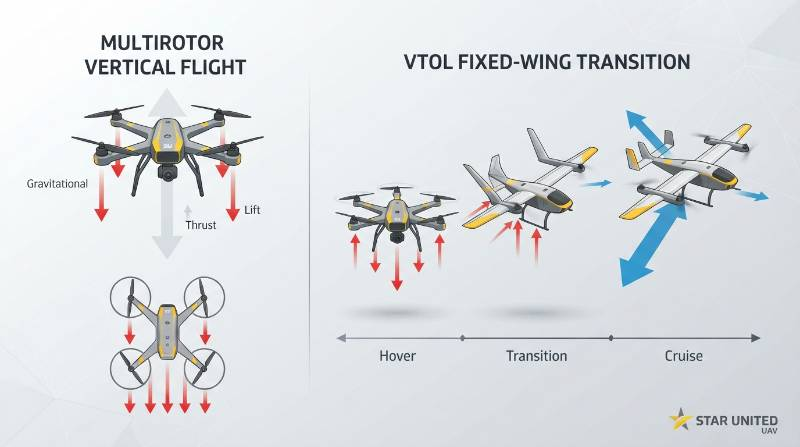
Aeronautical Engineering Benchmark: A standard industrial multirotor requires roughly 180 to 220 W/kg of continuous mechanical power to sustain stationary hover. In contrast, an aerodynamically optimized fixed-wing UAV operating at cruise speeds requires only 30 to 45 W/kg to maintain level flight under standard atmospheric conditions (ISA).
Aerodynamic Efficiency and Performance Benchmarks
Aerodynamic efficiency directly translates to operational range, battery cycle longevity, and weather tolerance. Enterprise engineering teams must evaluate cruise speeds, altitude ceilings, and wind penetration when selecting a commercial fleet. Enterprise operators deploying VTOL fixed-wing UAV platforms gain higher ground speeds (65 to 110 km/h) and superior wind penetration. Multirotors cruise at lower speeds (30 to 50 km/h), limiting their effectiveness in gusty or high-altitude environments.Flight Time, Range, and Powertrain Diversification
Pure electric multirotors face a steep battery weight-to-energy density ceiling. Even high-capacity semi-solid-state lithium batteries cap industrial multirotor flight times at 35 to 55 minutes under payload. VTOL fixed-wing systems accept diverse powertrain options:- Pure Electric (LiPo / Solid-State): 90 to 180 minutes of flight endurance.
- Hybrid Gas-Electric / EFI: 4 to 8+ hours of continuous operation with ranges exceeding 400 km.
Area Coverage Metrics: Hectares Mapped per Sortie
For large-scale aerial mapping and surveying, flight endurance directly determines labor overhead. A high-speed VTOL fixed-wing captures large swathes of land in a single flight leg without returning for battery swaps. In our flight operations telemetry, a VTOL platform operating at a 3 cm/pixel Ground Sampling Distance (GSD) routinely covers 1,200 to 2,000 hectares in a single sortie. A high-end commercial multirotor maps between 100 and 250 hectares under identical lighting and GSD conditions before depleting its pack.Payload Integration, Modular Flexibility, and Weight Capacities
While VTOL fixed-wings excel in coverage, heavy-lift multirotor systems dominate when carrying heavy, un-aerodynamic, or multi-axis gimbal payloads.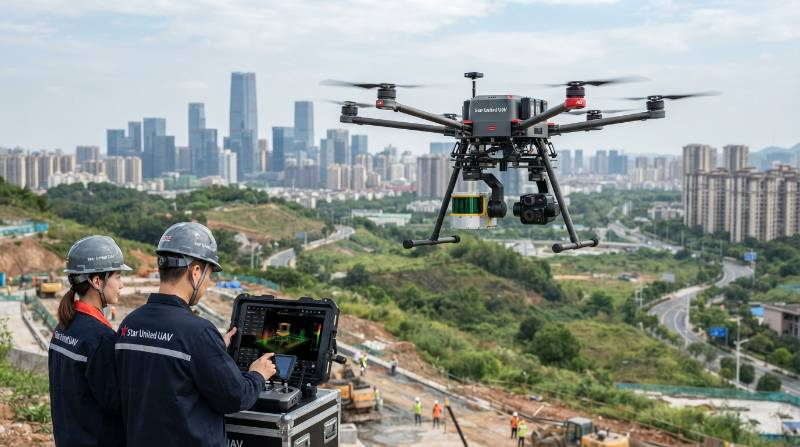
Mission-Specific Profiles: Matching Airframes to Demands
Selecting the right airframe depends on your survey geometry. Deploying the wrong platform inflates operational costs and degrades data quality.Linear Corridor Monitoring: Utilities and Pipelines
Linear assets—such as oil pipelines, transmission corridors, and railway networks—demand high forward speed and extended range. VTOL fixed-wings complete 80 to 150 km of continuous corridor survey per sortie, minimizing pilot repositioning time along remote right-of-ways.Close-Proximity Asset Inspection and Precision Hover
For close-quarters industrial inspection, multirotors remain unbeatable. Inspecting vertical wind turbine blades, flare stacks, sub-deck bridge concrete, and cell towers requires zero forward speed and sub-centimeter position holding. VTOL fixed-wing aircraft cannot safely hover near vertical structures during forward cruise due to stall speeds (typically 14 to 18 m/s) and vulnerability to turbulent localized building drafts.The Star United UAV Fleet Architecture Matrix (SU-FAM)
To eliminate procurement guesswork, Star United UAV systems engineers use the SU-FAM Decision Protocol. This four-pillar framework scores enterprise mission requirements to identify the ideal airframe configuration: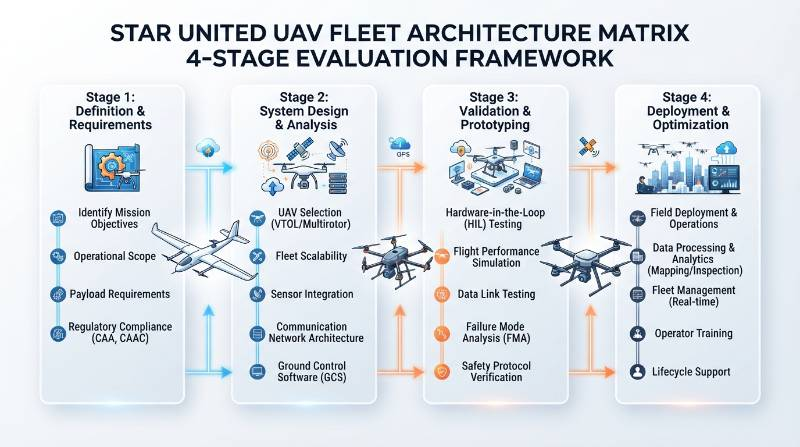
- 1. Spatial Geometry Score (SGS): If the survey target is linear (>20 km) or regional area (>300 ha), VTOL fixed-wing scores +10. If the asset is a compact vertical structure, multirotor scores +10.
- 2. Hover-to-Transit Ratio (HTR): If the flight profile demands stationary dwell time >15% of total sortie time, select multirotor. If hover is only needed for takeoff and landing, select VTOL.
- 3. Ingress/Egress Envelope (IEE): If the operational launch footprint is <3x3 meters with heavy overhead canopy, deploy a compact multirotor. Clearings >5x5 meters support enterprise VTOL.
- 4. Specific Coverage Budget (SCB): Calculated as Target Area (ha) / Available Work Hours. If SCB > 250 ha/hour, a VTOL platform is mandatory to meet project timelines.
Deployment Logistics and Runway-Free Operations
Traditional fixed-wing drones required pneumatic catapult launchers, belly-landing zones, or parachute recovery nets, leading to frequent airframe stress and sensor damage. Modern hybrid VTOL technology removes these logistical bottlenecks. Modern enterprise VTOL aircraft transition vertically from a 5x5 meter patch of grass, a vessel deck, or a forest clearing. Once clear of tree lines and obstacles, the autopilot engages forward propulsion, combining multirotor takeoff flexibility with fixed-wing aerodynamic efficiency.BVLOS Readiness, Dual-Redundant Avionics, and Failsafes
Beyond Visual Line of Sight (BVLOS) flight requires compliance with global aviation safety standards, such as ASTM F3298 and ISO 21384-3 operational safety guidelines. Star United UAV integrates dual-redundant IMUs, triple-GNSS RTK positioning, and cellular-satellite failover datalinks into its advanced flight control systems. If a forward motor fails on a VTOL aircraft during cruise, the autopilot automatically activates the vertical quad-rotors to safely land the aircraft.Total Cost of Ownership (TCO) and ROI Financial Modeling
Procurement teams often look only at initial hardware CapEx. A true Total Cost of Ownership (TCO) model factors in pilot field hours, battery replacement cycles, and mobilization costs across 300 operational days.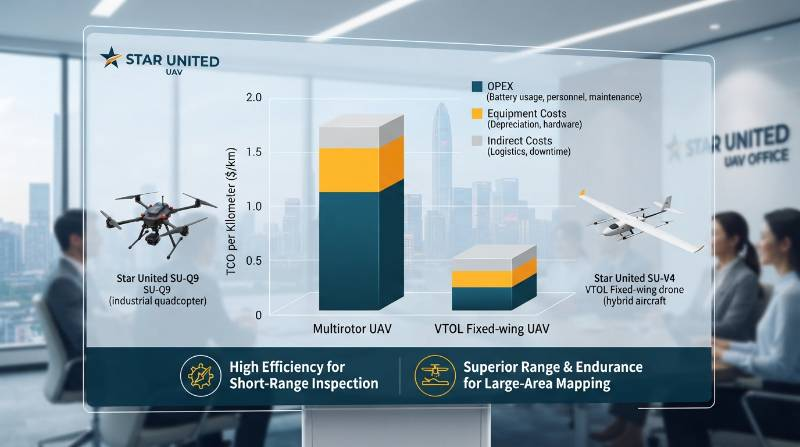
- Battery Replacement Frequency: Multirotor packs experience 2C to 4C continuous discharge rates, reducing life to 150–200 cycles. Fixed-wing cruise draws <0.8C, extending cell life beyond 400 cycles.
- Field Crew Costs: Mapping a 10,000-hectare mining concession takes 2 days with a single VTOL vs. 12 to 14 days with a multirotor fleet, cutting pilot field wages and per-diem costs by over 75%.
- Operating Cost Benchmark: At scale, VTOL operational mapping cost averages $0.35 to $0.80 per hectare, compared to $2.20 to $4.50 per hectare for multirotor setups.
Enterprise UAV Platform Comparison Matrix
Review the direct engineering trade-offs between both airframe architectures:| Metric / Parameter | Industrial Multirotor | VTOL Fixed-Wing UAV |
|---|---|---|
| Cruise Speed Range | 0 – 50 km/h (0 – 14 m/s) | 65 – 115 km/h (18 – 32 m/s) |
| Flight Endurance (Electric) | 30 – 55 minutes | 90 – 180 minutes |
| Flight Endurance (Hybrid EFI) | 1.5 – 2.5 hours (Rare) | 4.0 – 8.0+ hours |
| Coverage per Flight (3cm GSD) | 100 – 250 hectares | 1,000 – 2,500 hectares |
| Takeoff Footprint | 2x2 meters | 5x5 meters (No runway needed) |
| Stationary Hover Capability | Precise, sub-centimeter RTK hold | Emergency hover / Transition only |
| Maximum Wind Resistance | 10 – 14 m/s (Moderate Gale) | 14 – 18 m/s (Fresh Gale) |
| Ideal Applications | Bridge, tower, and turbine inspection | Corridors, mining, agriculture, border patrol |