
Perimeter Security Patrol Drones: Enterprise Defense Guide
Star United Flight Control (Shaanxi) Technology Co., Ltd.
8 min read·2026-09-11
The Evolution of Boundary Defense: From Static Fencing to Autonomous Drone Patrols
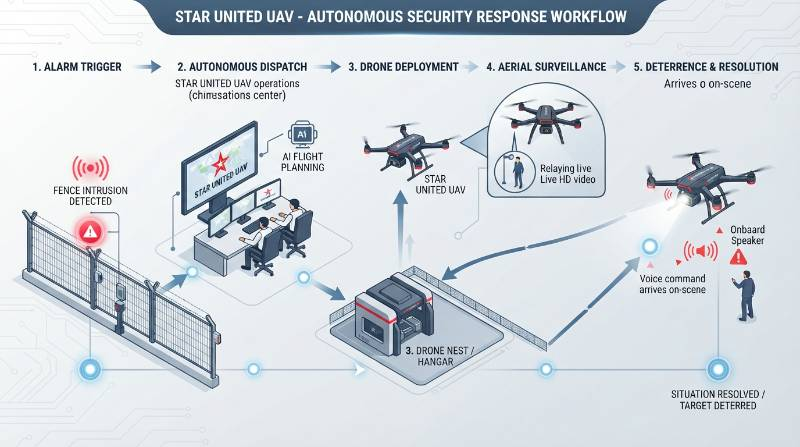
Perimeter security patrol drones are unmanned aerial systems engineered to execute automated, continuous boundary surveillance, detect unauthorized intrusions, and provide real-time aerial reconnaissance to security operations centers. Combining Drone-in-a-Box (DiaB) automation with multi-sensor payloads, these systems eliminate traditional line-of-sight blind spots across expansive industrial facilities. Traditional physical security relies on static physical barriers, buried fiber-optic sensor lines, and fixed pan-tilt-zoom (PTZ) cameras. These legacy systems suffer from inherent vulnerabilities: physical terrain blind spots, fixed camera viewing angles easily bypassed by coordinated adversaries, and slow human response cycles.Critical Infrastructure Protection Benchmark: According to industrial physical security audit standards (ASIS International guidelines), traditional ground response times to fence-line breach alarms average 7 to 12 minutes. Deploying autonomous patrol drones reduces target verification and spatial intercept timelines to under 20 seconds.Fixed Intrusion Detection Systems (IDS) frequently generate nuisance alarms caused by wildlife, vegetation movement, and severe weather. Security personnel waste hundreds of labor hours annually investigating false triggers. Autonomous boundary surveillance transforms passive fence monitoring into an active tactical response. When a perimeter sensor trips, a robotic aerial platform launches instantly, vectors directly to the coordinates, and streams high-definition electro-optical and thermal video to operators before a ground team even mobilizes.
Core Technological Pillars of Autonomous Patrol UAVs
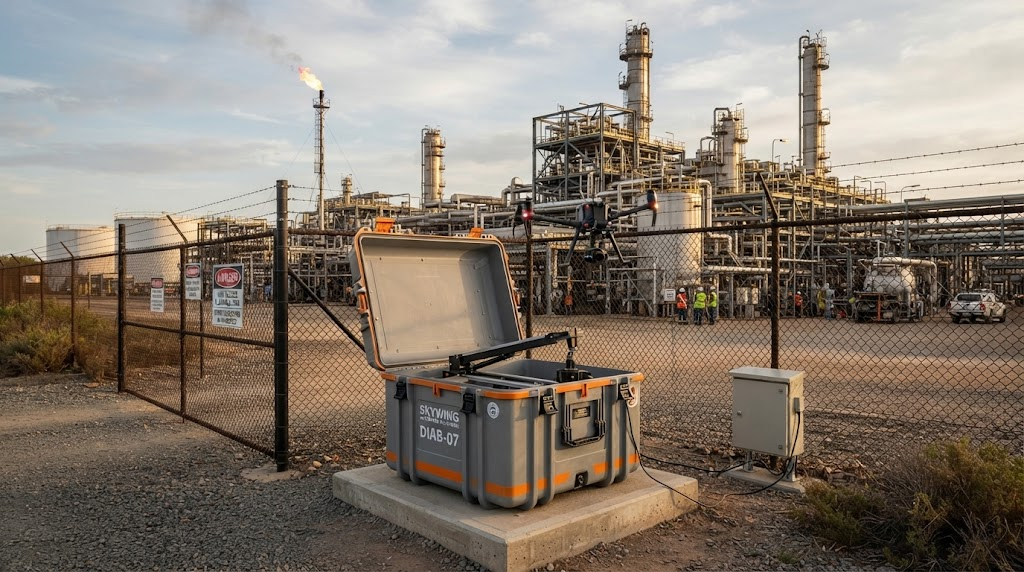
Modern autonomous security UAVs operate without direct human stick inputs. They rely on an ecosystem of industrial hardware, edge computing, and hardened communications to maintain continuous perimeter readiness.- Drone-in-a-Box (DiaB) Docking Stations: Weatherproof (IP55/IP67) enclosures provide automated precision landing via RTK-GPS, rapid contact charging, and climate-controlled shelter for 24/7 readiness.
- Edge AI Computer Vision: High-performance onboard neural processing units (NPUs) execute Automated Target Recognition (ATR), distinguishing humans, vehicles, and wildlife at ranges exceeding 800 meters.
- Encrypted C2 and Video Links: AES-256 encrypted datalinks provide beyond visual line of sight (BVLOS) flight telemetry and ultra-low-latency RTSP video transmission directly into security consoles.
- Triple-Redundant Flight Avionics: Industrial systems utilize advanced flight control systems featuring dual IMUs, optical flow positioning, and LiDAR-based obstacle avoidance.
Modular Payloads: Radiometric Thermal, Optical Zoom, and Active Deterrence
Standard security cameras fail when zero-lux illumination, smoke, or dense foliage obscures the target. Specialized perimeter UAVs employ multi-sensor payload gimbals optimized for tactical reconnaissance. Electro-Optical / Infrared (EO/IR) dual-sensor payloads combine a 4K visible-light sensor (equipped with up to 40x optical zoom) and an uncooled long-wave infrared (LWIR) radiometric thermal camera with thermal sensitivity below 30mK NETD. This setup enables long-range visual identification of license plates and facial contours by day, along with heat signature tracking in total darkness. To stop incursions before physical entry occurs, drones integrate synchronized active deterrence modules. High-intensity searchlights (delivering up to 10,000 lumens) pair with directional acoustic hailers (capable of 120dB voice warnings) to disorient and warn off intruders remotely.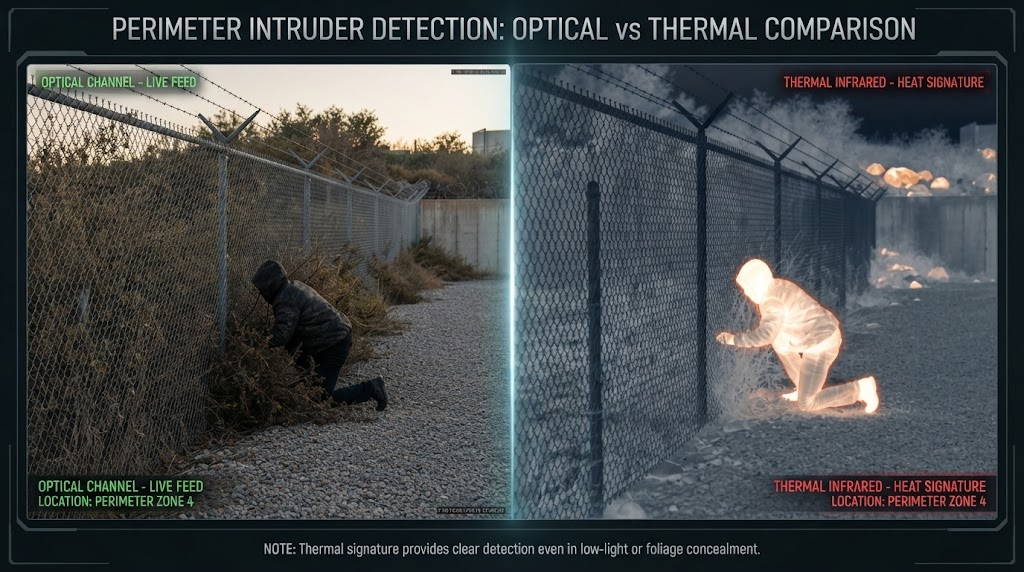
Multi-Domain Critical Infrastructure Deployments
Enterprise physical security mandates vary significantly across commercial sectors. High-reliability autonomous security patrol drone solutions solve unique domain challenges across mission-critical facilities.- Oil & Gas Refineries & Tank Farms: Persistent aerial monitoring prevents vandalism, detects fugitive thermal emissions, and verifies fence integrity along expansive, explosive-hazard buffer zones without risking human entry.
- Utility-Scale Solar Farms: Spanning thousands of rural acres, solar installations suffer from inverter theft and panel tampering. UAVs follow pre-programmed GPS fence routes to eliminate patrol vehicle wear and blind spots.
- Electrical Substations & Grid Hubs: Rapid thermal scanning spots both unauthorized physical intrusions and overheating transformer components in a single flight pass.
- Intermodal Seaports & Logistics Terminals: Drones oversee container stacks, rail spurs, and water-facing shorelines, detecting breach attempts that evade ground-level security vehicles.
- National Borders & Remote Corridors: Long-endurance hybrid VTOL (Vertical Takeoff and Landing) aircraft cover 50+ kilometer linear boundaries on single-battery cycles, transmitting live geolocated threat tracks to tactical command posts.
The Star United Autonomous Perimeter Defense (APD) Protocol
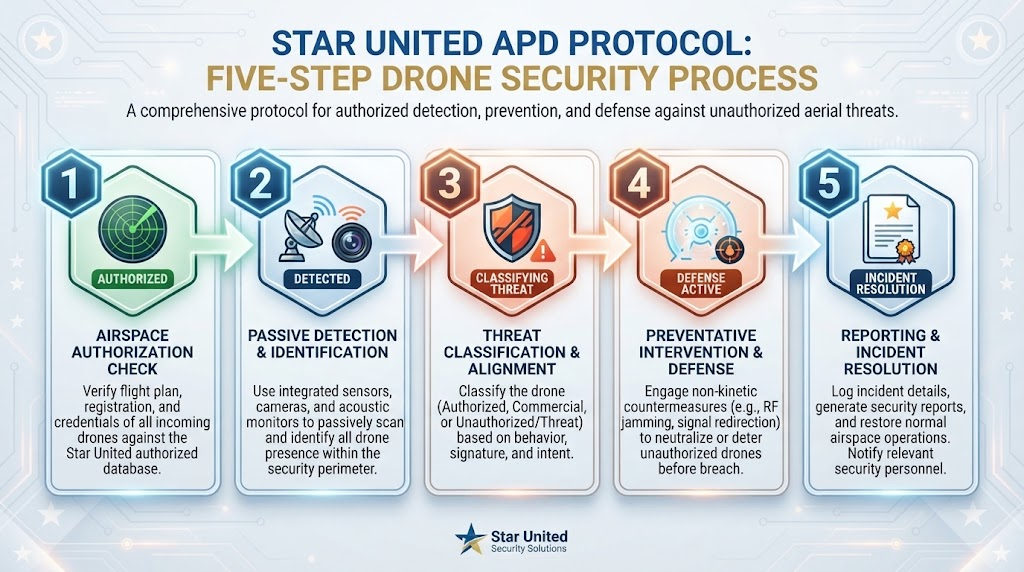
Deploying autonomous security drones requires an integrated operational methodology. Star United UAV adheres to the proprietary Star United APD Protocol, a 5-phase framework designed for automated perimeter control:- Phase 1: Spatial Threat Mapping & Blind Spot Profiling High-resolution 3D photogrammetry maps facility terrain, structure elevations, and existing sensor coverage zones to locate dead spots.
- Phase 2: Geofence Vectoring & Waypoint Architecture Precise 3D flight corridors, no-fly zones (NFZs), and automated fence-line patrol routines are programmed into the command and control suite.
- Phase 3: Sensor-Triggered Autonomous Dispatch The drone-in-a-box dock interfaces directly with ground sensors (microwave barriers, seismic cables, AI fence cameras). When an intrusion is detected, the drone launches automatically without human intervention.
- Phase 4: AI Edge Threat Verification & Tagging Onboard edge AI classifies the entity (human, vehicle, animal, false trigger) and centers the dual EO/IR gimbal on the subject using automated visual tracking.
- Phase 5: Interception, Deterrence & Live SOC Handoff The platform deploys spotlights or audio challenges while feeding high-bandwidth encrypted video streams to the local Security Operations Center (SOC) and mobile response teams.
System Integration: Connecting UAVs to SOC and Video Management Software (VMS)
Autonomous security patrol drones must not exist as isolated technology silos. Modern enterprise defense architectures require seamless, real-time integration into established physical security software. Star United UAV platforms utilize open MAVLink and RESTful APIs to feed data directly into enterprise Video Management Systems (VMS) such as Genetec Security Center and Milestone XProtect. Drones function as mobile, elevated IP cameras with controllable PTZ telemetry. When an alarm is triggered, the drone appears instantly on the SOC video wall map as an active tracking asset. Security operators take control of payload optics with a single click, allowing the UAV's autonomous autopilot to manage flight safety, collision avoidance, and battery return margins. Data sovereignty and cybersecurity remain critical priorities. Operating on non-restricted, NDAA-compliant firmware architectures ensures that all telemetry, encrypted C2 data links, and mission video archives remain strictly on private enterprise servers without unauthorized external routing.Total Cost of Ownership (TCO): Autonomous Drone Patrols vs. Static Guard Forces
Staffing industrial perimeters with 24/7 human guard teams introduces high recurring operational expenses, recruitment challenges, and safety liabilities. Autonomous DiaB platforms deliver predictable capital expenditures and rapid amortization.| Evaluation Metric | Manned Patrol Vehicles (24/7 Guards) | Autonomous Patrol Drone (DiaB) |
|---|---|---|
| Breach Response Time | 8 – 15 Minutes | 15 – 30 Seconds |
| Annual Labor & Fleet Cost | $280,000 – $420,000 (3 shifts + vehicles) | $45,000 – $65,000 (Maintenance & SaaS) |
| Visual Elevation & Range | Ground level (Obstacles block line-of-sight) | 50 – 120m AGL (Complete overview) |
| False Alarm Verification Cost | High (Dispatches field personnel every trip) | Negligible (Automated AI confirmation) |
| Payback Period (ROI) | N/A (Ongoing operational drain) | 9 – 14 Months |
Star United UAV Security Platforms & Enterprise Payloads
Star United UAV engineers ruggedized aerial hardware designed for demanding industrial environments. Our systems maintain structural integrity and flight performance through severe precipitation, high winds, and extreme temperatures. Our catalog of enterprise industrial drones features high-efficiency multirotor architectures for localized facility surveillance, alongside hybrid VTOL fixed-wing drones capable of mapping and patrolling linear infrastructure up to 100 kilometers per sortie. Beyond active security defense, these multi-mission platforms double as critical infrastructure inspection UAVs. They can switch seamlessly from boundary patrols to autonomous structural inspections of flare stacks, pipelines, and storage silos using modular quick-release payload bays.Frequently Asked Questions About Perimeter Security Patrol Drones
Are perimeter security drones permitted to fly BVLOS autonomously?
Yes. Under global aviation frameworks (such as FAA Part 107 waivers in the US and EASA Specific Category SORA approvals in Europe), facilities can obtain beyond visual line of sight (BVLOS) operational clearance by demonstrating automated geofencing, detect-and-avoid (DAA) sensors, and reliable fail-safe landing routines.How do autonomous patrol drones perform in severe weather?
Industrial security UAVs feature IP55 or IP67 ingress ratings. They operate reliably in sustained winds up to 35 knots (18 m/s), heavy rain, blowing dust, and temperatures ranging from -20°C to +50°C. Autonomous docking stations include integrated meteorological stations that halt flight operations if conditions exceed safe aerodynamic thresholds.How long does it take for a drone-in-a-box station to recharge?
Modern automated docking stations utilize high-current fast-charging contact plates or robotic battery-swap mechanisms. Rapid charging typically restores battery capacity from 15% to 90% in 25 to 35 minutes, enabling near-continuous patrol rotations throughout high-risk security shifts.Can perimeter security drones detect airborne counter-drone threats?
While perimeter patrol drones primarily monitor surface boundaries, they integrate into broader Counter-UAS (C-UAS) architectures. By combining micro-Doppler radar feeds with optical target tracking, the central command system can redirect patrol drones to visually verify rogue aerial vehicles entering low-altitude facility airspace.Upgrade Your Perimeter Defense With Autonomous Aerial Systems
Eliminate blind spots, cut response times to seconds, and automate facility surveillance with Star United UAV industrial drone-in-a-box solutions.
Request Technical Consultation