
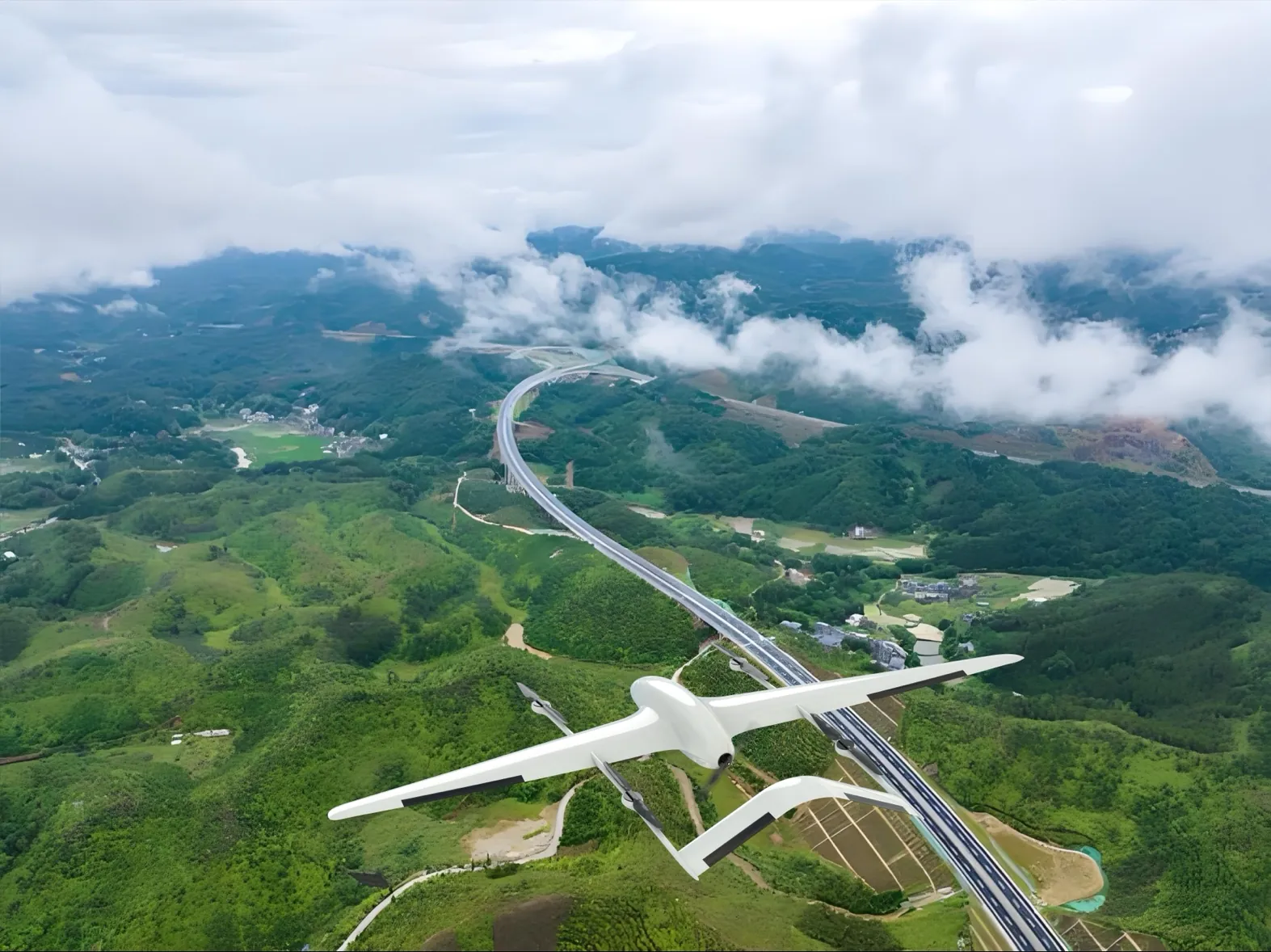
VTOL Fixed-Wing UAV vs. Multirotor: Why Long-Endurance Missions Demand a Hybrid Approach
For missions requiring more than 30 minutes of flight time with meaningful payloads, the physics of fixed-wing aerodynamics are simply superior to multirotor designs. VTOL fixed-wing platforms capture the best of both worlds — but understanding the trade-offs is critical for procurement decisions.
The Fundamental Physics of UAV Endurance
Every UAV procurement decision ultimately comes down to physics. Multirotor drones generate lift by pushing air downward with spinning rotors — an energetically expensive process that limits flight time to 20–45 minutes for most commercial platforms. Fixed-wing aircraft generate lift aerodynamically, using forward motion to create pressure differential across the wing — a far more efficient mechanism that enables hours, not minutes, of flight time.
The challenge: fixed-wing aircraft require runways or catapult launch systems. They cannot hover, cannot take off vertically, and cannot land in confined spaces. For many operational environments — mountain valleys, urban rooftops, ship decks, disaster zones — this is a disqualifying limitation.
VTOL fixed-wing UAVs resolve this fundamental tension. By combining multi-rotor vertical takeoff capability with fixed-wing cruise efficiency, they deliver the operational flexibility of a multirotor with the endurance and payload capacity of a fixed-wing aircraft.Comparative Analysis: Three Platform Types
| Parameter | Multirotor | VTOL Fixed-Wing | Conventional Fixed-Wing |
|---|---|---|---|
| Endurance (5kg payload) | 20–40 min | 3–7 hours | 5–12 hours |
| Cruise Speed | 40–80 km/h | 70–120 km/h | 80–200 km/h |
| Takeoff Requirement | None | None | Runway / catapult |
| Hover Capability | Yes | No (transition required) | No |
| Wind Resistance | Moderate (Level 4–5) | Good (Level 5–6) | Excellent |
| Payload Efficiency | Low (20–30% of MTOW) | Moderate (15–25% of MTOW) | High (25–40% of MTOW) |
| Deployment Complexity | Very low | Low | High |
| Operational Altitude | Up to 3,000m | Up to 4,500m | Up to 6,000m+ |
Mission-Specific Analysis
Intelligence, Surveillance & Reconnaissance (ISR)
ISR missions demand persistent coverage — the ability to maintain eyes on a target area for hours, not minutes. A multirotor platform covering a 50km² area at 60km/h would need to land and recharge every 30 minutes, creating coverage gaps and requiring multiple battery sets and ground crew.
The SG 30kg-class VTOL fixed-wing platform delivers 5 hours of continuous ISR with a 5kg EO/IR payload — covering the same area with a single sortie. Its payload bay is positioned precisely at the aircraft's center of gravity, eliminating the need for CG adjustment when switching between EO, IR, SAR, or communications relay payloads.
Emergency Response and Disaster Relief
When an earthquake strikes or a wildfire spreads, response teams need aerial assessment immediately — and they need it to last. A multirotor drone can provide the first 30 minutes of reconnaissance, but sustained situational awareness for a multi-hour rescue operation requires fixed-wing endurance.
The SG SX30K VTOL platform deploys from any flat surface within minutes, requires no runway, and provides 3+ hours of continuous coverage with a 5kg payload. Its one-key takeoff and landing system enables operation by non-specialist personnel — critical in emergency response scenarios where trained UAV operators may not be available.
Border Security and Perimeter Monitoring
Border security operations require 24/7 coverage of extended linear features — coastlines, mountain passes, fence lines. The economics of multirotor coverage at scale are prohibitive: a 100km border segment would require dozens of simultaneous multirotor platforms to maintain continuous coverage.
The SG 150kg-class VTOL platform, with its 7-hour endurance and 200km data link range, can patrol a 100km border segment continuously for an entire operational shift. Its hybrid electric-VTOL/fuel-cruise power system maximizes endurance while maintaining the deployment flexibility of a VTOL platform.
The Altitude Advantage
Operational altitude is a frequently overlooked parameter in UAV procurement. Multirotor platforms struggle above 3,000m due to reduced air density limiting rotor efficiency. This is a significant constraint for operations in mountainous regions, high-altitude plateaus, and certain geographic areas.
The SG VTOL series is specifically engineered for high-altitude operations:
- SX30K: VTOL takeoff up to 3,000m (plain version)
- 30kg-Class: VTOL takeoff up to 4,500m (plateau version)
- 150kg-Class: Cruise altitude 150m–4,000m, takeoff at 2,500m
This high-altitude capability is essential for operations in regions like Central Asia, the Tibetan Plateau, the Andes, or the Hindu Kush — environments where multirotor platforms are operationally limited.
Payload Integration: The Center-of-Gravity Advantage
One of the most practically significant design decisions in VTOL fixed-wing UAV engineering is payload bay placement. Many competing platforms place the payload bay at the nose or belly of the aircraft — a position that shifts the center of gravity significantly when different payloads are installed, requiring time-consuming CG adjustment procedures between missions.
The SG 30kg-class platform positions its 14-liter payload bay precisely at the aircraft's center of gravity. This means operators can swap between an EO pod, a SAR radar, a communications relay payload, or an atmospheric sensor without any CG adjustment — enabling rapid mission reconfiguration in the field.
Procurement Considerations
When evaluating VTOL fixed-wing platforms for procurement, the following parameters warrant particular attention:
- Endurance at operational payload weight — not empty endurance
- VTOL takeoff altitude — critical for high-altitude deployments
- Payload bay volume and CG position — determines mission flexibility
- Data link range and encryption — operational radius and security
- Denied-environment navigation — GPS-denied operation capability
The SG VTOL series addresses all five parameters with specifications validated through operational deployment. Contact our engineering team to discuss specific mission requirements and platform selection.