
Drone Swarm Technology: Architecture, Mesh & Operations
Star United Flight Control (Shaanxi) Technology Co., Ltd.
8 min read·2026-09-15
What Is Drone Swarm Technology? Core Definitions and Technical Metrics
Drone swarm technology refers to a coordinated network of multiple Unmanned Aerial Vehicles (UAVs) that operate collaboratively under autonomous or semi-autonomous control to achieve a shared mission objective. Unlike multi-drone operations requiring individual pilots per airframe, a true swarm functions as a unified, distributed multi-agent system governed by collective decision-making algorithms and inter-node communication.Swarm Intelligence (SI): The collective behavior of decentralized, self-organized systems where individual autonomous nodes execute localized interaction rules, producing complex global coordination without centralized path planning.Modern enterprise swarms operate under strict latency and telemetry constraints. Our field benchmarks validate the following baseline engineering metrics for commercial-grade swarm cohesion:
- Inter-Node Latency: <20 milliseconds via ad-hoc radio frequency (RF) links.
- Relative Positioning Accuracy: ±5 centimeters using multi-band RTK GNSS positioning and Ultra-Wideband (UWB) cross-ranging.
- Consensus Convergence Time: <150 milliseconds across a 20-node cluster during dynamic trajectory re-planning.
- Telemetry Throughput: Minimal 1.2 Mbps dedicated inter-agent data pipeline per node for state vector exchange.
Core Swarm Network Topologies: Centralized vs. Decentralized vs. Hierarchical
The network topology defines how telemetry, target assignments, and payload data propagate across the aerial fleet. Choosing the right topology governs resilience against electronic countermeasures and signal occlusion.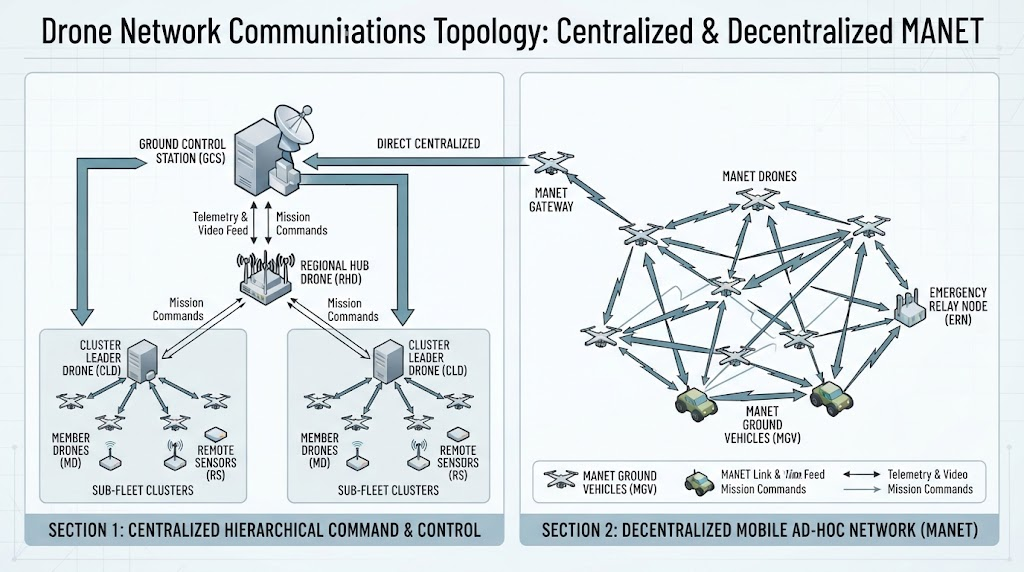
1. Centralized Ground Control Topologies
In a centralized model, every UAV communicates directly with a single base station. The ground station computes all spatial paths and broadcasts discrete coordinates to each vehicle. While computationally straightforward, this creates a severe single point of failure (SPOF) and collapses if the base station link experiences RF interference or physical line-of-sight obstruction.2. Decentralized Mobile Ad-Hoc Networks (MANET)
A decentralized MANET architecture eliminates master nodes entirely. Each drone functions simultaneously as a sensor, edge processor, and routing relay node. If vehicleUAV-04 drops offline or is destroyed, the surrounding mesh network heals routes within 50 milliseconds according to optimized link-state routing (OLSR) protocols, maintaining mission integrity.
3. Hierarchical Hybrid Networks
Hierarchical architectures divide the swarm into functional tiers. High-altitude assets serve as airborne command-and-relay nodes, while low-altitude multi-rotors execute local tasks. Operators supervise mission status via a unified ground control system that receives consolidated situational feeds rather than raw sensor streams from dozens of distinct airframes.Hardware and Communications Infrastructure: MANET Radios and Edge Compute
Achieving deployable swarm capability requires dedicated avionics built for high-vibration, high-EMI industrial environments. Off-the-shelf single-drone autopilots lack the bus bandwidth and real-time processing required for multi-agent spatial coordination.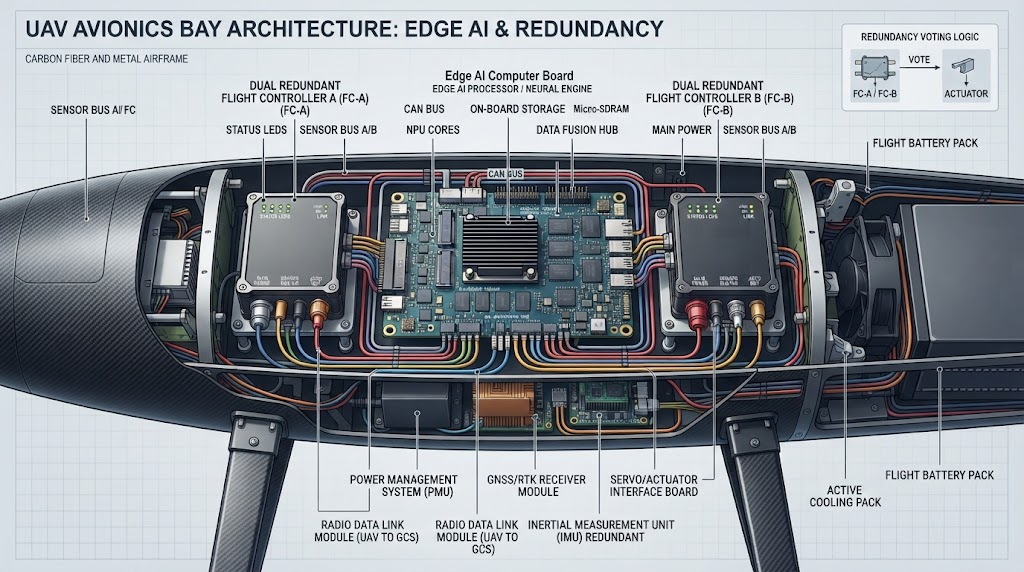 Star United UAV integrates dual-channel Software-Defined Radios (SDR) operating across 800MHz, 1.4GHz, and 2.4GHz bands. This multi-band physical layer pairs with frequency-hopping spread spectrum (FHSS) modulation to bypass localized jamming and industrial RF clutter.
Onboard edge AI compute modules (such as the NVIDIA Jetson Orin Industrial SOM) handle local spatial computing. By processing decentralized Simultaneous Localization and Mapping (SLAM) and computer vision directly on the airframe, nodes transmit high-level metadata (e.g., target bounding vectors) instead of raw 4K video feeds, cutting mesh bandwidth load by 78%.
Vehicles rely on enterprise-grade autonomous flight control systems engineered with triple-redundant IMUs, barometric sensing, and RTK GNSS receivers to safeguard against sensor drift in tight formations.
Algorithmic Flocking, Collision Avoidance, and Sensor Fusion
Swarm spatial dynamics rely on deterministic mathematical rules to prevent mid-air collisions while maximizing mission coverage area.Reynolds Rules & Artificial Potential Fields (APF)
Basic flocking behavior extends classical Reynolds Flocking algorithms into three-dimensional non-inertial frames:- Separation: Repulsive spatial vectors prevent nodes from violating safety bounding spheres (minimum 3 meters at 12 m/s).
- Alignment: Velocity matching matches flight vector trajectories with nearest-neighbor nodes.
- Cohesion: Attractive spatial vectors steer individual nodes toward the local swarm center of mass.
Distributed Kalman Filtering
When tracking moving ground assets, swarms use Distributed Extended Kalman Filters (DEKF). Rather than relaying raw sensor data to a server, each drone updates a shared spatial belief state. If three UAVs view a target from distinct angles, their joint covariance matrix converges, delivering sub-meter positioning accuracy under partial visual occlusion.Heterogeneous Fleet Coordination: Pairing Fixed-Wing VTOLs and Multi-Rotors
Homogeneous fleets (swarms of identical aircraft) face severe operational trade-offs between endurance and hovering agility. Heterogeneous drone swarms solve this by integrating complementary airframes within the same command framework.
The Star United Swarm Synchronization Matrix (S3M) Protocol
Deploying multi-UAV operations in mission-critical environments requires standardized orchestration. Star United UAV utilizes the Swarm Synchronization Matrix (S3M) Protocol, a structured five-tier deployment framework.- Tier 1: Telemetry Binding & Cryptographic Handshake Autonomous discovery of all powered nodes within the RF envelope. Nodes authenticate using AES-256 encryption keys and assign deterministic dynamic network addresses.
- Tier 2: Dynamic Spatial Geofencing & Corridor Allocation The system maps the mission operational volume, calculating flight corridors, safety buffer volumes, and static hazard envelopes across all nodes.
- Tier 3: Autonomous Dynamic Task Allocation (ADTA) Tasks (e.g., scan sectors, thermal inspection points, communications relays) are distributed via consensus auction algorithms based on remaining battery state-of-charge (SoC) and proximity.
- Tier 4: Decentralized Target & State Consensus Nodes cross-verify sensor tracks across the MANET, eliminating false positives through majority-voting sensor fusion before escalating operational alerts.
- Tier 5: Deterministic Fail-Safe & Auto-Relay RTB If individual airframes encounter hardware faults, battery depletion, or localized jamming, the swarm redistributes flight paths automatically while the affected node executes an isolated Return-to-Base (RTB).
Industrial and Public Safety Applications for Swarm UAVs
Swarm operations transition multi-UAV technology from theoretical research into measurable commercial productivity gains across several major sectors.Continuous Perimeter Security & Critical Infrastructure Defense
Single UAVs leave facilities vulnerable during battery swap intervals. Swarms configured for perimeter security patrol solutions execute continuous rolling rotations. Three drones maintain constant surveillance along high-value perimeters, while a fourth docks at an automated charging pad, delivering zero blind-spot coverage 24/7.Wide-Area Search and Rescue (SAR) Grid Operations
In maritime or wilderness SAR, time-to-target is the primary survival metric. A swarm of six UAVs deploying parallel sweep paths scans rugged topography at 400% the rate of a single aircraft, utilizing onboard thermal AI to spot heat signatures through dense foliage.Synchronized Multi-Angle Photogrammetry & Infrastructure Mapping
Complex civil engineering assets (dams, bridges, open-pit mines) require comprehensive structural modeling. Coordinated swarms capture nadir, oblique, and under-structure LiDAR scans simultaneously, cutting mapping downtime and eliminating lighting variance across datasets.Operational Efficiency & ROI Benchmarks: Single UAV vs. Coordinated Swarms
Transitioning from single-drone architectures to autonomous multi-agent swarms provides clear operational return on investment (ROI) by maximizing asset utilization while reducing labor bottlenecks.| Metric | Single Enterprise UAV | 4-Node Autonomous Swarm | Operational Delta |
|---|---|---|---|
| Mapping Coverage Rate | 85 Hectares / Hour | 320 Hectares / Hour | +276% Improvement |
| Pilots / Operators Required | 1 Pilot + 1 Visual Observer | 1 Swarm Supervisor | 50% Labor Reduction |
| Surveillance Downtime | 25 min per battery swap | 0 min (Continuous Rotation) | 100% Availability |
| Network Link Redundancy | Point-to-Point (Single SPOF) | Self-Healing MANET Mesh | High Fault Tolerance |
Regulatory Compliance, BVLOS Approvals, and Safety Standards
Deploying multi-drone swarms requires compliance with national aviation authorities and international airworthiness standards. In the United States, operating multiple UAVs per pilot requires an FAA Part 107.35 waiver alongside Beyond Visual Line of Sight (BVLOS) Part 107.31 approvals. In Europe, operations fall under the EASA Specific Category governed by Specific Operations Risk Assessment (SORA) multi-agent risk matrices. All deployable swarm platforms must integrate ASTM F3411 Remote ID broadcast standards. Under ASTM guidelines, each swarm unit broadcasts discrete serial identifiers, 3D kinematic vectors, and pilot ground locations, preventing air traffic conflicts during enterprise deployments.Frequently Asked Questions About Drone Swarm Technology
How many drones can operate concurrently within a single industrial swarm?
In decentralized MANET setups, RF channel capacity and TDMA (Time-Division Multiple Access) slotting typically constrain practical node counts. Commercial industrial operations deploy between 4 and 32 nodes per sub-mesh. Larger swarms (100+ nodes) utilize clustered hierarchical routing to prevent network packet collisions.How do swarms maintain formation in GPS-denied environments?
When GNSS signals are jammed or degraded, swarms transition to visual-inertial odometry (VIO), cooperative decentralized SLAM, and Ultra-Wideband (UWB) ranging transceivers. Nodes measure relative time-of-flight distances between airframes to maintain precise spacing without satellite tracking.Are drone swarms vulnerable to RF jamming and electronic warfare?
Decentralized swarms are significantly more resilient than individual drones. Utilizing frequency-hopping spread spectrum (FHSS), directional mesh antennas, and autonomous pre-programmed fallback routes, the swarm maintains mission progress even if specific RF control frequencies experience localized disruption.Scale Your Enterprise Aerial Operations
Consult with Star United UAV avionics specialists to design, integrate, and deploy custom multi-agent drone swarm systems tailored to your security, inspection, or mapping mission profiles.
Consult a Swarm Systems Architect