VTOL Fixed-Wing UAV vs Helicopter for ISR Operations
Star United Flight Control (Shaanxi) Technology Co., Ltd.
8 min read·2026-09-23
Tactical ISR Airframe Selection: The Strategic Shift
Vertical Take-Off and Landing (VTOL) fixed-wing unmanned aerial vehicles deliver higher aerodynamic efficiency, longer station loiter times, and significantly lower operating costs than rotary-wing helicopters for wide-area tactical surveillance. While rotary airframes excel at stationary hovering and heavy cargo sling operations, hybrid VTOL platforms achieve superior range and acoustic stealth by transitioning to fixed-wing cruise during active intelligence gathering. Modern defense, border control, and public safety agencies face expanding surveillance footprints with constrained flight-hour budgets. Selecting between traditional rotary-wing platforms (both manned turbine helicopters and unmanned rotary rotorcraft) and hybrid VTOL fixed-wing drones dictates operational agility, sensor stability, and lifecycle sustainability. Deploying tactical ISR surveillance systems requires evaluating airframe mechanics against mission profiles. Where legacy doctrines relied on manned rotary assets for target tracking and perimeter oversight, unmanned hybrid systems have reshaped intelligence pipelines through continuous multi-sensor streaming and zero-runway logistics.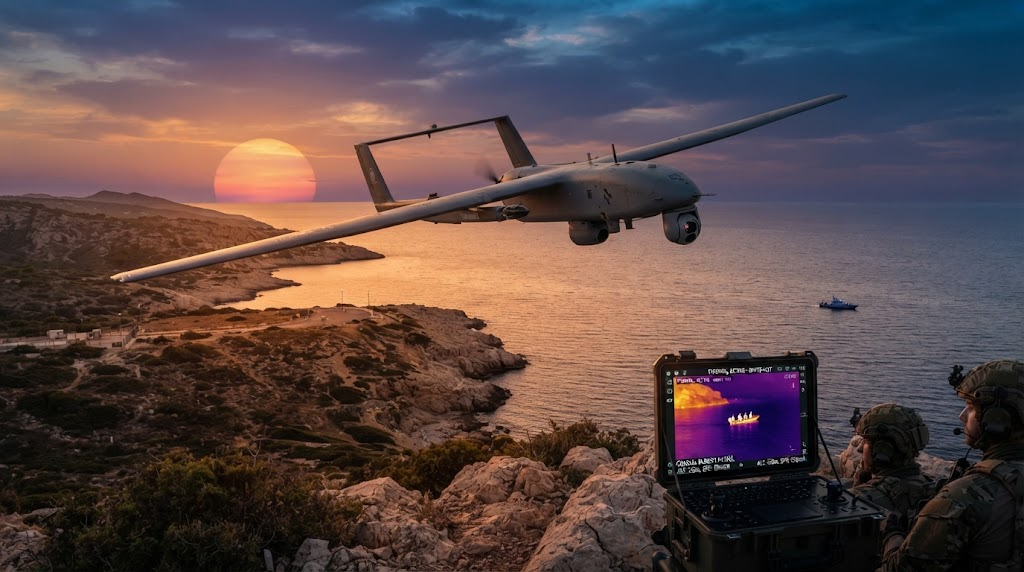
Aerodynamic Benchmark: Wing-Borne Lift vs Rotary Continuous Thrust
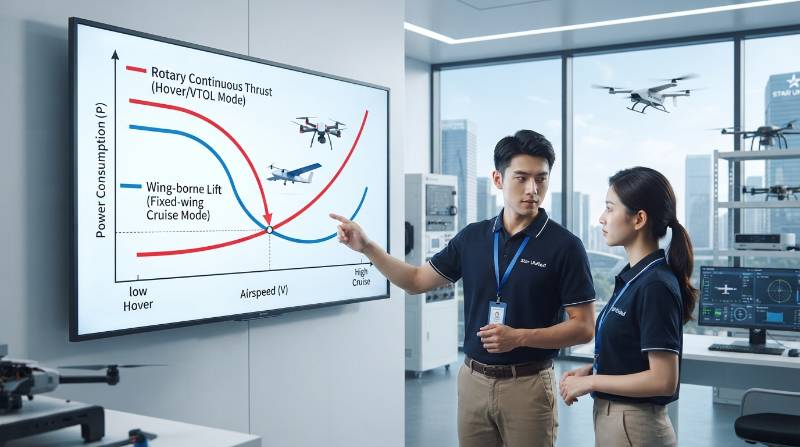
The fundamental divide between fixed-wing VTOLs and rotary-wing aircraft lies in lift generation physics. A rotary-wing aircraft generates all lift through continuous mechanical rotation of its rotor blades. This demands constant high-power engine output to overcome severe aerodynamic drag and vortex ring states. In contrast, a VTOL fixed-wing platform engages dedicated vertical lift rotors only during takeoff and landing cycles (typically lasting 60 to 90 seconds). Once at transition altitude, forward push or pull propulsion engages, directing airflow over fixed airfoils to generate aerodynamic lift at lift-to-drag (L/D) ratios frequently exceeding 14:1 to 18:1.Aerodynamic Lift Efficiency (L/D Ratio): A dimensionless metric quantifying the aerodynamic performance of an aircraft. Fixed-wing platforms achieve L/D ratios of 14–18, requiring roughly 75% to 85% less propulsive power per kilogram of payload during cruise than pure rotary aircraft (which operate with effective L/D equivalencies below 4.5).
Endurance and Loiter Capability in Broad-Area Reconnaissance
In standard ISR orbits, a light turbine helicopter (such as a Bell 407 or Eurocopter AS350) expends between 140 and 190 liters of Jet-A fuel per hour. This limits on-station loiter time to 2.0–2.5 hours before mandatory return-to-base (RTB) reserves engage. Modern hybrid VTOL fixed-wing UAV platforms utilize high-density lithium-solid-state batteries or EFI (Electronic Fuel Injection) hybrid generators. These powertrains deliver 6 to 10+ hours of continuous station loiter within operational radiuses stretching beyond 100 to 150 kilometers under standard ASTM F38 unmanned aircraft standards.Runway Independence and Field Maneuverability
Traditional fixed-wing reconnaissance drones require pneumatic catapult launchers, recovery arrestor nets, or asphalt runways. These external mechanics create critical operational bottlenecks in rugged maritime, jungle, or mountainous sectors. Hybrid VTOL architectures bypass ground infrastructure completely. They execute vertical climb profiles from confined ship decks, mountain clearings, or urban rooftops, transitioning cleanly to aerodynamic flight without ground support equipment.Economic Lifecycle & Total Cost of Ownership (TCO) Breakdown
Direct procurement cost accounts for only a fraction of total aviation expenses. Defense and enterprise fleet managers assess platforms across a 5,000-flight-hour operational baseline, incorporating depot-level maintenance intervals, turbine hot-section inspections, sensor wear, and qualified flight-crew staffing.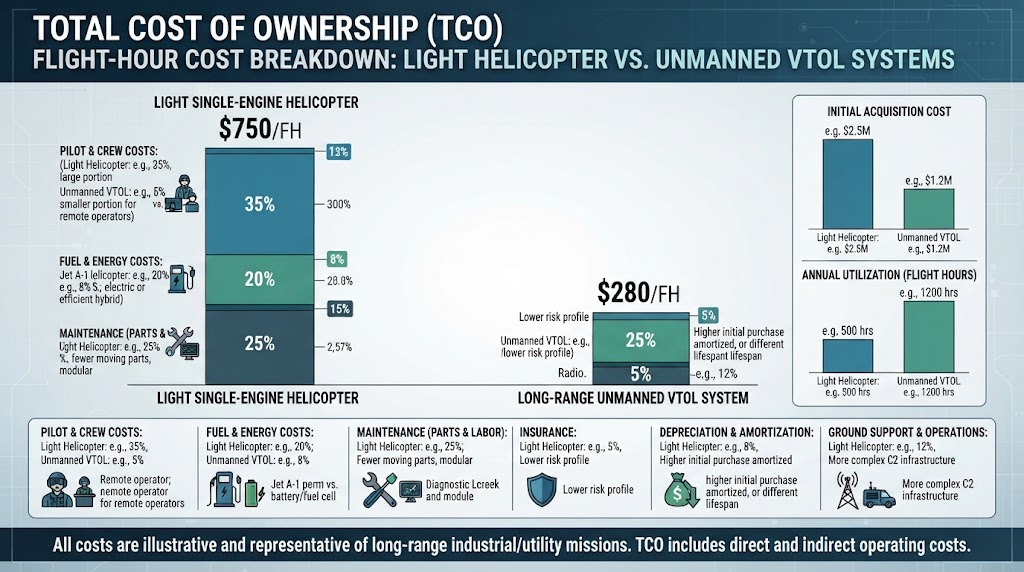
Flight-Hour Economics: $1,200–$3,500/hr vs Under $60/hr
The table below provides an empirical operating expenditure model based on standardized aerospace maintenance logs across 1,000 operational flight hours.| Cost Factor | Light Turbine Helicopter (Manned) | Tactical Rotary UAV (VTOL) | Hybrid VTOL Fixed-Wing UAV |
|---|---|---|---|
| Fuel / Energy Consumption | $450 – $650 / hr (Jet-A) | $40 – $80 / hr (AvGas/Fuel) | $4 – $18 / hr (Battery / Hybrid EFI) |
| Scheduled Maintenance Reserve | $550 – $850 / hr (Depot Overhaul) | $180 – $320 / hr (Swashplate/Gears) | $15 – $30 / hr (Direct Motor Replacement) |
| Pilot & Crew Direct Allocation | $400 – $900 / hr (Dual Pilot + Crew) | $120 – $250 / hr (2-Person GCS Crew) | $20 – $40 / hr (Autonomous/Single-Operator) |
| Inspections & TBO Milestones | 100-hr / 300-hr mandatory FAA Tear-down | 250-hr gearbox and linkage inspection | 500-hr brushless motor / bearing inspection |
| Total Direct Flight Cost / Hr | $1,400 – $2,400+ / hr | $340 – $650 / hr | $39 – $88 / hr |
Crew Logistics, Pilot Training, and Fleet Scalability
Operating manned rotary assets requires certified commercial pilots, flight engineers, and dedicated airfield maintenance technicians. Ground downtime scales quickly: every single flight hour in a manned turbine helicopter requires roughly 3 to 5 hours of unscheduled and scheduled ground maintenance. In contrast, enterprise VTOL systems interface directly with integrated ground control stations. These stations feature pre-programmed waypoint routes, geofenced flight limits, and automated emergency landing algorithms, allowing a single flight engineer to monitor multiple concurrent airframes.Sensor Payload Integration & Multi-INT Capabilities
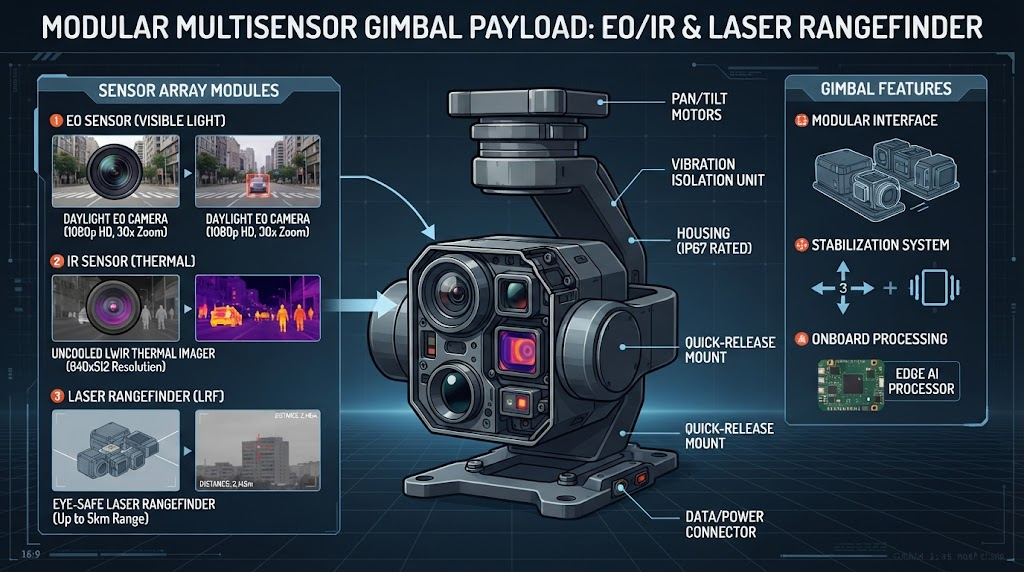
Modern ISR operations rely on multi-sensor payloads capable of simultaneous full-motion video (FMV), thermal signature extraction, and active telemetry tagging. Rotary airframes induce high dynamic vibration through mechanical swashplates and rotor pitch adjustments, requiring heavy gyroscopic dampeners to stabilize optical arrays. Fixed-wing VTOL airframes provide clean, low-vibration cruising envelopes. This stable flight environment supports lightweight, high-performance gimbal payloads across multiple sensor classes:- Cooled MWIR (Medium-Wave Infrared): Long-range thermal imagers capable of detecting human activity beyond 8 km and vehicles beyond 15 km in total darkness.
- High-Definition Electro-Optical (EO): 30x–60x continuous optical zoom sensors delivering 4K resolution with target detection, recognition, and identification (DRI) compliance.
- Synthetic Aperture Radar (SAR): Compact strip-map and spotlight SAR pods that penetrate fog, cloud cover, and battlefield dust clouds to render high-resolution ground mapping.
- Laser Rangefinders (LRF) & Designators: Class 3B/4 eye-safe rangefinders providing target coordinate extraction within sub-meter circular error probability (CEP).
Electronic Warfare Resilience and GNSS-Denied Navigation
Contested airspaces feature intense electronic countermeasure (ECM) threats, including GPS/GLONASS spoofing, broad-spectrum RF jamming, and directed signal interception. Aircraft relying strictly on unshielded civilian satellite constellations face immediate mission failure. Enterprise VTOL fixed-wing drones utilize autonomous flight control systems engineered with multi-layer navigation redundancy. These systems integrate anti-jam Controlled Radiation Pattern Antennas (CRPA), tactical-grade Inertial Navigation Systems (INS), and optical flow visual dead reckoning.The Star United ISR Operational Evaluation Matrix (OEM)
To help defense and enterprise procurement teams select optimal airframe architectures, Star United UAV developed The Star United ISR Operational Evaluation Matrix (OEM). This five-stage framework assesses real-world capability requirements before platform capital expenditure.- 1. Spatial Coverage Index (SCI): Evaluates total square kilometers surveyed per sortie against required Ground Sample Distance (GSD). VTOL fixed-wing platforms score over 300% higher in linear mapping efficiency.
- 2. SWaP-C Envelope: Balances Sensor Weight, Power draw, Cost, and Cooling against overall airframe endurance limits.
- 3. Acoustic and Visual Detection Signature: Measures decibel exposure at operating altitude. Fixed-wing VTOLs cruising at 400m AGL remain silent (<38 dB), whereas helicopters exceed 85 dB within a 2 km radius.
- 4. Launch and Recovery Agility (LRA): Evaluates environmental footprint and crosswind tolerance during takeoff in non-permissive or unprepared operational areas.
- 5. Mission Survivability & Redundancy: Validates multi-rotor motor fail-safe routines, gliding glide-slope safety margins, and autonomous return-to-launch (RTL) trigger thresholds.
Mission Profile Showdown: Border, Maritime, and Critical Infrastructure
Practical deployment requires mapping airframe strengths directly to mission operational profiles:Border Security & Linear Corridor Surveillance
Securing 200 km frontier borders demands continuous cruising, fast waypoint transit, and rapid zoom tracking. VTOL fixed-wing drones deliver unbroken 8-hour line-of-sight tracking at a fraction of the fuel consumption of rotary patrols, serving as core assets for perimeter security and patrol solutions.Maritime EEZ and Vessel Interdiction
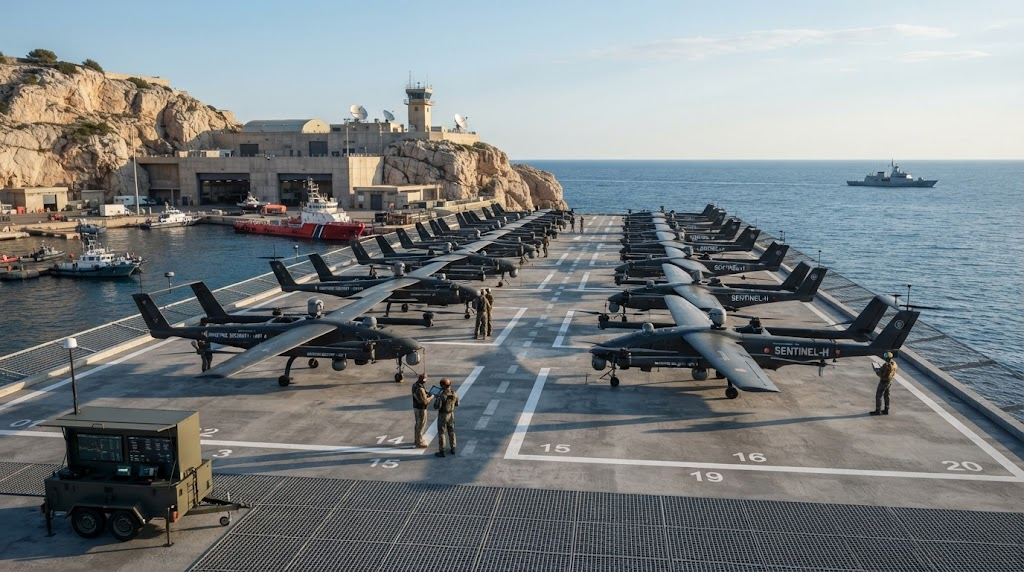
Operating from offshore patrol vessels (OPV) with tight helicopter landing decks requires vertical recovery without risking tail-rotor strikes in rolling seas. VTOL fixed-wing systems launch directly from vessel helipads, search broad maritime vectors for unauthorized vessels via AIS and SAR, and land safely with automated deck-lock sensors.Target Tracking in Dense Urban Environments
When tactical operations require an airframe to remain stationary over a single street intersection for 20 minutes with zero orbit displacement, pure rotary drones retain an advantage. However, dual-flight-mode VTOL platforms can dynamically transition into hover mode over tactical hotspots before re-engaging fixed-wing cruising to conserve battery reserves.