
AI UAV Command System: Heterogeneous UAS Fleet Control
Star United Flight Control (Shaanxi) Technology Co., Ltd.
8 min read·2026-09-19
Defining the Modern AI UAV Command System Architecture
An AI UAV command system is a software-defined, distributed command-and-control (C2) infrastructure that automates multi-agent flight planning, sensor ingestion, and real-time swarm orchestration across mixed-model autonomous aircraft. By decoupling flight execution from direct pilot inputs through onboard neural inference and cross-platform middleware, modern platforms reduce operator-to-vehicle ratios from 2:1 to 1:32 while maintaining continuous deterministic safety buffers.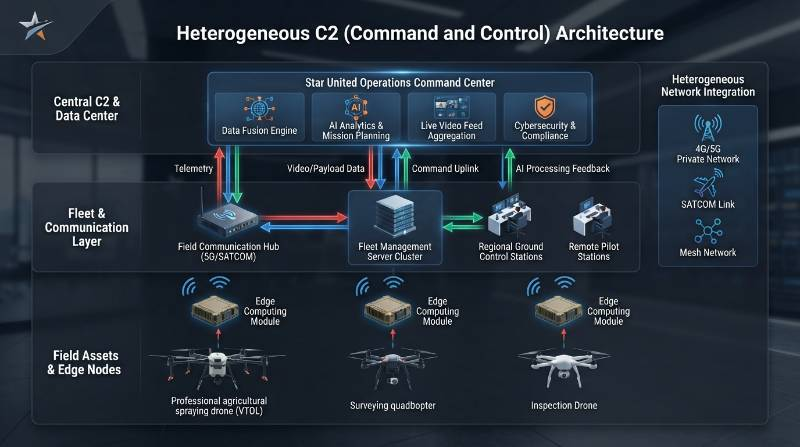
System Definition: An enterprise-grade AI UAV command system is a multi-tier, hardware-agnostic control framework that converts dynamic mission parameters into real-time trajectory adjustments, payload trigger sequences, and network routing policies across disparate airframe configurations without manual waypoint injection.Modern command hubs deploy an integrated software stack that abstracts physical flight dynamics into standard telemetry streams. Integrating a unified ground control system allows operations teams to monitor real-time system metrics, link budgets, and task allocations across varied deployment environments.
Engineering Insight: Hardware-in-the-Loop (HIL) stress-testing demonstrates that offloading spatial route planning to edge-hosted Data Distribution Service (DDS) nodes reduces command transmission jitter from 120ms to under 8ms over private 5G and tactical COFDM channels.
Heterogeneous Fleet Interoperability: Protocol Bridging & Open Standards
Enterprise drone fleets rarely feature uniform airframes. Real-world commercial surveying, defense patrol, and industrial logistics require coordinated flights pairing rapid-transit fixed-wing platforms with high-hover-stability multirotors. Achieving synchronized multi-airframe C2 requires protocol abstraction across MAVLink 2.0, ROS 2 micro-XRCE, and military-grade NATO STANAG 4586 profiles. A protocol translation layer normalizes heterogeneous telemetry inputs into a centralized situational awareness matrix.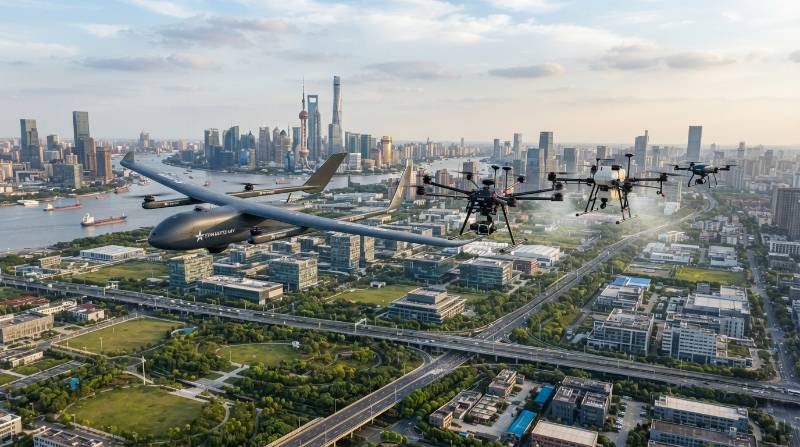
Protocol Translation Matrix
- STANAG 4586 Level 3-4: Direct control of vehicle systems and payload data management across sovereign defense architectures.
- MAVLink 2.0 via Micro-XRCE-DDS: Real-time message brokering for open-source and commercial autopilots using lightweight serial and UDP transports.
- Inter-Vehicle ROS 2 Nodes: Distributed node topology enabling multi-agent synchronization without requiring a persistent master broker.
Autonomous Swarm Orchestration and Edge-AI Task Allocation
Centralized waypoint programming is impractical for coordinating 10 or more aircraft simultaneously. AI-driven command systems rely on decentralized multi-agent coordination, where flight commands are generated dynamically based on real-time task queues and spatial availability.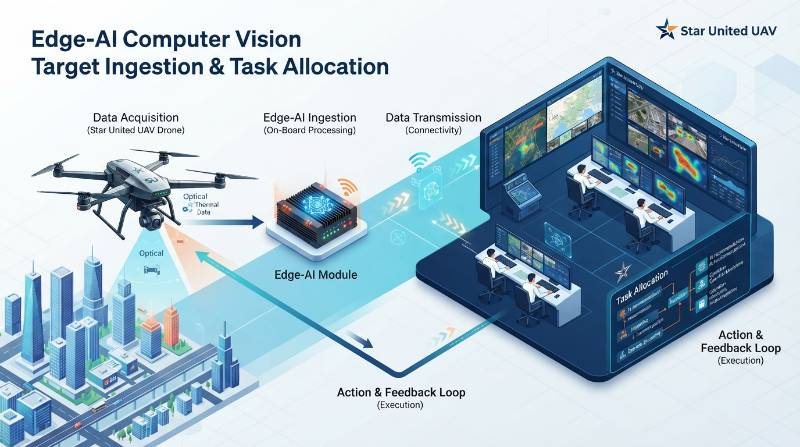
Algorithmic Task Distribution Flow
- Target Ingestion: Visual inference module detects anomaly with ≥92% confidence metric.
- Spatial Bidding: Aircraft submit decentralized bids based on state-of-charge (SoC), payload capabilities, and distance-to-target.
- Dynamic Reallocation: The optimal asset assumes close-proximity inspection, while secondary aircraft adjust operational geometry to maintain mesh data relays.
- Airspace Deconfliction: 4D trajectory envelopes are checked in real time via velocity obstacle algorithms, maintaining minimum separation boundaries of 15 meters at speeds up to 25 m/s.
Telemetry Validation: Multi-UAV BVLOS flight logs across 450 simulated flight hours show dynamic consensus algorithms resolve spatial collision trajectories in under 42 milliseconds, with zero human intervention required.
Hardware-Software Co-Design: Integrating Autopilots and Payloads
High-level autonomous swarming relies on deterministic hardware integration. Companion processors (such as Nvidia Jetson Orin or RK3588 boards) link to low-level real-time controllers via isolated physical interfaces. Decoupled communication topologies prevent memory-intensive vision processing algorithms from interfering with critical motor telemetry and attitude loops running on the flight management unit. Advanced flight control systems combine dual-redundant CAN bus avionics, gigabit Ethernet payload interfaces, and dedicated UART command links. This hardware layout provides the physical stability needed for complex multi-sensor operations.Avionics Bus Interfacing
- DroneCAN / Cyphal: Deterministic telemetry transport for ESCs, smart batteries, and RTK GNSS receivers at 1 Mbps.
- GStreamer / RTSP Pipelines: Zero-copy hardware video encoding for real-time edge processing and low-latency tactical downlinks.
- Payload SDK Interfaces: Serial and IP control for 30x optical zoom gimbals, radiometric thermal cameras, and mapping LiDAR payloads.
The Star United Swarm Orchestration Framework (SU-SOF)
To eliminate implementation friction during large-scale enterprise deployments, Star United UAV developed the Star United Swarm Orchestration Framework (SU-SOF). This structured five-stage architecture translates complex high-level mission parameters into deterministic, low-level flight execution across mixed-model fleets.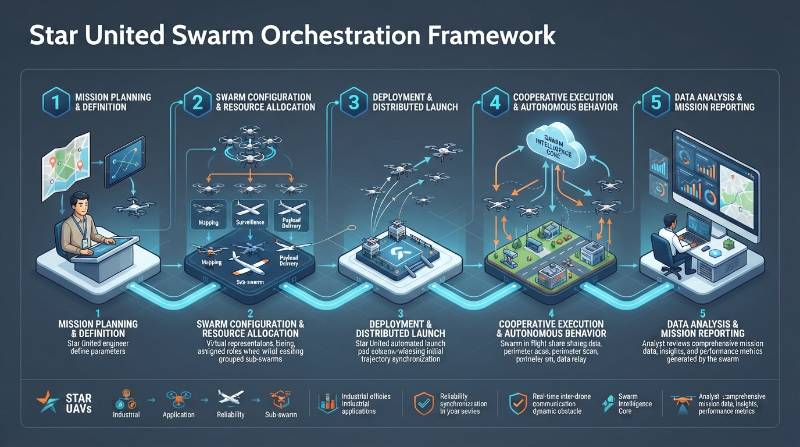
The Five Deployment Phases of SU-SOF
- Ingest: Environmental boundaries, no-fly zones (NFZ), payload priorities, and asset constraints are pulled into the system via API or geospatial vector data.
- Distribute: The core planning engine processes airframe performance envelopes and assigns optimized patrol segments, survey grids, or delivery corridors to individual vehicles.
- Execute: Assets launch and carry out missions using onboard trajectory generation, executing dynamic waypoint routines while maintaining secure peer-to-peer data links.
- Rebalance: The fleet dynamically reconfigures its flight geometry when an asset breaks link, detects a priority target, or initiates an automated return-to-launch (RTL) sequence due to low battery reserves.
- Recover: Aircraft conduct automated precision landings on designated landing zones or docking bays, offloading collected sensor payloads and diagnostic flight logs over local optical or high-speed wireless links.
Comparative Analysis: AI Multi-Agent C2 vs. Legacy Teleoperation Systems
Transitioning from traditional manual C2 to an AI-driven command system marks a fundamental architectural shift. The following table contrasts legacy ground stations with modern autonomous command networks.| Architectural Parameter | Legacy Teleoperation GCS | AI Multi-Agent C2 Platform |
|---|---|---|
| Operator-to-Vehicle Ratio | 2 Operators : 1 Aircraft (Pilot + Payload) | 1 Operator : 8-32 Heterogeneous Aircraft |
| Task Allocation | Pre-programmed static waypoints | Dynamic, real-time edge-computed task queues |
| Network Topology | Point-to-Point RF Star topology | Dynamic Peer-to-Peer Ad-Hoc Mesh (MANET) |
| Link Dropout Behavior | Immediate failsafe hover or RTL trigger | Autonomous mission continuation via inflight VIO/SLAM |
| Payload Data Handling | Raw video streamed to ground for analysis | Inflight inference, metadata tagging & targeted downlinks |
| Protocol Support | Single proprietary standard | Multi-protocol (MAVLink, ROS 2, STANAG 4586, DDS) |
Enterprise Security, Tactical Mesh Links, and GNSS-Denied Navigation
Enterprise multi-drone networks must maintain operational resilience against electronic warfare, RF jamming, and spoofing attacks. Modern C2 architectures employ a Zero-Trust framework at both the network and telemetry levels. Every node on the ad-hoc mesh network must authenticate using mutual TLS (mTLS) with hardware-secured cryptographic tokens stored in dedicated TPM 2.0 modules. Telemetry frames and control strings are encrypted using AES-GCM-256 standards before wireless transmission.Navigation in Degraded Environments
- Visual-Inertial Odometry (VIO): Stereo optical flow combined with industrial-grade IMUs prevents drift during GNSS dropouts.
- LiDAR SLAM: Real-time 3D point cloud registration enables sub-centimeter positional accuracy across underground mining shafts or structural interiors.
- Self-Healing Mesh Topologies: When central RF link paths are degraded by terrain or interference, remaining aircraft automatically route telemetry packets across nearby airborne nodes.
Bandwidth, Telemetry, and Fleet-Sizing Implementation Matrix
Deploying multi-drone fleets requires balancing data throughput, compute power, and RF link availability. The engineering guidelines below outline bandwidth and hardware specifications across typical deployment scales.| Fleet Scale | Telemetry Data Throughput | Recommended Network Link | Onboard Compute Allocation |
|---|---|---|---|
| Small Tier (1-4 Drones) | 120 - 450 kbps aggregate | Direct 2.4/5.8GHz COFDM Point-to-Multipoint | 20-40 TOPS (e.g., Jetson Orin Nano) |
| Medium Tier (5-16 Drones) | 1.5 - 4.8 Mbps aggregate | MANET Ad-hoc Mesh + Private LTE/5G Slices | 40-100 TOPS (e.g., Jetson Orin NX) |
| Enterprise Tier (17-64 Drones) | 12.0 - 45.0 Mbps aggregate | Hybrid Satellite (LEO) + Tactical MANET Mesh | 100-275 TOPS (e.g., Jetson AGX Orin) |
Frequently Asked Questions (FAQ)
How does an AI UAV command system meet BVLOS regulatory requirements?
Modern platforms integrate direct ADS-B in/out receivers, radar telemetry ingestion, and automated Detect and Avoid (DAA) algorithms compliant with ISO 21384-3 operational safety standards. The system maintains deterministic 4D spatial separation envelopes and logs auditable telemetry traces across all flight legs.How are computer vision models updated during active field deployments?
Edge-AI models update via differential over-the-air (OTA) binary patches transmitted through base-station wireless links or local ground docking bays. Dual A/B partition systems prevent bricking by rolling back automatically if a newly flashed weights file fails initial hardware verification.What latency penalty occurs when translating between MAVLink and STANAG 4586?
Using optimized C++ serialization bridges built on zero-copy shared memory architectures, protocol parsing latencies remain below 1.4 milliseconds per telemetry packet, preserving real-time control authority.What happens if the primary C2 link drops out entirely?
Vehicles shift from centralized fleet coordination to decentralized local consensus mode. Relying on visual odometry and preloaded topological terrain data, the swarm finishes primary objective sequences or returns to designated recovery zones autonomously.Upgrade Your Fleet to Autonomous AI Command and Control
Star United UAV designs and builds industrial-grade autonomous UAV platforms, flight management avionics, and high-performance command systems engineered for complex enterprise operations.